EN

OEM/ODM Premium Baby Burp Cloth | 100% Organic Cotton Plant-Dyed Muslin Washcloth | Eco-Friendly Non-Toxic Botanical Dye Hand-Tied Tie-Dye Infant Spit-Up Rag for Private Label | Highly Absorbent Sustainable Nursery Essential


- Overview
- Custom Plant-Dyed Tie-Dye Organic Cotton Baby Burp Cloth
- Recommended Products
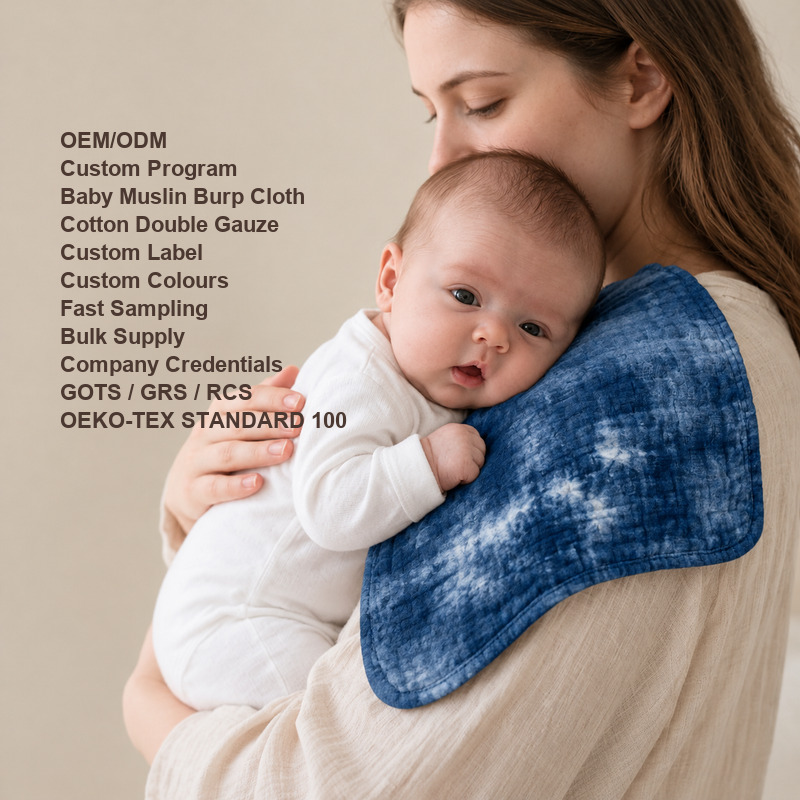
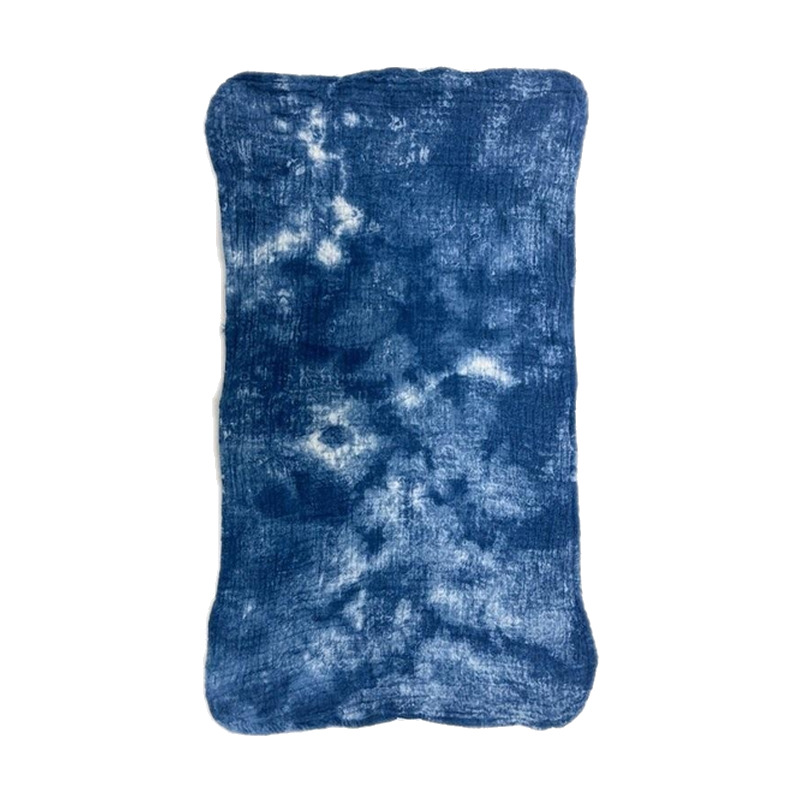
A burp cloth in a 100% cotton double-layer crinkle gauze at 135 g/m², cut to a rectangle with rounded corners, and dyed in indigo from Isatis after being gathered and tied.
The first thing worth knowing about it is what the white is. It is not a gap the colour failed to reach. The cord that did the tying is itself in the bath, so the cord takes colour, while the cloth pressed directly under it cannot; what the eye reads as a pale burst is the shape of the compression, with the cord's own dyed imprint running through its centre. Because the tie was made near the middle of the cloth rather than at an edge, the curve of this piece is inverted: the deepest colour is at the two ends that hung free, and the palest point is the heart.
At a glance

1. The cord takes colour; the cloth under it does not
- A tied resist is two materials in one bath. The cord is a material like any other and it dyes, while the cloth held under tension beneath it is compressed so tightly that the liquor cannot enter.
- Both are visible at once on this sample. Each pale burst has a darker imprint at its centre, radiating like the wrap it came from, and the pale cloth sits around that imprint rather than under it.
- That is why the centre of a burst is not simply white. There is a small deep point where the cord crossed and a ring of pale cloth immediately around it, so the pattern reads inside out: dark core, pale halo, mottled edge.
- The pale is also not white. It is a very light blue, because some liquor does work its way into the compressed bundle; a pure white would mean the cloth had been blocked rather than tied.
- For the buyer this decides what can be specified. The cord's thickness and how hard it is pulled are orderable; the exact position of a burst is not, because it is a record of a hand tying a gathered bundle rather than a mark placed on a flat surface.
2. The deepest colour is at the ends, because that is what hung free
- The cloth was gathered and tied near the middle and then dipped, so the two loose ends travelled through the liquor unhindered while the pinched centre stayed closed.
- The result is a gradient the wrong way round. Most garments are deepest where the cloth was open and lightest at a folded edge; here the palest point is the interior and the deepest passages are the two ends.
- The gradient is a record of how the bundle was held, not a decision taken about the design: a bundle held at one end and dipped vertically darkens toward the free end, and a bundle turned between dips darkens more evenly on both sides.
- It cannot be corrected by dipping again. A second dip deepens the free ends further and barely reaches the tied core, so the contrast widens rather than closes; the route to an even piece is a different tie, not more dips.
- Which makes the depth a route question to settle before sampling, alongside the number of dips: two pieces dipped the same number of times are still two shades if the bundles hung differently.
3. How tight the tie was decides how big the pale heart is
- A tight tie gives a large pale heart and short fingers, because the bundle is compact and the liquor only reaches a little way in from the outside.
- A loose tie gives the opposite: a smaller white core with long, feathery fingers where the liquor worked along the folds of the gathered cloth.
- On this sample the bursts are open and feathery, with fingers reaching well beyond the core, which reads as a firm tie around a bundle that was not crushed.
- The fingers are the part that varies most between pieces, because each one follows a different set of folds in the gathered cloth; so the specification that holds is the size of the core and the reach of the fingers, not the number of fingers.
- That is also why two pieces from one order will not match burst for burst, and why a burp cloth is approved as a set rather than one at a time: the question a buyer is asking is whether the family reads as one product, and only a set can answer it.
4. The pucker cuts the bursts into a net
- Two structures occupy the same square centimetre here. The tie produced radiating fingers; the cloth produced a grid of small puffed cells. Where they overlap, the fingers are cut into a mesh.
- At arm's length the mesh wins and the cloth reads as a mottled blue with a fine texture; close up the rays reappear and the mesh becomes the surface they are drawn on.
- The grid is what makes the pale areas legible, because a pale field on a flat cloth would read as a stain while a pale field broken by the pucker reads as a pattern.
- It also means the pattern changes with the light. Held flat the rays read; held up to a window the mesh dominates, because the cells transmit differently from the valleys between them.
- So the two references to approve are the same cloth in two states, flat and backlit, rather than two different drawings.
5. Both layers are penetrated, so both faces carry the pattern
- A tie resists mechanically and indigo penetrates as a liquid, so the two gauze layers are gathered, compressed and wetted together rather than one face being worked and the other left.
- The reverse therefore carries the same bursts in roughly the same places, offset by the pucker and by the small difference in how the two layers sat inside the bundle.
- On a burp cloth that is the right outcome, because both faces get used within a minute of each other: one against a shoulder, the other against a chin. A cloth that showed a pattern on one face and a plain ground on the other would read as two different products.
- The offset between the faces is worth seeing before approval, since it is the one place where the two sides visibly disagree: hold the cloth up to a light and the bursts on the two faces separate slightly.
- It also means the piece cannot be pressed flat without losing part of the effect, because the offset only shows while the layers are still puffed.
6. The stain point and the wear point are not in the same place
- The palest part of the cloth is the middle, and the middle is what sits against a chin: milk, saliva and whatever a baby brings up show first on a pale field and least on a deep one.
- The deepest part is the two ends, and the ends are what gets gripped, wrung and rubbed against a shoulder, so they are where indigo gives up surface pigment first.
- That split is useful rather than awkward. The area that will be washed and rubbed hardest is the area where the colour is deepest and therefore most forgiving; the area that will be stained is the area where a mark is most visible and least permanent.
- It argues for a cloth that is used and washed hard, since the two failures arrive on different parts and neither one ruins the piece early: a burp cloth that has gone slightly pale at the ends and slightly marked in the middle is a cloth that has been used as intended.
- It also argues for the indigo to be judged after the first wash, because that is when the surface pigment settles and the difference between the ends and the heart stops changing.
7. Sizes, sampling and quoting
- One size, with the dimensions fixed per order: length, width, corner radius, finish width, and where the tie is placed along the length.
- Customization. The number of tied points and their spacing; how hard each is tied; the number of dips; whether the bundle hangs free or is turned between dips; the size of the core and the reach of the fingers you will accept; the corner radius; the finish width; the dimensions; and whether the cloth is supplied flat or pre-washed.
- Sampling: 3-7 days from a confirmed tech pack, covering a tied set of two or three pieces approved on the dipped, oxidised and washed result; the pattern judged flat, backlit and pulled diagonally as it would be in use; both faces compared for offset; the tie placement checked against the length; and the depth re-read after the first wash.
- Bulk: 30-60 days from approval, tied and dipped in batches with the dip count, dwell and hanging position recorded per batch against a retained cloth reference; AQL 2.5 major and 1.0 critical.
- MOQ: 300 pcs for a custom development covering cloth, depth, tie layout or dimensions; 50 pcs for a decorative process on a stock cloth; 100 pcs for stock cloth with your own logo and label. Mixed orders are quoted per order.
- For a baby product the test list is not a formality. The faces of this cloth meet a chin and a shoulder, so the tests that matter are the ones for what a mouth leaves behind, and the artificial saliva test (ISO 105-E04) is the standard one for that; which tests apply, at what limits, and whether they run in your brand name are set by the destination market and confirmed at quotation.
Production runs with our production partner, Suzhou Shelmin Trade Co., Ltd.: founded 2017, 7,200 m² workshop, 8 lines, 200 staff, 6,000 pieces per day. Design confidentiality is held under NDA; buyer patterns, shades and tie layouts are not re-used.
To quote, we need: destination market and the age group it will be sold for; the Class I scope you need and the test list that comes with it; the dyehouse documentation for the indigo and the vat; the number of tied points and their spacing, with two reference pieces if you have them; the number of dips; whether the bundle hangs or is turned between dips; length, width and corner radius; finish width; whether the cloth is supplied flat or pre-washed; the certificate held for the cloth and the scope you need; the lot certificate for the dyestuff; the pH target and the dyehouse water specification; packing method; and whether certification is to run in your brand name.