EN

OEM/ODM 100% Cotton Baby Girls Dress Natural Plant Botanical Dyed Tie Dye Infant Toddler Flutter Sleeve Ruffle Princess Dresses with Bow Custom Wholesale Private Label


- Overview
- OEM Custom 100% Cotton Plant Dyed Baby Girls Ruffle Dress
- Recommended Products
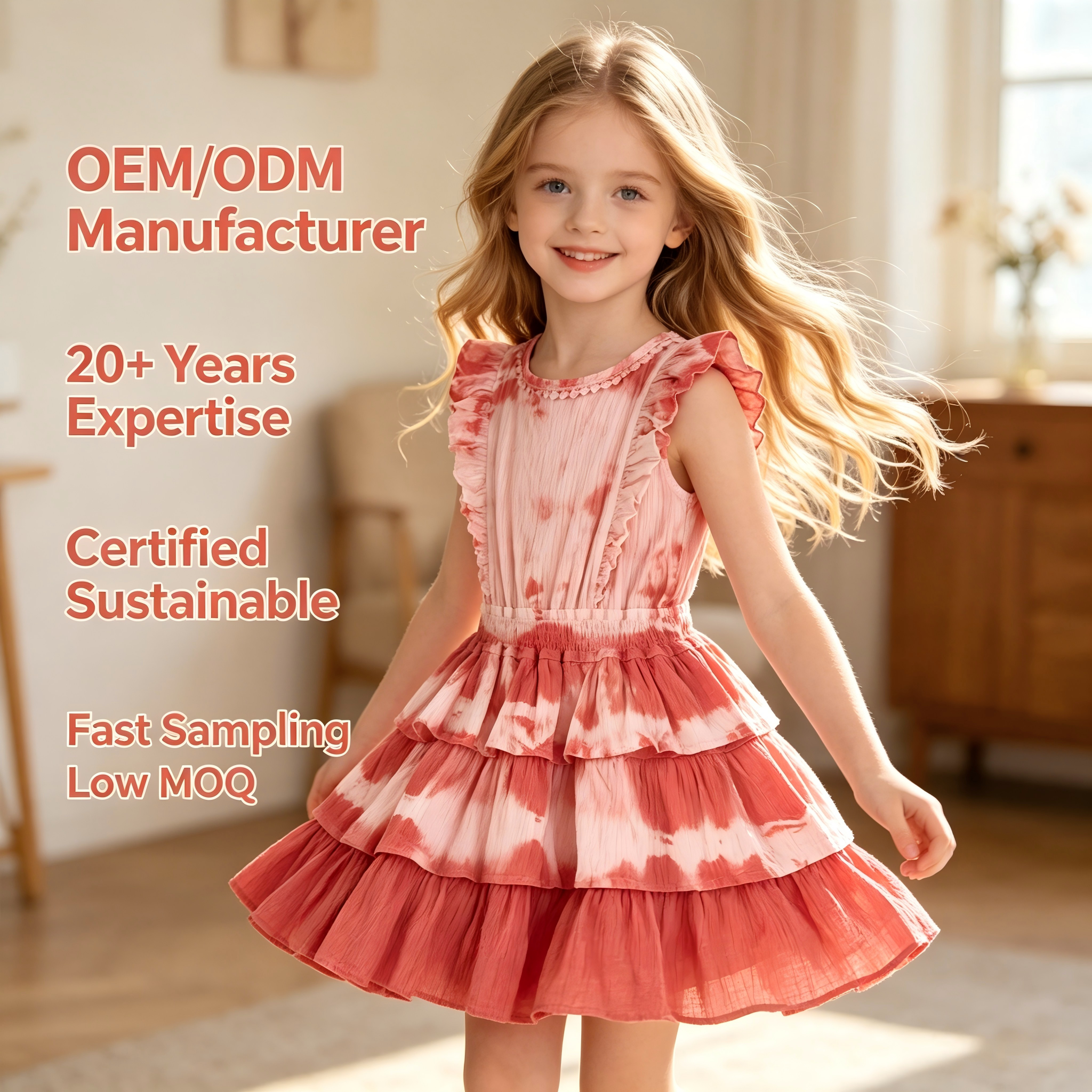
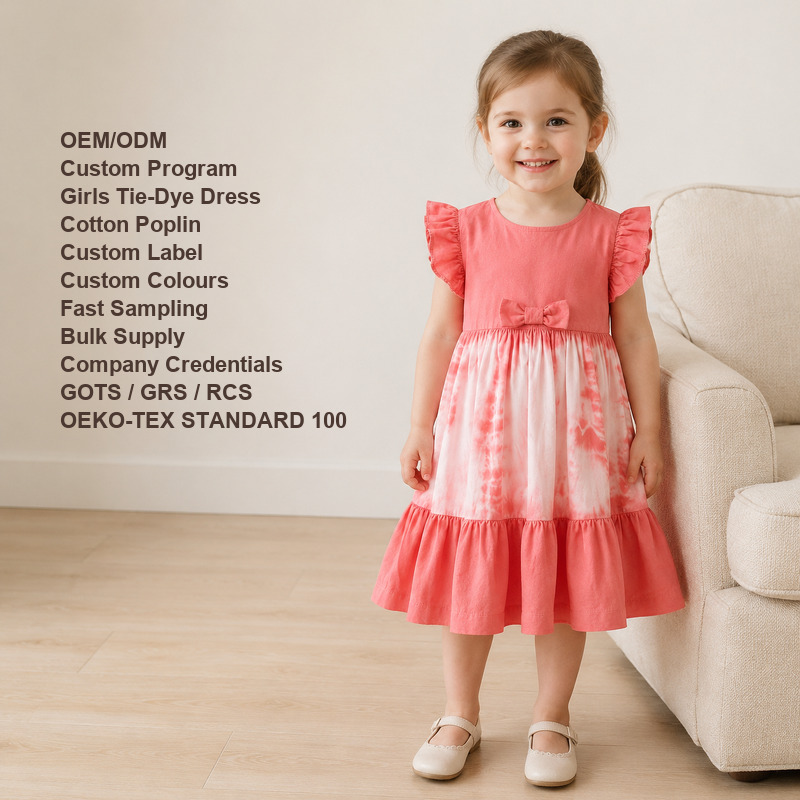
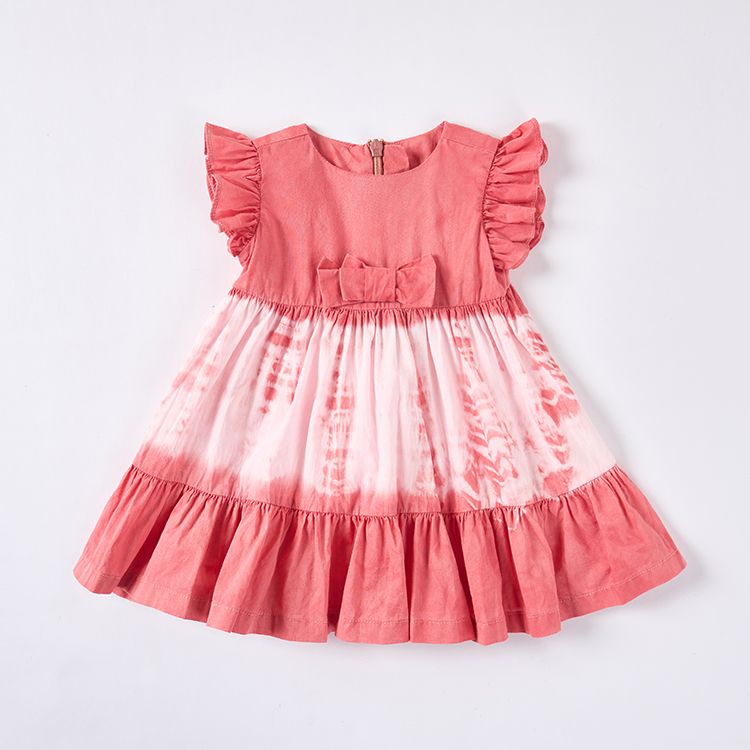
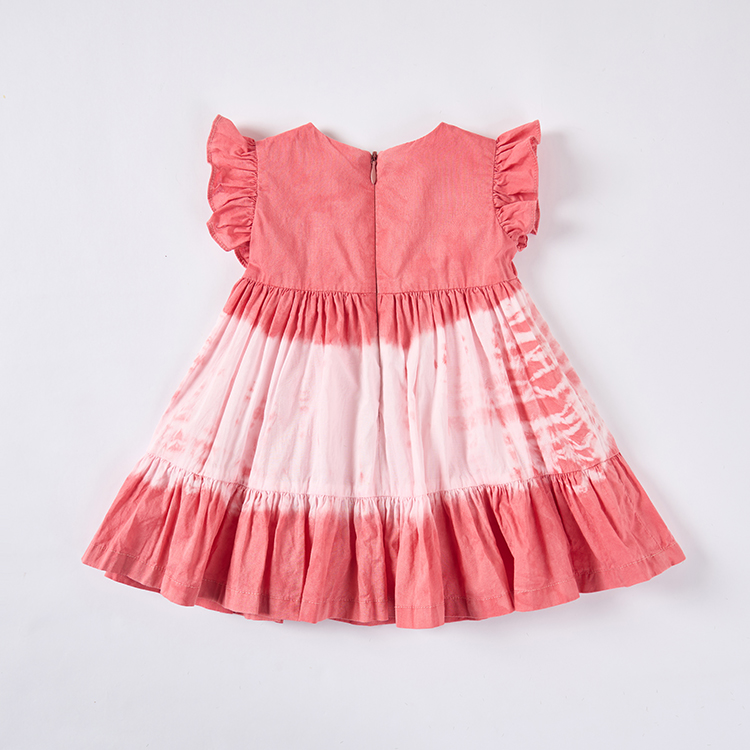
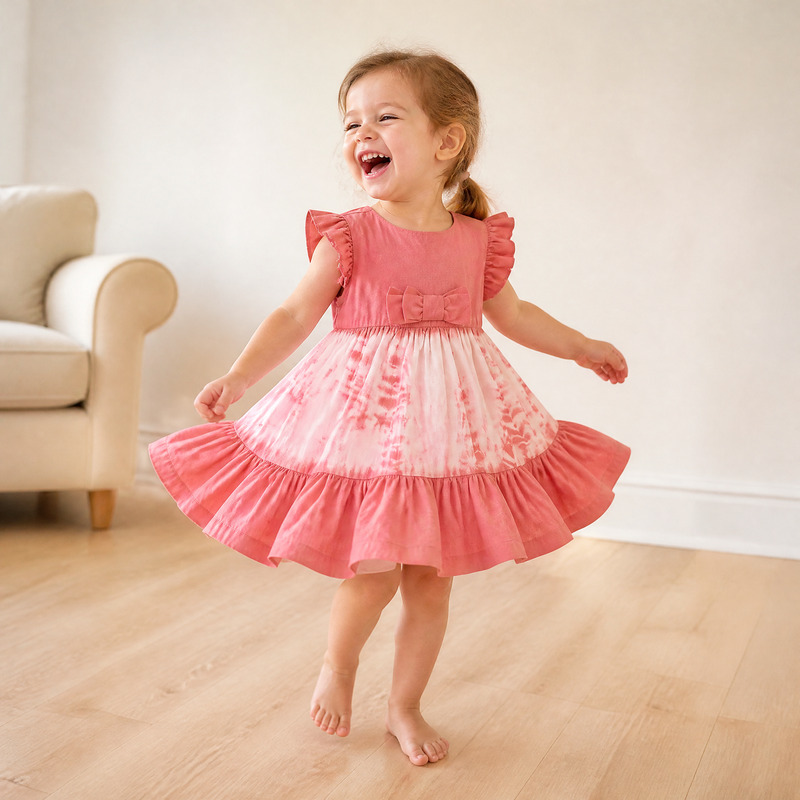
A tiered dress in 125 gsm cotton poplin, plant dyed to a coral with sappanwood (苏木) and madder (茜草), with no added mordant: a round neckline, a flutter ruffle set into the armhole in place of a sleeve, a self-fabric bow tacked at the waist seam, a centre-back zip, and a two-tier skirt whose middle panel is resist dyed against an undyed ground while the bodice and the hem ruffle are dyed solid.
Two dye states on one garment is the technical subject here. The solid panels are dyed in the bath and read as one colour; the resist panel is pale where the cloth was clamped and coral where it was not, and its deepest coral has to sit beside the solid coral without either reading as the wrong shade. Everything below holds those two states together from sampling to quoting.
At a glance
1. Two dye states, and the darker one is the reference
- The bodice and the hem ruffle are dyed solid, in the bath, in one lot: that is the colour the buyer sees first and everything else is judged against.
- The middle tier carries the same coral at its deepest and undyed cotton at its palest, because the liquor reached it in some places and was held off in others.
- So approval runs in one direction: the deepest coral of the resist tier is matched to the solid tier in daylight, on the made-up garment; a resist panel two steps off the bodice is a reject.
- The palest area is read at the same time, because a resist matched at the deep end and chalky at the light end reads as a washed-out panel beside a saturated bodice.
- Both are recorded as a pair on the approval sheet, the way a two-colour print is approved, not as one average colour.
2. The resist is a physical process, and the pale ground is cloth the liquor never reached
- The cloth is folded and clamped between boards before it goes into the bath. Where the boards press, the liquor stays out; where the cloth is free, it takes colour. Nothing is printed and nothing is painted on.
- That is why the marks have soft edges: liquor creeps a few millimetres under every board, so a hard geometric edge is not what this process produces, and a crisp edge is the signature of a print.
- It is also why the marks sit close to a check, and why regularity is rejected. A clamped resist reads as gingham when the folding is too even, so the definition excludes a repeating grid: no two marks in the same relationship twice across a panel.
- On the approved sample the deepest colour sits in the gathers at the waist and the ground opens out below it. That gradient belongs to the design and is specified as such, not corrected on the next lot.
- The undyed ground is a specified white rather than a default. Cotton left undyed reads warm; cotton with an optical brightener reads blue in daylight and turns the panel cold beside the coral. The base white is agreed with the fabric order.
3. The seam between two dye states is where the garment is approved
- The tier seam joins a solid panel to a resist panel, so it is where a shade difference shows as a line rather than a surface.
- Panels come from one lot per garment, and the resist tier is cut so its deepest area sits at the seat of the tier rather than at the hem, where it is compared directly with the solid ruffle below.
- Nothing is matched at the seam itself. A resist has no repeat to align, so what is controlled is the weight of colour on each side of the join, read on the made-up garment with the gathers in.
- The waist seam carries three layers and the bow, and a pucker there reads as a dark line on plant-dyed cloth, because the cloth that gathers is the deepest part of the tier.
- The centre-back seam gets the same reading, since the zip splits the resist tier in two: the halves are cut from adjacent positions across the roll so the marks carry on across the opening instead of restarting.
4. The pale ground is the first place a fault shows
- An undyed ground beside a plant-dyed tier is the most sensitive indicator on the garment. Any colour that moves in the wash, or in damp storage, lands on the pale area first, where it reads as a fault at once.
- So washing runs on the whole garment, both tiers in the load, and the pale ground is read against its own unwashed counterpart rather than a white card.
- Light is read the same way. A shade built without a metal salt is the one to watch, and the pair is re-read together, since the two states move at different rates and can open a gap that was not there at sampling.
- Pale cellulose is where storage yellowing shows, so phenol yellowing is run to ISO 105-X18 on a specimen carrying the actual packing fold, and packaging is specified free of BHT.
- Rubbing is tested across the tier seam in both directions, because that seam presses a solid surface against a resist surface and is where transfer would appear first.
5. A centre-back zip is what lets the neckline stay round
- The neckline is a clean round shape because it does not have to pass over a head. The zip opens the back from neck to waist, so the opening does the work a stretched neckline would.
- The zip finishes at the waist seam, bottom stop above the gather. A zip run into the gathered seam pulls the gathers open at the centre back and leaves a gap that shows when a child moves.
- A metal slider and pull at the back is a decision, not a styling detail. Set against a fabric guard, or covered by a placket, both change the neckline finish, so the choice is written into the tech pack before sampling.
- The metal is tested as a metal part: nickel release to EN 1811 with the EN 12472 wear simulation, the pull checked for attachment at 70 N, and the slider and pull checked against the small-parts cylinder.
- A metal zip is a needle-detection exclusion. The detector reads the slider and the pull, so the zip zone is declared, the cloth around it is checked with the zip folded out of the aperture, and broken-needle control stays in force.
6. The flutter ruffle and the bow are the two parts the eye judges first
- The ruffle is set into the armhole instead of a sleeve, so there is no sleeve cap to ease: it is gathered along the armscye at a ratio set per size, and that seam carries the whole fall of the piece.
- It is cut on the bias so that it falls, which makes the armhole edge the place where the piece grows; the armscye is stabilised before the ruffle goes in, or the opening relaxes after the first wash.
- The outer edge is a narrow rolled hem on a curve, where a ruffle turns wavy or twists; the hem is set with the ruffle off the machine rather than on the flat, and checked for a level fall on the hanger.
- The armhole seam sits against skin and is finished for it, bound or flat-felled with thread ends secured, since a ruffle seam is handled more than a plain one.
- The bow is folded from the same dyed cloth, stitched closed at the knot and tacked at two points, with ends kept short inside the cord limits this programme works to and checked as a decorative trim. A functional tie at the back would change both the pattern and the compliance route.
7. Sizes, sampling and quoting
- Seven sizes graded on measurements: 3M, 6M, 9M, 12M, 18M, 2Y and 3Y move on chest, bodice length, tier depth, skirt sweep and zip length. Tier depth and sweep are set per size, because a tier graded like a seam loses its proportion at the ends of the run.
- The resist is read at both ends of the run. A mark that reads calm on 3M lands on a much larger panel at 3Y, so scale is agreed per size band and the smallest and largest sizes are approved as a pair.
- Customization. Resist tier as sampled or solid tiers throughout; ruffle width and gather ratio; bow size or a plain waist seam; zip, buttons or a keyhole back; sleeve option; a tighter clamp pattern at higher contrast or a looser one showing more ground, each sealed on its own reference set.
- Sampling: 3-7 days from a confirmed tech pack, covering a clamped strike-off with its two reference pieces, a made-up dress with zip, bow and both tiers finished as production, a wash-and-remeasure with the pale ground re-read, crock across the tier seam, light on both dye states, a zip pull test and a fit check over a nappy on the smallest size.
- Skin-contact tests run with the same lot: perspiration and saliva to ISO 105-E04 plus the destination market's saliva method, with pH measured on the garment and held between 4.0 and 7.5, and extractable heavy metals tested on the finished garment rather than on the greige.
- Bulk: 30-60 days from approval, planned per dyebath with the cutting layout made per lot, since the layout follows the resist rather than the other way round; AQL 2.5 major and 1.0 critical on the finished garment.
- MOQ: 300 pcs for a custom development covering cloth, shade, resist, trim or fit; 50 pcs for a decorative process on a stock body; 100 pcs for stock cloth with your own logo and label. Mixed colour and size orders are quoted per order.
Production runs with our production partner, Suzhou Shelmin Trade Co., Ltd.: founded 2017, 7,200 m² workshop, 8 lines, 200 staff, 6,000 pieces per day. Design confidentiality is held under NDA; buyer patterns, shades and prints are not re-used.
To quote, we need: target market and the Class I tests it requires; whether the resist tier's deepest coral is matched to the solid tier or to your own swatch; the base white for the undyed ground, with or without optical brightener; clamp pattern density and the scale you want at 3Y; zip type, length, guard or placket, and metal finish; bow size, or a plain waist seam; lot certificates for both plants and for the zip; the pH target and the dyehouse water specification; packing method; and whether certification is to run in your brand name.