EN

OEM/ODM 100% Cotton Baby Girls Tiered Ruffle Skirt Natural Plant Botanical Dyed Tie Dye Infant Toddler Kids Summer Layered Skirts Custom Wholesale Private Label


- Overview
- OEM Custom 100% Cotton Plant Dyed Baby Tiered Ruffle Skirt
- Recommended Products
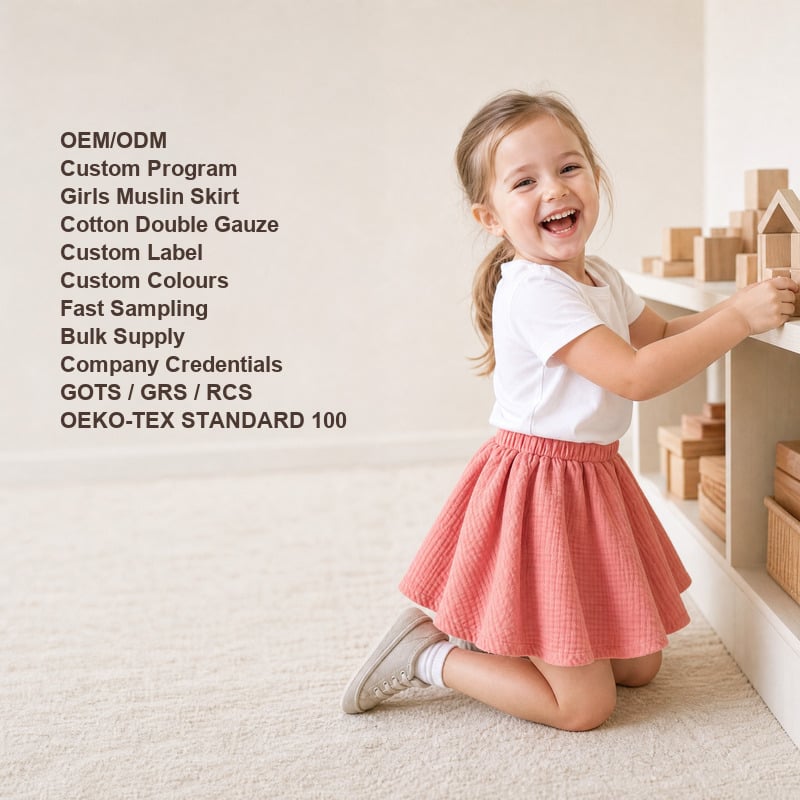
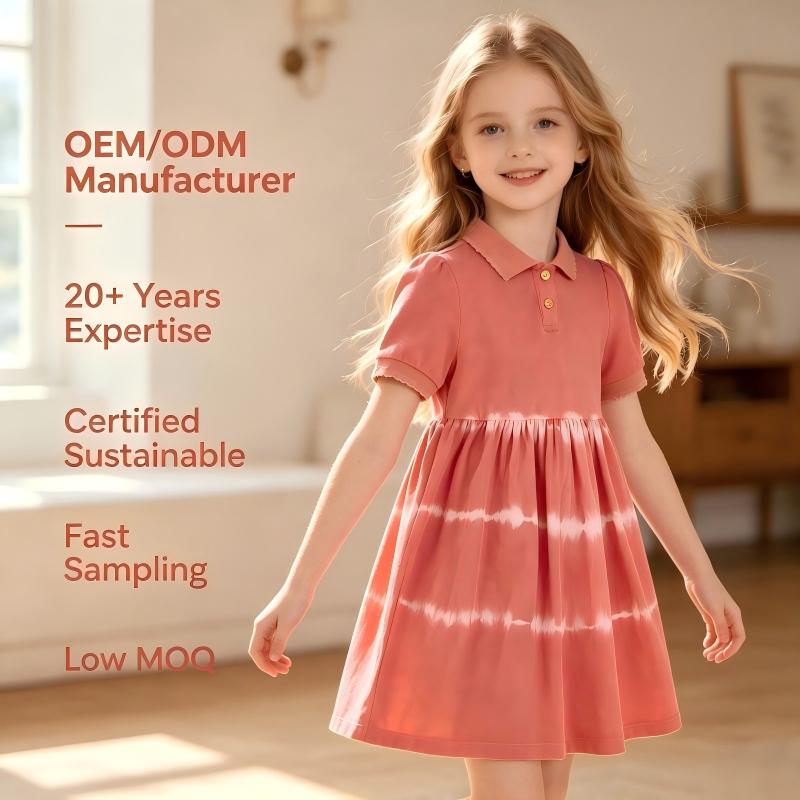
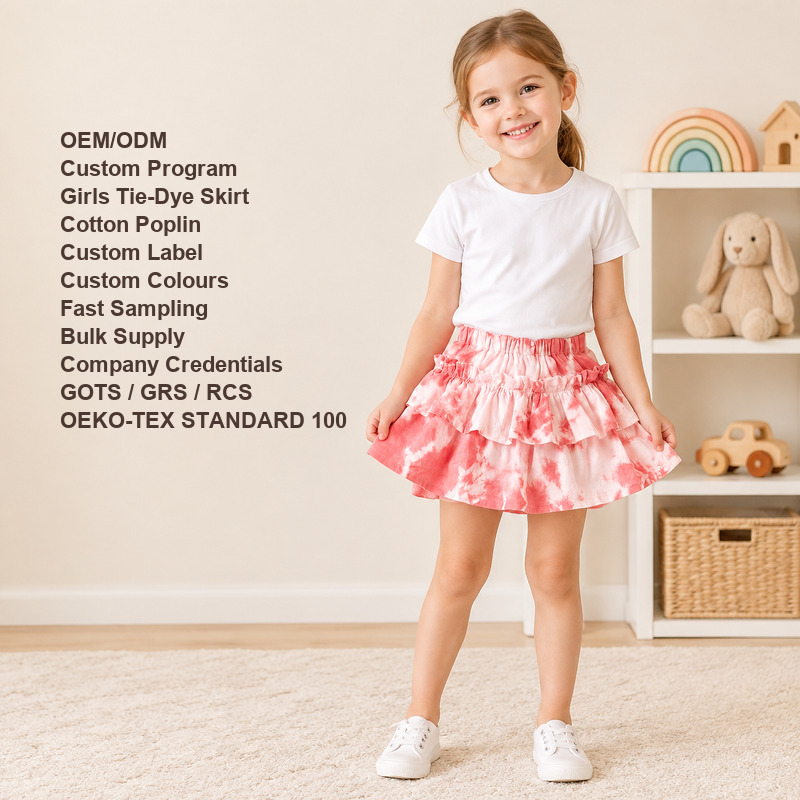
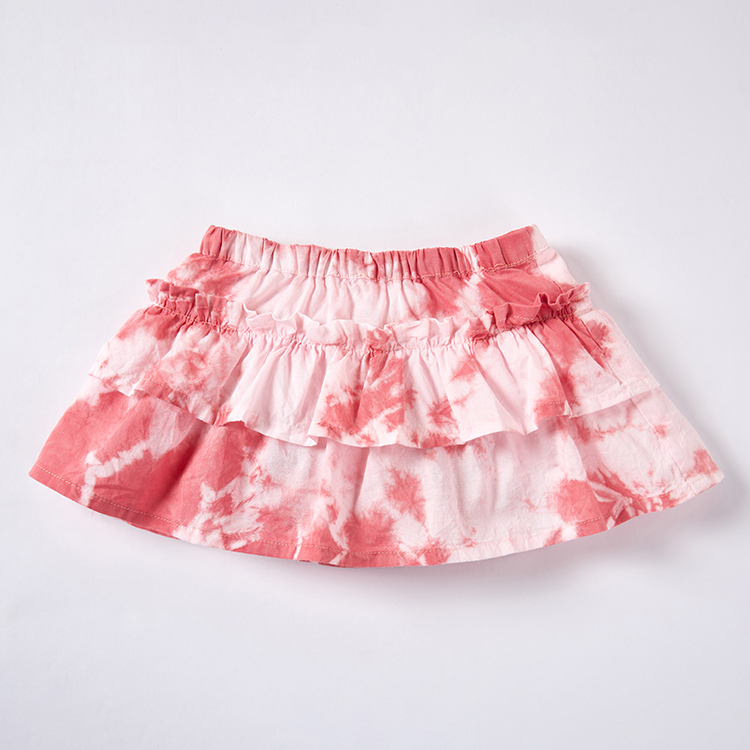
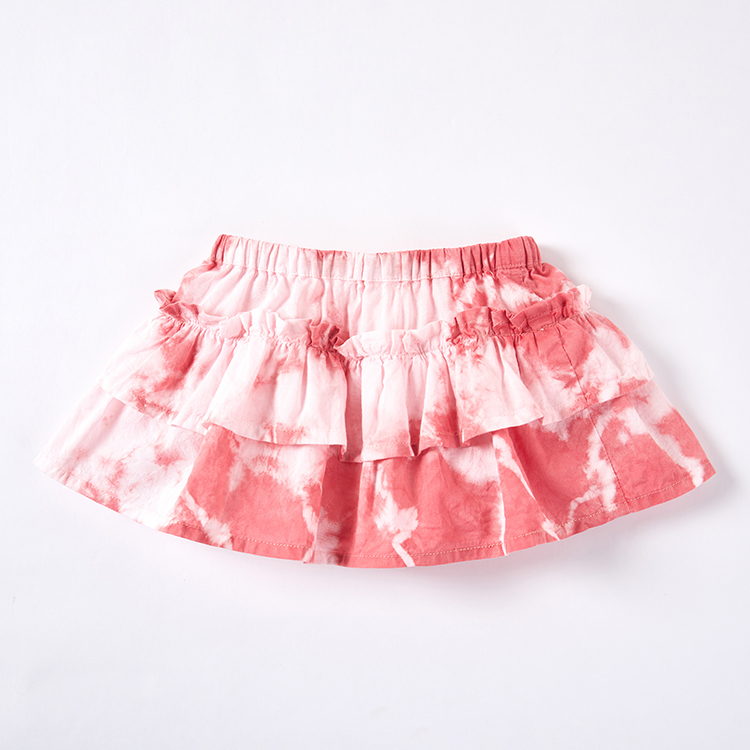
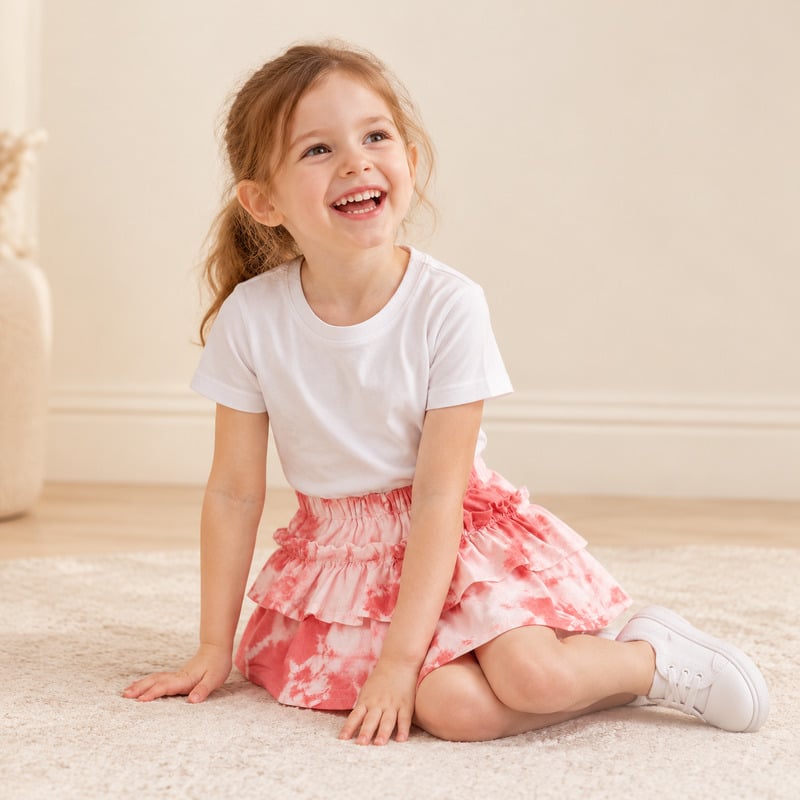
A tiered skirt in a light cotton, plant dyed to a coral mottle with sappanwood (苏木) and madder (茜草), no added mordant: a paperbag waist with the elastic set below the upper edge so a short frill stands above it, two ruffle strips gathered and set at the tier lines, a full hem on the lower tier, and no fastening of any kind.
A skirt is all perimeter, and this one is built out of three long strips and a casing. That changes what has to be controlled: the mottle is read across a two-metre ruffle rather than across a bodice, the elastic is the entire fit and cannot go into the bath, and a hem this full waves unless it is set with the cloth relaxed.
At a glance
1. The elastic is the whole fit, and it goes in after the bath
- An encased elastic is the entire construction of a pull-on skirt: it holds the skirt up, it sizes it, and it is the only part a parent touches when dressing a baby.
- So it is inserted after dyeing, not before. An elastic in a plant bath takes no colour, sits in the liquor through every dip and rinse, and comes out of the drying tunnel with a different recovery from the one it went in with. The casing is dyed empty and the elastic is threaded afterwards.
- That sets the order of work: dye the strips, make the skirt, thread the elastic. Reversing it puts the one engineered component in the garment through a process it was not made for.
- The elastic is declared as a component, tested to the same restricted-substance limits as the cloth, because it is a different material against the skin and it carries its own additives.
- Recovery is measured, not assumed: waist measured relaxed, extended to the working range and released, at the sample and again after five washes, since a skirt that sags is a skirt that falls down.
2. On an infant, the waist barely moves
- Between 3M and 3Y the waist grows by a few centimetres while the length roughly doubles, so the size run is carried by length and the waistband has to work across a range rather than at a single measurement.
- That makes the elastic specification a working range, not a length: the relaxed circumference, the extension it is expected to give, and the tension at the middle of the range, quoted per size band rather than per size.
- The casing is sized to the elastic, not to the waist, since a casing wider than the elastic lets it roll inside the channel and the waist reads as a twist.
- The waist frill is part of the fit, not decoration: the elastic sits below the upper edge, so the cloth above it compresses into a short frill. Its height is fixed per size, because a frill that grows with the grade overwhelms a small skirt.
- No fastening anywhere: a pull-on skirt with an encased elastic has no cord, no drawstring and no toggle, which is the simplest compliance position for this age group and is worth stating on the page rather than leaving to be discovered.
3. The tier lines are where the mottle turns into a fan
- Each ruffle strip is gathered and set at a tier line, so the pattern is compressed along that line and opens below it: a patch that reads as a cloud on the flat becomes a fan of streaks under a gather.
- The gather ratio is set per tier, not once for the skirt, because the upper strip has less room to fall into than the lower one; the same ratio at both lines gives a skirt that stands out at the waist and hangs flat at the hem.
- The topstitch line is the darkest line on the skirt. It presses the cloth flat, the cloth there carries the deepest part of the mottle, and the stitch shadow adds to it — so the line is expected and is graded for straightness rather than for tone.
- The seam is judged where the ruffle covers it. A tier seam that peeks below its ruffle reads as a second, unintended line, so the ruffle's drop below the stitch line is a fixed dimension.
- Width is checked at three points per tier, since a strip cut slightly off-grain drifts as it is gathered and the tier slopes.
4. Long strips stretch the mottle
- A ruffle strip is two metres long and fifteen centimetres deep, so the pattern is read along a strip rather than across a panel: a mottle that reads well on a bodice looks stretched and thin on a ruffle.
- Scale is therefore specified against the strip, as the number of patches over a metre of ruffle, and not against the garment silhouette.
- Each strip is joined into a ring, and that join is where the pattern restarts. One join per tier; it is placed in a fold rather than on a pale patch, because a join that lands in an open pale area reads as a gap in the cloth.
- The waistband is a short, narrow piece, so the mottle compresses there into a near-stripe, which is why the waistband is cut from the calmest area of the lot rather than from the strongest.
- Strips for one skirt come from one length, so the three tiers belong to the same pattern rather than to three different parts of a roll.
5. A hem this full waves unless it is set relaxed
- The hem is a narrow hem on a full circle of gathered cloth, the longest edge on the garment, and it will wave if it is turned while the gathers are under tension.
- So the hem is set with the tier hanging free and the cloth relaxed, pressed as it falls rather than flat on the table, and checked on the hanger for a level line.
- It is also where the mottle's edge quality is read, because the hem is the only straight run on a skirt made of gathers; a patch that fades out is the process working, a patch that stops on a line is a fold that held liquor.
- Hem depth is fixed per size, since a deep hem on a 3M skirt takes a visible share of the tier.
- The hem is also where the cost sits. Sweep roughly doubles between 3M and 3Y, so the longest edge on the garment becomes twice as long while the waist barely moves, and the operator time follows the hem rather than the waist.
- The hem stitch is the place a skirt is pulled on, so it is checked for skipped stitches after washing rather than only at the machine.
6. Class I, and the parts that are not cloth
- 3M to 24M sit inside Class I by age, and 3Y is assessed as Class I because the skirt can be worn by a child under that age; the scope for this cloth and colourway is confirmed against the certificate at quotation.
- Saliva and perspiration run to the destination market's methods on the same lot, with pH measured on the garment and held between 4.0 and 7.5, since a garment at this age is in a mouth as often as it is on a waist.
- The elastic, the care label and the brand label are declared separately from the 100% cotton shell in the fibre content, each with its own restricted-substance position.
- Every skirt passes needle detection at the end of the line, with the casing checked separately, because an elastic channel is a place where a fragment can sit out of the general sweep.
- No cords, no toggles and no exposed elastic ends: the elastic is joined into a ring inside the casing, and the join is positioned so it does not sit at the centre front.
7. Sizes, sampling and quoting
- Seven sizes graded on measurements: 3M, 6M, 9M, 12M, 18M, 2Y and 3Y move on waist relaxed, skirt length, tier depth and hem sweep. Waist is graded by the elastic's working range, not by a percentage of the chest.
- Customization. Number of tiers, from two as sampled to three; ruffle depth and gather ratio per tier; paperbag frill height, or a plain casing with no frill; elastic width and tension; hem depth; and the mottle at a larger scale or a lower contrast, each sealed on its own reference pair.
- Sampling: 3-7 days from a confirmed tech pack, covering a mottled strike-off with its two reference pieces, a made-up skirt with both ruffles, the casing and the hem finished as production, a waist extension and recovery check before and after five washes, a hanging check for hem level, crock in the deep and pale areas and across the tier line, and light on both areas.
- Bulk: 30-60 days from approval, planned per dyebath with the strips cut per lot, since the layout follows the mottle and the strips are long; AQL 2.5 major and 1.0 critical.
- MOQ: 300 pcs for a custom development covering cloth, shade, tiers, trim or fit; 50 pcs for a decorative process on a stock body; 100 pcs for stock cloth with your own logo and label. Mixed colour and size orders are quoted per order.
Production runs with our production partner, Suzhou Shelmin Trade Co., Ltd.: founded 2017, 7,200 m² workshop, 8 lines, 200 staff, 6,000 pieces per day. Design confidentiality is held under NDA; buyer patterns, shades and prints are not re-used.
To quote, we need: target market and the Class I tests it requires, including the saliva method; whether the elastic is to be supplied by us or by you, with its specification and certificate; the relaxed waist and the tension you want at the middle of each size band; tier count, ruffle depth and gather ratio; frill height or a plain casing; the mottle's contrast and the patch count per metre of ruffle; lot certificates for both plants; the pH target and the dyehouse water specification; packing method; and whether certification is to run in your brand name.