EN

OEM/ODM 100% Cotton Double-Layer Wrinkled Gauze Baby Girl Skirt | Eco-Friendly Plant-Dyed 135gsm Toddler A-Line Mini Skirt | Custom Sustainable Organic-Feel Kids Boutique Summer Apparel Wholesale


- Overview
- OEM/ODM 135gsm Plant-Dyed Cotton Baby Skirt
- Recommended Products
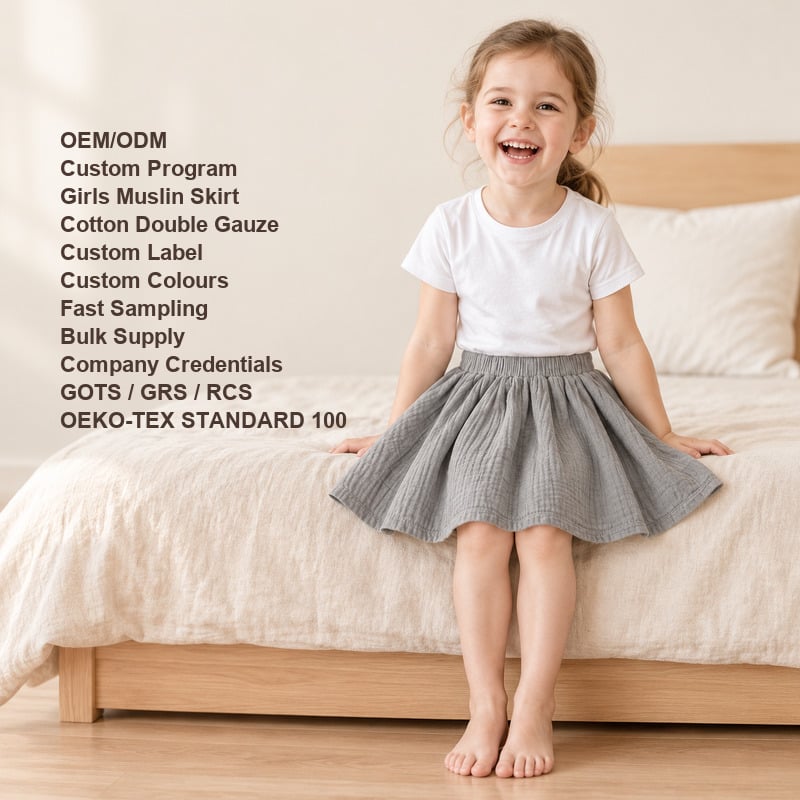
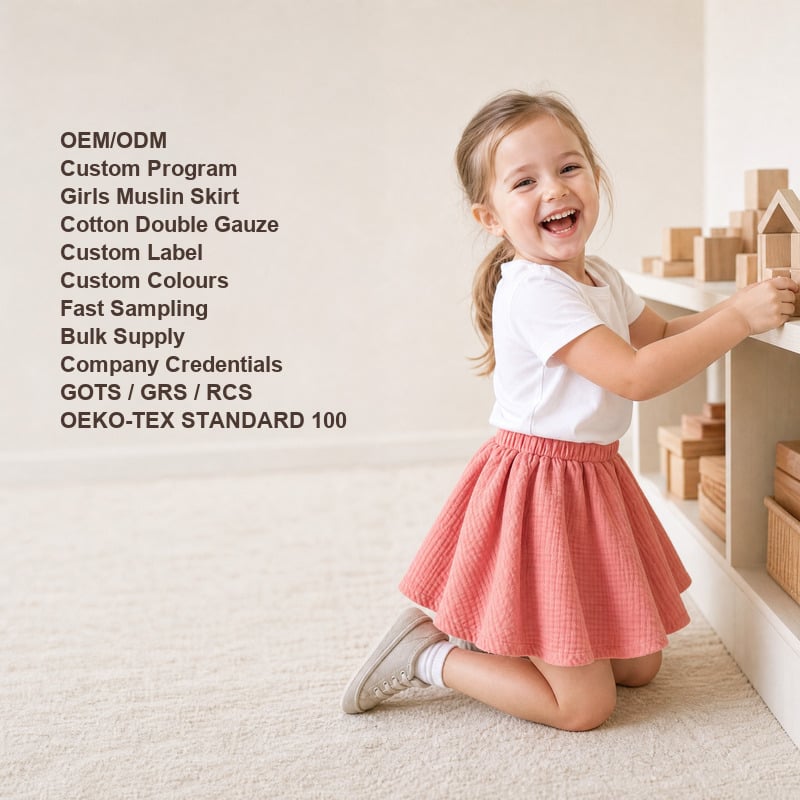
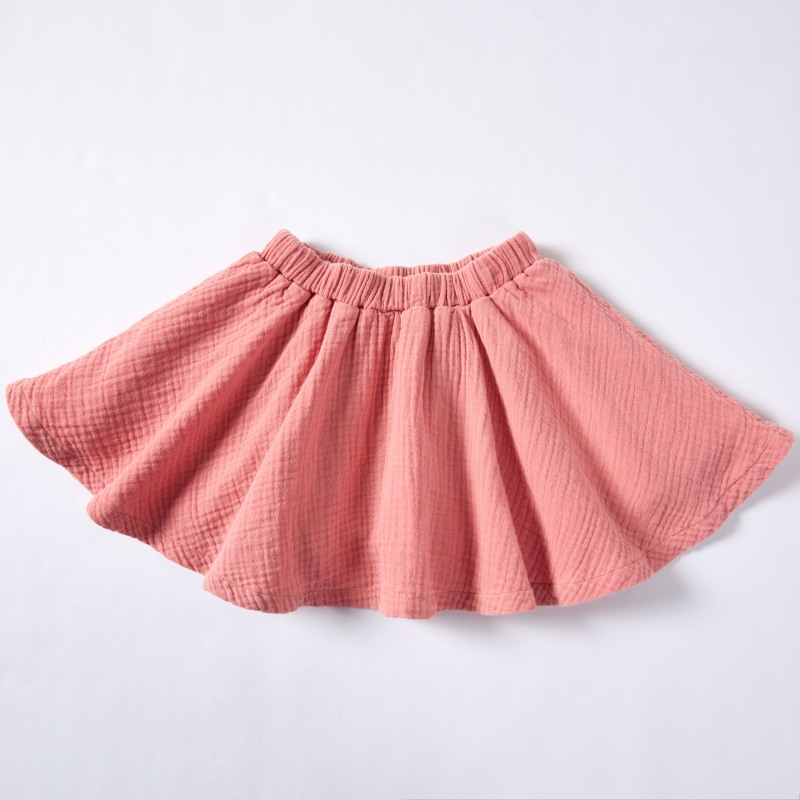
A gathered baby skirt in a double-layer crinkled cotton, 135 gsm, dyed to a coral peony with sappanwood (苏木) and madder (茜草) alone: a gathered elastic waist in a self tunnel, a flared body, a narrow hem, and no cords, ties or fastenings anywhere on the garment.
Two reds and nothing else means the colour is built in passes rather than in one bath, and a pass is a wet-dry cycle. On a skirt that matters twice: every pass is its own shade and its own length, and a flared skirt is the one garment here that uses many panels from one bath and shows a length difference at the hem. So on this piece the hem level is a dyeing result as much as a cutting one, and the depth offered is the deepest that survives rubbing rather than the deepest the bath can reach.
At a glance

1. Two reds, no carrier: depth is built by repetition
- Neither plant here is a tannin, so nothing in the fibre gives the colour a layer to bond to, and the process adds no metal mordant; what fixes the colour is the dye's own affinity for cotton.
- That is why the colour arrives in passes rather than in one bath. A single concentrated bath dyes the surface and leaves the yarn core light, which reads as a garment that looks washed before it is sold.
- So the bath is light and the passes are several, with drying between them, and the depth is whatever the passes add up to rather than what one bath could be pushed to.
- Each pass is also a full wet-dry cycle on the cloth, and that is the part a skirt notices, in shade first and in length second.
2. Every pass is its own shade and its own length
- A pass is not a neutral step. Two passes make a deeper colour than one, and they also relax the cloth a little further, so a cloth that has been through five passes is a different cloth from one that has been through three.
- A flared skirt uses many panels from one bath, which is more visible cloth per garment than any other piece here, so a difference between panels has room to be seen and a difference in length has somewhere to show.
- So each dip is treated as its own lot: shade, hand and length are recorded per dip, panels are cut per dip and kept together through sewing, and two dips are never mixed inside one garment.
- The hem is marked on the hanging garment per garment, not per pattern, because the drop that follows joining depends on how much the panel was relaxed, and that is a property of the dip.
- This is why hem level on this colourway is a dyeing result as much as a cutting one, and why the level check is written into the bulk plan rather than treated as a cutting-room matter.
3. The gather ridge is the abrasion line
- A gathered waist bends the cloth sharply at the crest of every gather, and a skirt keeps pulling on it all day.
- On a colour that sits near the surface, a sharp bend plus repeated stretch is where colour goes first: the ridges lighten before the flat cloth does, and on a mid-depth coral that reads as a speckled paler crown just under the waistband.
- So the ridge is tested as a zone: rub and stretch at the gather ridges against unworked ridges from the same panel, after the wash sequence rather than before it.
- The answer is construction, not more dye. A slightly less aggressive gather ratio towards the crest of the waist, a deeper tunnel so the elastic does not sit on the bend, and a seam allowance that spreads the pull are all cheaper than another pass, and none of them change the shade.
- The same logic applies to the elastic print check, which is done after washing because that is when both the print and the ridge wear appear.
4. What rubbing takes, and where
- The inside face sits against a nappy and skin on the seat and the back of the thighs, which is the most humid and most abrasive contact on the garment.
- Rubbing is therefore tested on the inside face as well as the outside, read against an unrubbed area of the same face, and colour transfer is checked against a white cotton reference rather than by eye.
- The hem is the second zone, because a skirt on a crawling baby meets the floor; on this route the hem rubs and the ridges lighten for the same underlying reason.
- Both results are reported as change from a specimen, not as a pass or fail, so a buyer can see how much colour a season of wear takes rather than only whether it cleared a threshold.
5. The depth offered is the depth the fastness allows
- There is a shallower limit and a deeper limit on this route, and the deeper one is set by rubbing and washing rather than by what the bath can reach.
- So the colour is quoted as the deepest that holds after the wash and rub sequence, which is why this coral is a mid-depth coral and not a saturated red.
- A request for the same shade on a heavier cloth, or with the rind included, is a different route rather than a variant of this one, because the third material changes both the depth that can be reached and the way the colour ages.
- That is worth saying plainly at quotation, since a buyer comparing two corals across a range is comparing two processes, and the difference in price and lead time comes from the process rather than from the colour.
6. Fit, construction and the points a buyer should confirm
- The waist sits high, above the nappy line, so the skirt hangs from the smallest part of the torso and does not work its way down as the child moves.
- A skirt rides up when a baby crawls, because nothing holds it down; that is a property of the shape rather than a fault in the make, so the garment is presented as a layer over a nappy cover or bloomers and sampled that way.
- It carries no cords, ties, toggles, buttons or snaps, so its trim list is the waist elastic alone.
- Length is specified in the hanging state after the drop period, and a re-order is measured the same way rather than cut to the same pattern length.
- The hem allowance, stitch and differential feed are specified together, because a narrow hem on a curved, two-ply, springy edge is the hardest seam on the garment; the hem is pressed under rather than flat, and inspected in raking light along the edge.
7. Tests, sizes, sampling and quoting
- Fabric tests at the shipped depth: light to ISO 105-B02, wash to ISO 105-C06 with a whole garment in the load, rubbing to ISO 105-X12 on the outside face, on the inside face and through creases, perspiration and saliva to ISO 105-E04 plus the destination market's saliva method, with colour read on both plies.
- Route-specific checks: rub and stretch at the gather ridges against unworked ridges after the wash sequence; a transfer rub from the inside face onto a white cotton reference; a both-ply read at the hem and waist turns; and a dip record covering shade, hand and length for each pass lot.
- Hem checks: level at marked points, on the hanging garment and again after washing, reported per dip lot; abrasion against an unrubbed specimen; and a raking-light inspection for a flattened band.
- pH is measured on the garment and held between 4.0 and 7.5; phenol yellowing is checked to ISO 105-X18 on a specimen carrying the actual packing fold, with packaging specified free of BHT.
- Trim and safety checks: waist elastic relaxed and stretched circumference per size, recovery after repeated washing, a print check at the waist after washing, tunnel stitching integrity, and confirmation that the garment carries no cords, ties, toggles or small parts.
- Five sizes on a measurement chart: 6-9M, 9-12M, 12-18M, 24M and 36M move on waist, skirt length and hem circumference, measured in the hanging state after the drop and confirmed after washing.
- Sampling: 3-7 days from a confirmed tech pack, covering a dyed strike-off with its pass count and rinse stated, a made-up skirt hung for its drop period and hemmed, a wash-and-remeasure with hem level marked, a fit check over a nappy cover on the smallest and largest size, a ridge rub and stretch check, a two-face read at both turns, and a waist print check after washing.
- Bulk: 30-60 days from approval, planned per dip lot as well as per dyebath, with panels cut and kept per dip, and cloth released only after colour, ridge, rub, level and print results are in hand.
- MOQ: 300 pcs for a custom development covering cloth, shade, crinkle level, trim or fit; 50 pcs for a decorative process on a stock body; 100 pcs for stock cloth with your own logo and label. Mixed colour and size orders are quoted per order, and terms are confirmed against the current quotation.
Production runs with our production partner, Suzhou Shelmin Trade Co., Ltd.: founded 2017, 7,200 m² workshop, 8 lines, 200 staff, 6,000 pieces per day. Design confidentiality is held under NDA; buyer patterns, shades and prints are not re-used.
To quote, we need: target market and the Class I tests it requires; the crinkle level you want, as crease count and depth per unit; whether the shade may be quoted as the deepest that passes rub and wash rather than as a target colour; the skirt length you are targeting and whether it is approved in the hanging state after the drop period; the acceptable post-wash length change and hem level tolerance; whether one garment may contain panels from two dips, since the standard answer here is that it may not; waist elastic type and relaxed and stretched circumference, with the tunnel width; whether the skirt is sold alone or as a set with a nappy cover; lot certificates for the two plants and for the thread; the pH target and the dyehouse water specification; packing method; and whether certification is to run in your brand name.