EN

OEM/ODM 100% Cotton Toddler Girls Polo Dress Natural Plant Dyed Tie Dye Summer Kids Short Sleeve Princess Dresses Custom Wholesale


- Overview
- OEM Custom 100% Cotton Plant Dyed Girls Polo Dress
- Recommended Products
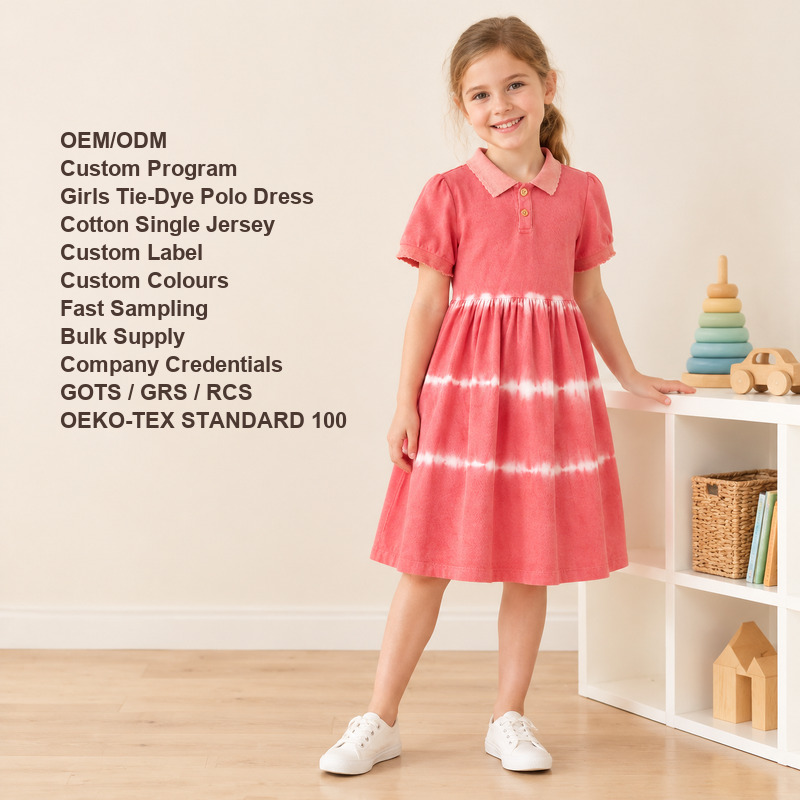
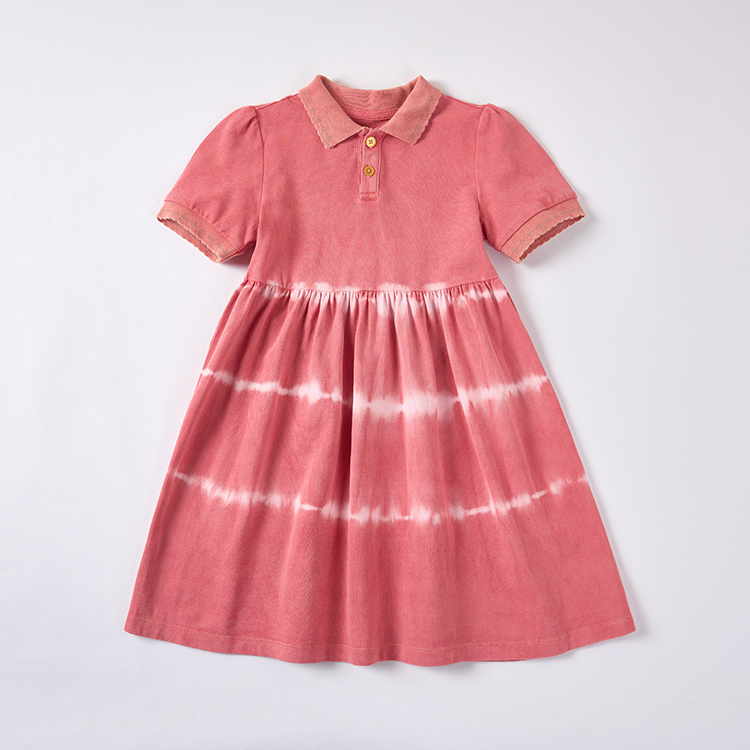
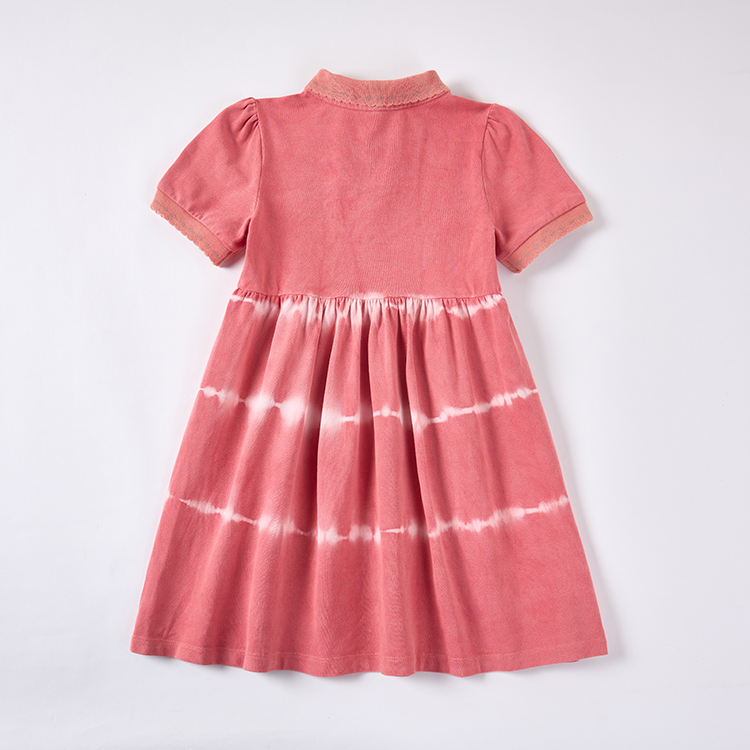
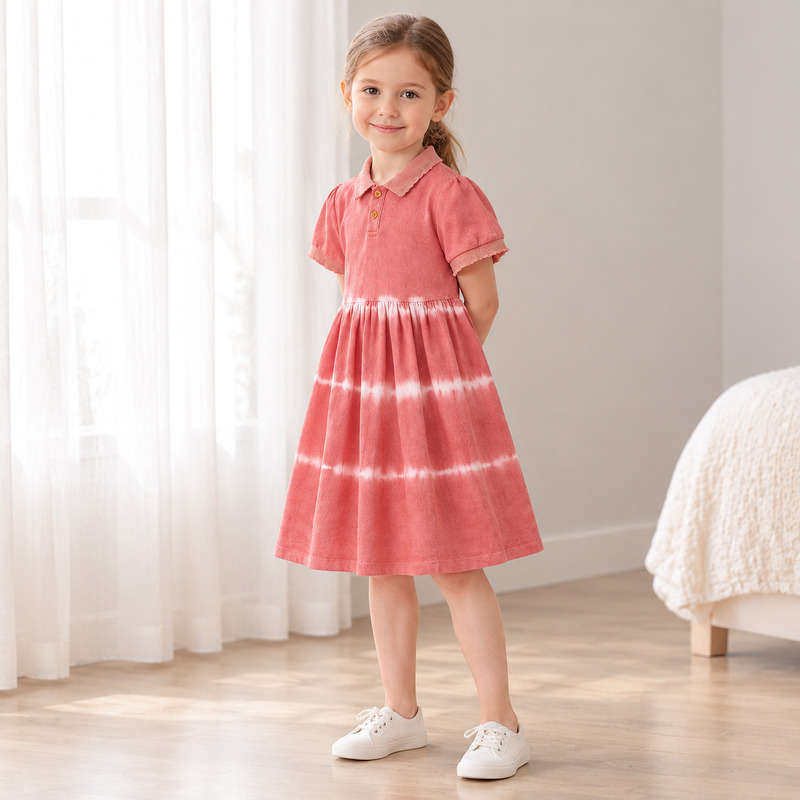
A polo dress in a cotton piqué, plant dyed to a coral with sappanwood (苏木) and madder (茜草), no added mordant: a shell-edge collar, a two-button placket, short puff sleeves finished with a shell-edge flounce, and a gathered skirt carrying two pale bands made by binding the cloth across its width before it was cut.
Two things on this dress are repeated, and both are where it goes wrong. A pair of lines has to agree in width and stay the same distance apart the whole way round; and one shell edge is cut in three places, on three different curves. A single mark forgives sloppy work. A repeat does not.
At a glance
1. A pair of lines is a rhythm, not two marks
- One band can be anywhere; two bands are read as a rhythm, so what is judged is the gap between them and the relation of that gap to the skirt's length.
- The widths have to be either equal or clearly different. Two bands that differ by a few millimetres are the failure mode: the eye reads the difference as a mistake rather than as a decision, and no amount of good dyeing rescues it.
- The gap is set as a proportion of the skirt length, not as a fixed number of centimetres, or the pair drifts apart as the size grows and the 8Y reads as two unrelated lines.
- Both lines are level in the cloth, so both have to be level on the garment: one line checked at the side seams is a single check, and two lines is four checks.
- The pair is approved on the made-up skirt, because two lines that each look fine flat can converge by a few millimetres once the skirt is gathered and hanging.
2. Four cross-check points, not two
- Each band crosses two side seams, so a pair of bands gives four points where the line has to continue; a single band gives two, and that is the whole difficulty of this dress in one sentence.
- A band that is level at one seam and two millimetres out at the other reads as a slant, because the eye follows the line round the body rather than comparing heights.
- The check is done at four points on the same garment and written down as four numbers, not as a pass, because the number is what tells you whether the cutting layout is drifting or the binding was uneven.
- The bands are measured from the hem, which is the only straight line on the skirt; the waist is a gathered curve and measuring from it imports the gather's unevenness into the band's height.
- A pair that diverges is a cutting fault rather than a dyeing fault, and it is corrected by the layout rather than by re-binding, which is worth knowing before the second lot is planned.
3. Gathering compresses the streaks, not the height
- A horizontal band survives gathering, because a gather compresses the cloth in one direction only: the band stays horizontal, and what changes is how tightly its streaks are packed.
- So the made-up skirt reads denser than the flat panel, and a buyer comparing the sample to a flat photograph sees a band that looks stronger than the photograph, not a band in the wrong place.
- The gap between two bands compresses as well, in the same proportion, which is why the pair is easier to judge on the flat than on the skirt and why the reference has to be both.
- The reference is the flat panel, and the acceptance is the made-up skirt: the flat sets the width and the spacing, the skirt confirms what the customer will actually see.
- At the waist the bands are not involved at all, since the first band sits well below the gather, so the gather and the bands never fight each other on this dress.
4. One shell edge, cut in three places
- The collar and both sleeve hems carry the same shell edge, so the eye compares them: the same pitch, the same stitch, the same thread, or the sleeve reads as an imitation of the collar.
- The collar is cut on a curve and the sleeve flounce on a straight strip gathered into a curve, so the same pitch lands differently: on the collar the scallops have to be divided around the curve so the corner falls right, and on the flounce the scallop has to be counted to the strip's length.
- The corner is the tell. A shell edge that ends with a partial scallop at the collar point is the most common fault on this garment, and it is fixed in the pattern rather than at the machine.
- The edge is finished with a dense stitch that closes the scallop, so the cloth does not fray at the tips; on a piqué knit that stitch also stops the scallop from curling away from the neck.
- The flounce is a narrow band set at the sleeve hem, so it carries a seam above it; that seam is what makes the cuff read as a finish rather than as a raw edge, and it is set at one distance from the scallop on both sleeves.
5. The placket and the yellow buttons
- The placket is short and functional, two buttons to open the neck, and it stops well above the waist; on a knit it is interfaced so it does not ripple between the buttons.
- The buttons are amber-yellow and are not plant dyed. They are the only warm colour on a cool coral garment, and that is a decision: they read as an accent only if both buttons are the same colour, from the same lot, with the same finish.
- They are declared and tested as a separate component, including the small-parts cylinder and attachment at 70 N, since a two-year-old's placket button is a mouth-sized object.
- The buttonhole is the place the knit shows its age, because a knit buttonhole opens with use: it is set with a stitch that closes the cut edge, and it is checked after washing rather than on the sample bench.
- The placket is approved with the collar, since the collar's scalloped points sit either side of it and the two edges are read together at the neck.
6. Class II, and a deep garment that still shows transfer
- The two pale bands are the transfer detector on this dress, not the ground: they are the shallowest dye on the garment and they are in the middle of the skirt where a bag and a hand land.
- Crock is read across the band edges rather than in the middle of the ground, because the edge is where two depths meet and where the streaked boundary is most visible.
- The shell edges are abrasion points, and a scallop that frays at the tip shows on a deep ground as a pale thread, which is the first thing a buyer sees on a returned garment.
- The buttons rub against the placket and the collar, so the area round the first button is checked for a transfer ring as well as for attachment.
- Class II applies: 3Y, 5Y and 8Y are for children over 36 months and the scope for this cloth, colourway and trims is confirmed against the certificate at quotation; perspiration runs to ISO 105-E04, pH is measured on the garment and held between 4.0 and 7.5, extractable heavy metals are tested on the finished garment, and the buttons and any interlining are declared separately from the 100% cotton shell.
7. Sizes, sampling and quoting
- Three sizes graded on measurements: 3Y, 5Y and 8Y move on chest, bodice length, skirt length, sleeve, the height of each band from the hem, the gap between the bands and the scallop pitch at the collar.
- Customization. Band width and gap, or a single band; both bands equal or deliberately unequal; shell edge at the collar only, or at collar and sleeves, at a finer or coarser pitch; flounce depth; placket length and button count; and the button colour changed to a tone that either disappears into the coral or stands out of it, each sealed on its own reference set.
- Sampling: 3-7 days from a confirmed tech pack, covering a bound strike-off with its reference pair, a flat panel showing both bands and their gap, a made-up dress with collar, flounce, placket, waist seam and hem finished as production, a four-point level check at the side seams written down as numbers, a scallop check at both collar points for a partial scallop, a wash-and-remeasure with the bands re-read, crock across both band edges, light on the band and on the ground separately, a button pull and a buttonhole check after washing.
- Bulk: 30-60 days from approval, planned per bound length and per dyebath with the cutting layout made per size so both bands land at the quoted heights and the gap closes with the size rather than opening; AQL 2.5 major and 1.0 critical.
- MOQ: 300 pcs for a custom development covering cloth, shade, bands, trim or fit; 50 pcs for a decorative process on a stock body; 100 pcs for stock cloth with your own logo and label. Mixed colour and size orders are quoted per order.
Production runs with our production partner, Suzhou Shelmin Trade Co., Ltd.: founded 2017, 7,200 m² workshop, 8 lines, 200 staff, 6,000 pieces per day. Design confidentiality is held under NDA; buyer patterns, shades and prints are not re-used.
To quote, we need: target market and the Class II tests it requires; band widths, the gap and the height of each band from the hem at 3Y and at 8Y; whether the two bands are to be equal or deliberately unequal; shell edge pitch and where it is wanted; flounce depth; placket length and button count, or your own button to be tested; lot certificates for both plants; the pH target and the dyehouse water specification; packing method; and whether certification is to run in your brand name.