EN

OEM/ODM 100% Cotton Double-Layer Wrinkled Gauze Baby Bubble Shorts | Eco-Friendly Plant-Dyed 135gsm Toddler Bloomers | Custom Sustainable Botanical Dye Infant Summer Shorts with Side Bows Wholesale


- Overview
- OEM/ODM 135gsm Plant-Dyed Cotton Baby Bubble Shorts
- Recommended Products
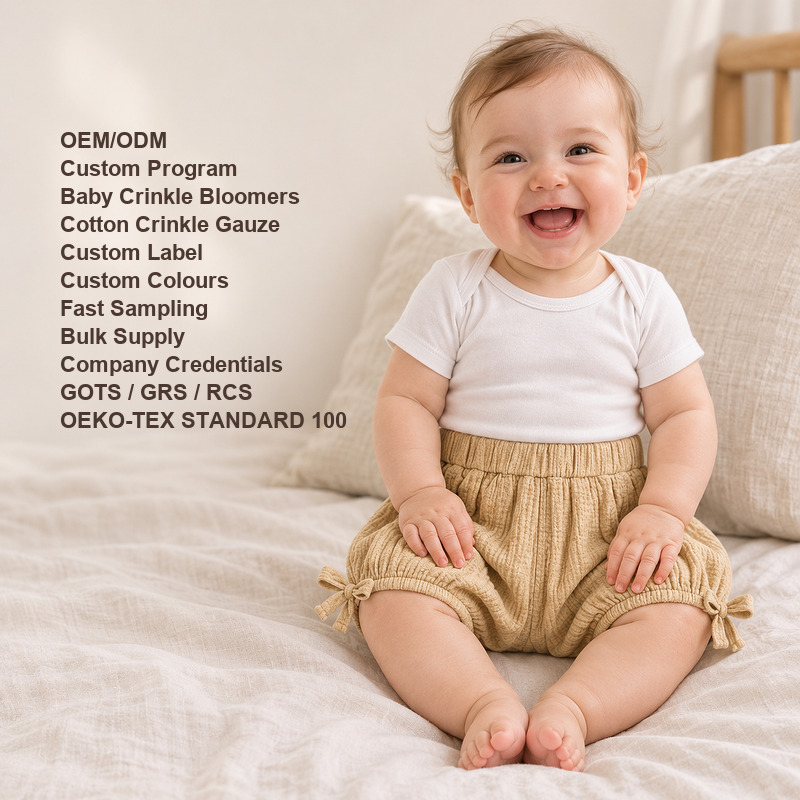
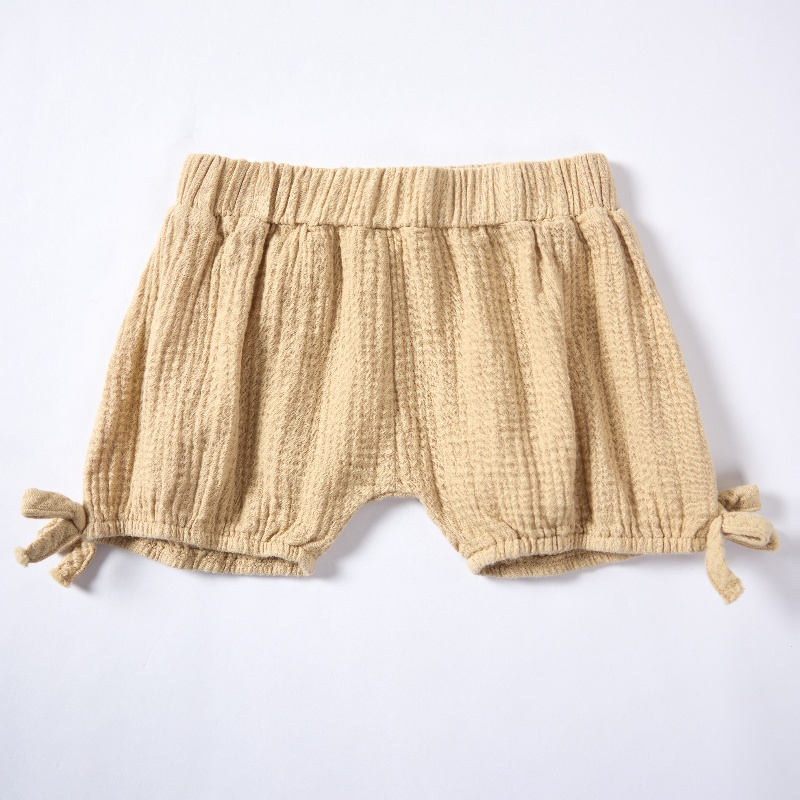
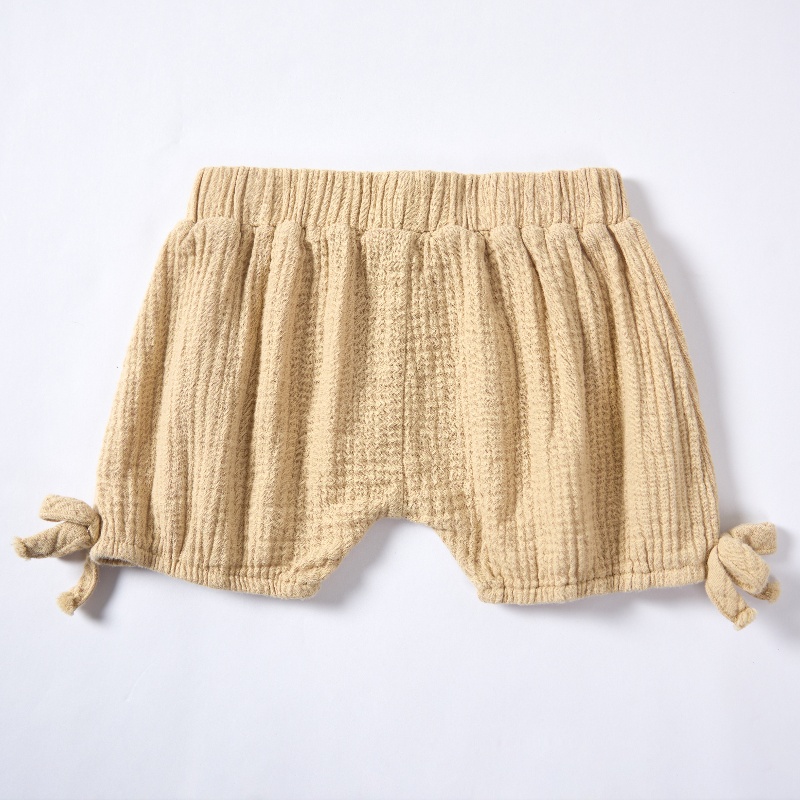
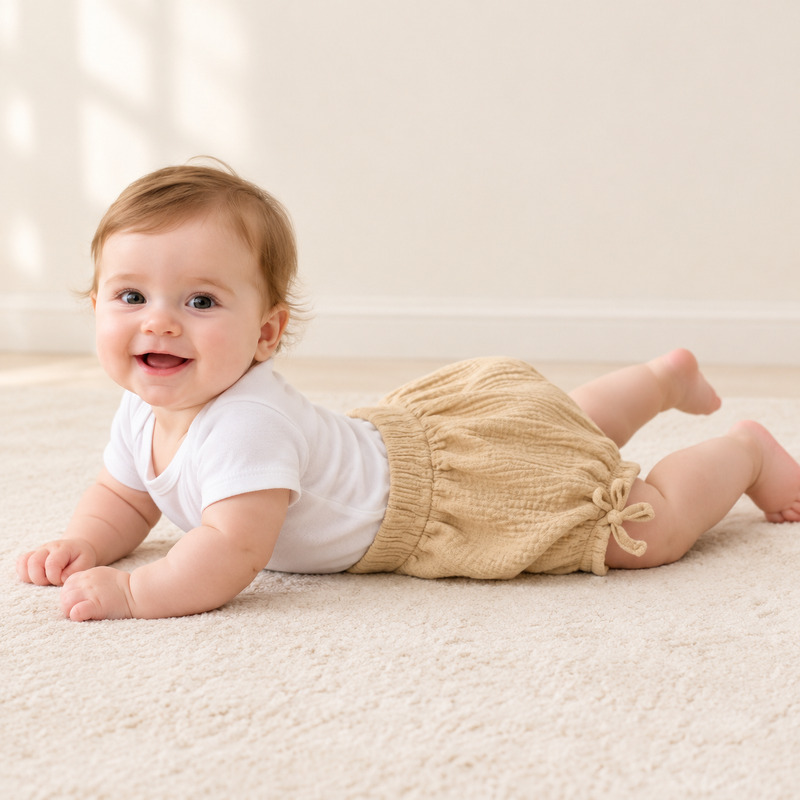
Baby bloomer shorts in a double-layer crinkled cotton, 135 gsm, dyed to a raw oat with pomegranate rind (石榴皮) and sappanwood (苏木) alone: a gathered paperbag waist on elastic, a full leg that closes at the thigh on encased elastic, and short self-fabric ties at the side seams.
In this recipe the rind carries the colour rather than supporting it. There is no madder to add red and no iron to push grey, so the oats are the rind's own colour warmed a little by sappanwood — and because the rind is loaded heavily, it also changes the hand of the cloth and the way the crease behaves. The crinkle then does something that matters to both the buyer and the inspector: it hides what a flat cloth would show.
At a glance
1. The rind carries the shade, and a loaded bath changes more than colour
- One material supplies the colour and the fixation. The rind's tannin gives the cotton a layer to hold colour and supplies the oats at the same time; sappanwood corrects warmth and keeps the tone off green.
- The rind dose therefore has two consequences that move together: more rind means more depth and a warmer cast, and it also means more tannin in the cloth.
- More tannin reads as a slightly firmer hand. A loaded crinkle is a little crisper than the greige it came from, which is visible in how the bloomer falls rather than in a measurement the customer can name.
- So hand is approved with the colour. A retained reference piece carries both, and a lot that matches on shade and feels different is a rejection at the sampling stage rather than a surprise at the fitting.
- The rinse is what protects the hand as much as the colour. Tannin and soap left in the creases dry firm and bloom as a tide line, so the rinse endpoint is verified on a crease specimen opened out and dried under D65.
2. A crinkle hides unevenness from the customer — and from the inspector
- Texture breaks up a flat patch. On a plain poplin a cloudy area reads as a cloud; in a crinkle the same area is interrupted by folds and reads as part of the surface, which is a real advantage in the hand and a real problem on the inspection table.
- The consequence is that a crinkled garment can pass a casual look and fail a buyer's return, so grading is not done by looking harder at the folds.
- Grading uses two views of the same piece. First the garment as it will be worn, which is what the customer judges; then a witness swatch cut from the same panel and pressed flat, which is what the texture was hiding.
- The places where the crinkle is already flat are the windows: the waistband facing, the seam allowances, the pressed tie and the leg turn. They are graded against the standard without any further preparation, because they show the true evenness of the dye.
- The witness swatch travels with the shipment paperwork, so a dispute about evenness is settled against a flattened piece from that same panel rather than against a photograph.
3. The crop sets the shade; the recipe only limits it
- Rind is a crop, and two lots with the same tannin content can dry to different yellows, which in this recipe is most of the shade rather than a small correction to it.
- Incoming rind is bought on two numbers: tannin content and the colour of the dried ground it gives, checked as a small dyeing against a retained standard before the lot is accepted.
- Lots are blended to hold the standard across seasons. A single-lot order for this shade is more variable than a blended one, and it is quoted as its own colourway with its own standard rather than as the same oat.
- Because texture masks lot-to-lot drift, comparison between lots is made on pressed swatches, not on the garment; on the garment the folds will make two different oats look closer than they are.
- The rind-lot document travels with the shipment, so a re-order can be matched to the batch it was approved against rather than to the last delivery.
4. Light over a nappy: coverage is a specification
- Oat is light enough that the seat matters. On a double-layer 135 gsm cloth the garment covers when dry; wet, a light tone loses opacity, and a bloomer that shows what is underneath is a return rather than a design.
- Coverage is checked dry and wet against a standard insert under D65, and the result is recorded per colourway, because it moves with depth rather than with construction.
- Depth and coverage pull in opposite directions, so a request for a lighter oat is answered in the structure — a seat lining or a slightly heavier crinkle — and quoted as a variant rather than promised as the same garment in another colour.
- The leg opening is where the light tone is most exposed, since the cloth stretches over the thigh and thins as it stretches; the check is made at the stretched leg opening as well as at the seat.
5. Waist, legs and ties on a firmer cloth
- The waist gathers a double-layer cloth onto elastic — four plies plus elastic at one seam, on a cloth that the tannin has made marginally stiffer. It is graded and pressed to sit flat and the needle and feed are specified for the bulk.
- Elastic is specified as relaxed and stretched circumference per size at the waist and both leg openings, with recovery checked after repeated washing, because a gathered waist is under constant tension and a firmer cloth does not forgive a weak elastic.
- Leg clearance is checked on the largest size first, since thigh growth outpaces the waist in this range and a tight leg reads as a fit fault rather than a style.
- The side ties are a children's-wear item: short, attached at both ends, unable to form a loop, held within the cord limit for the market against the 13 cm figure used for this size range.
- This is one place where the firmer hand helps: a tannin-loaded tie holds the knot a customer ties and does not slip open the way a very soft gauze does, so the tie keeps the width and finish that lets it hold.
6. Relaxation, drying and the length a customer ends up with
- A crinkle relaxes with wet-dry cycles and a loaded, firmer cloth relaxes a little differently from a light one, so relaxation is measured on the dyed lot rather than on the greige or on a previous colourway.
- The cut rests before sewing, and the pattern allowance comes from that measurement; a bloomer cut straight off a relaxed roll and one cut after resting are not the same garment, and the difference shows as length.
- Post-wash length, width and rise are the dimensions the customer experiences, so they are specified in the relaxed state and confirmed after the wash sequence.
- Drying is flat and in shade, never under tension: a crinkle dried under tension loses depth in the creases and dries unevenly along the fold lines, which on an oat shows as a faint stripe rather than a shadow.
- The ties are cut from the same panel as the body they hang on, because a self-fabric tie from another panel is the most visible mismatch in daylight at the widest point of the garment.
7. Tests, sizes, sampling and quoting
- Fabric tests at the shipped depth: light to ISO 105-B02, wash to ISO 105-C06 with a whole garment in the load, rubbing to ISO 105-X12 on flat areas and through creases, perspiration and saliva to ISO 105-E04 plus the destination market's saliva method, with colour read on both plies.
- Grading uses the as-worn view and the pressed witness swatch, both cut from the same panel, with the witness recorded in the shipment documents.
- Hand is approved with the colour against a retained reference piece, since the tannin load that produces the shade also firms the cloth.
- Coverage is checked dry and wet against a standard insert under D65, at the seat and at the stretched leg opening.
- Relaxation and dimension change after washing, recorded as length, width and rise before and after the wash sequence, with waistband and ties dimensioned in the relaxed state.
- pH is measured on the garment and held between 4.0 and 7.5; phenol yellowing is checked to ISO 105-X18 on a specimen carrying the actual packing fold, with packaging specified free of BHT.
- Five sizes on a measurement chart: 6-9M, 9-12M, 12-18M, 24M and 36M move on waist, rise, leg opening and outseam, measured in the relaxed state and confirmed after washing.
- Sampling: 3-7 days from a confirmed tech pack, covering a dyed strike-off on the crinkled cloth with its crinkle level and rind lot stated, a made-up bloomer washed once and re-measured, a fit check on the smallest and largest size with a nappy in place, a pressed witness swatch for evenness, a hand reference, a coverage check dry and wet, and elastic and tie checks.
- Bulk: 30-60 days from approval, planned per dyebath and per rind lot, with cloth released only after both-ply colour, rinse, hand, coverage and relaxation results are in hand.
- MOQ: 300 pcs for a custom development covering cloth, shade, crinkle level, trim or fit; 50 pcs for a decorative process on a stock body; 100 pcs for stock cloth with your own logo and label. Mixed colour and size orders are quoted per order, and terms are confirmed against the current quotation.
Production runs with our production partner, Suzhou Shelmin Trade Co., Ltd.: founded 2017, 7,200 m² workshop, 8 lines, 200 staff, 6,000 pieces per day. Design confidentiality is held under NDA; buyer patterns, shades and prints are not re-used.
To quote, we need: target market and the Class I tests it requires, including the cord and tie requirement that applies there; the crinkle level you want, as crease count and depth per unit; the oat you are targeting, and whether it is to be approved on the garment with a pressed witness swatch; the acceptable post-wash length change; waist and leg elastic type with relaxed and stretched circumferences; tie finished length and width; rind and sappanwood lot certificates with the dried-ground colour of each lot; the pH target and the dyehouse water specification; packing method; and whether certification is to run in your brand name.