EN

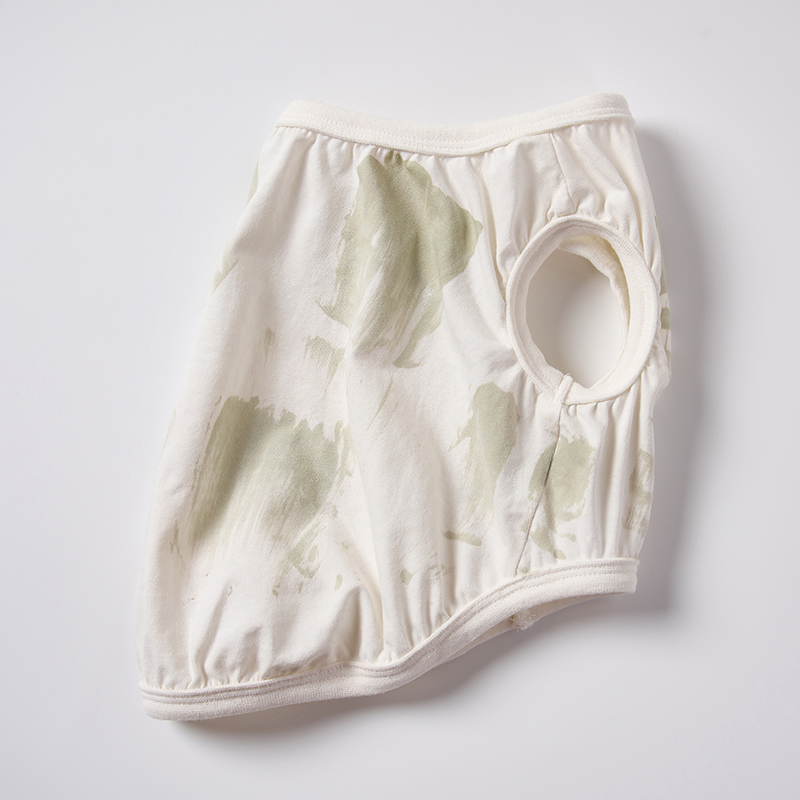
OEM/ODM Custom Pet Apparel | 100% Organic Cotton Plant-Dyed Dog Tank Top | Eco-Friendly Non-Toxic Botanical Dye Brush Stroke Print Cat Vest for Private Label | Sustainable Breathable Puppy Shirt | Wholesale Manufacturer


- Overview
- Custom Plant-Dyed Brush Stroke Cotton Pet Tank Top
- Recommended Products
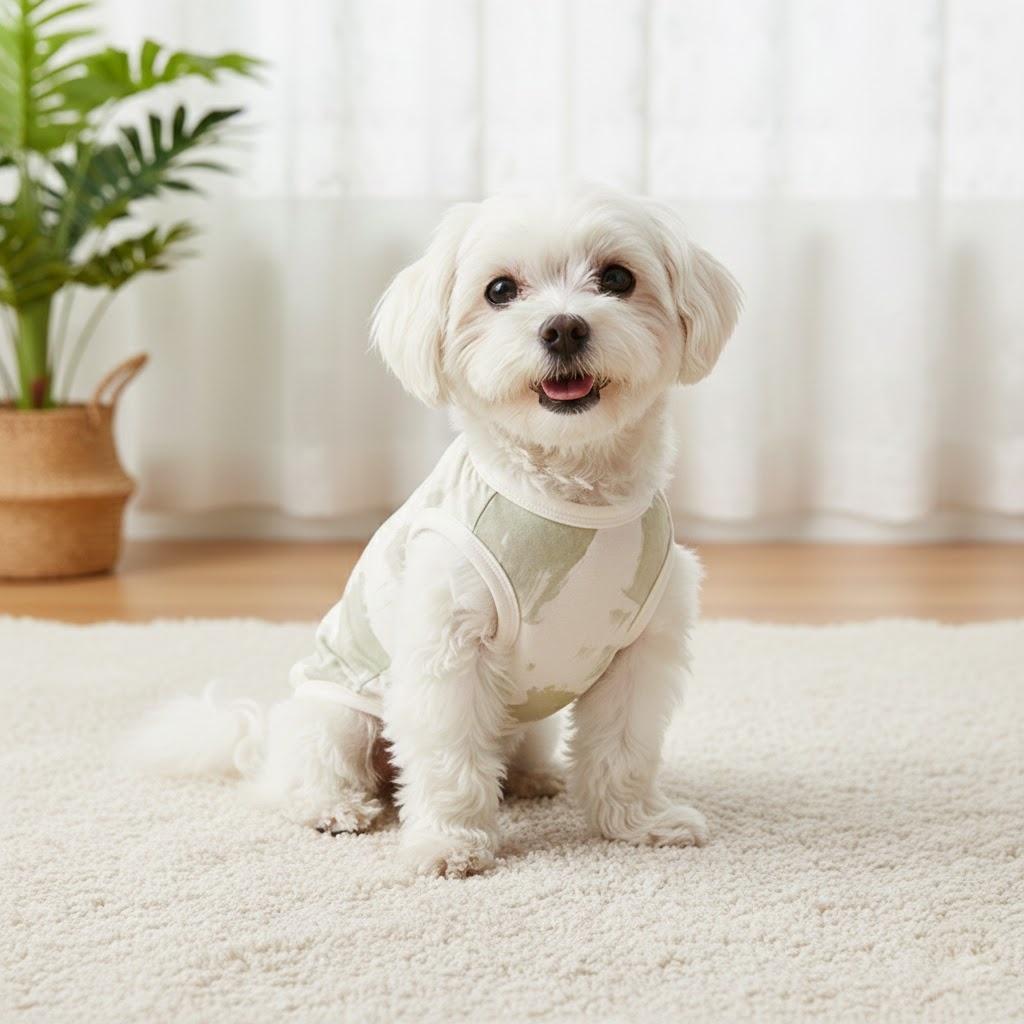
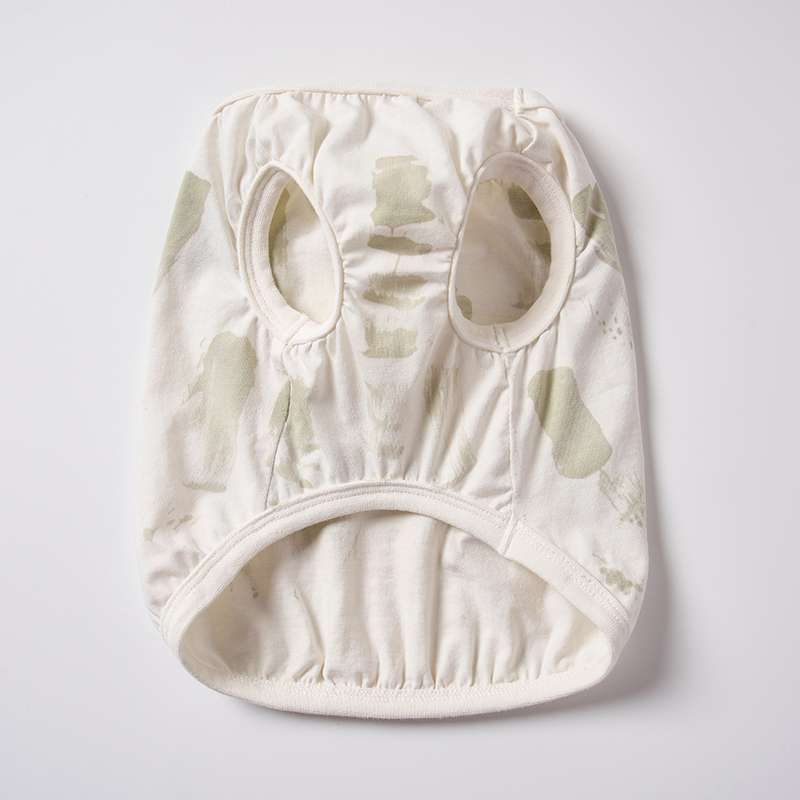
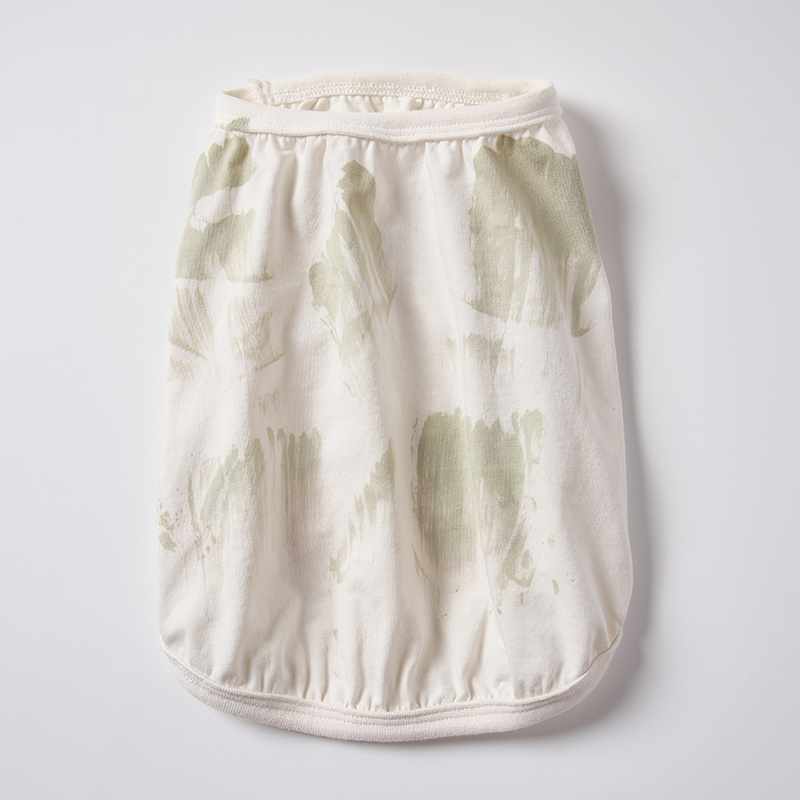
A sleeveless vest for a small dog or a cat: a 100% cotton knit body with a neck opening, two leg openings and a hem, every one of them finished with a strip of the same cloth, and a pale cream ground carrying soft sage patches brushed on by hand with a yellow from sophora buds and a blue from Isatis over it.
There is no fastening anywhere on this garment, which makes the neck binding the whole of its engineering. And the binding is cut shorter than the opening it finishes, which is why every opening in the flat view carries a ring of fine gathers - and which is also the reason the vest is a compromise in one specific place: the shorter that strip is, the more snugly the neck sits, and the harder the whole thing is to pull over an animal's head.
At a glance
1. Every opening carries a ring of fine gathers
- The binding is cut shorter than the edge it finishes, which is standard practice on a knit: a strip cut to the same length would stand away and gap, so it is cut down and eased on, and the cloth underneath has to go somewhere.
- Where it goes is into gathers. The ring of fine ripples below the neck binding, below the leg bindings and above the hem in the flat view is not decoration and not a fault: it is the arithmetic of a strip that is shorter than its opening.
- The gathers are also a visible record of how much shorter the strip was cut. A calm opening means the binding was cut close to the edge length; a strongly rippled one means it was pulled in hard, and the two behave differently when the garment is stretched over an animal.
- Nothing was added to make the ripples: no elastic, no cord, no shirring thread. The neck, the two leg openings and the hem are all finished the same way, so the garment reads as one object rather than as a body with trims attached to it.
2. That one number is both "snug" and "hard to get on"
- The binding length is a single dial with two opposite jobs. Shorten it and the neck sits down against the coat and does not gape; shorten it further and the opening closes in around the head instead of stretching over it.
- A bound edge gives far less than the knit around it, because the strip is doubled and stitched along its whole length; so the stretch available to pass a head is set by the binding, not by the jersey's own elasticity.
- Which means the neck has to be approved twice: measured flat, and measured stretched to the largest circumference it will reach in service, with the figure for the head it has to pass written next to it.
- It also means the vest is a judgement about the wearer, not only about the size. A breed that tolerates handling and a breed that does not are two different answers to the same neck measurement, because one of them will be pulled through the opening twice a day and the other will not.
- Nothing on this garment relaxes that tension: with no hook-and-loop tape, no button, no zip, no cord and no elastic, the only give in the whole vest is at the openings, so every one of them is a working part.
3. Where the cloth is gathered, a brushed patch cannot stay whole
- A patch brushed on flat cloth and then gathered is a patch folded up, so the pattern breaks into narrow strips as it crosses a gathered ring, and the finer the gathers the more complete the break.
- This is visible on the sample: where a sage patch runs into the ring below the neck binding it thins into separate streaks, and the same happens above the hem binding.
- So the pattern has to be decided while the piece is flat, and the gather is a later operation that eats it; a buyer who approves the pattern on a flat reference and then sees the gathered garment is looking at two different amounts of white.
- The practical consequence is a rule about where white belongs. Leaving the openings pale keeps a calm band at exactly the places the cloth is already disturbed, and pushing a patch into them buys a strip of colour that reads as torn.
- It also gives the pattern a natural frame: the pale rings at the neck, the legs and the hem become the quiet zones that make the patches between them read as deliberate.
4. One strip of tape, three openings, one tension
- The neck, the leg openings and the hem are bound from the same cloth and the same cut width, so they behave as one system rather than as separate trims.
- On the sample the neck binding and the leg binding meet at the chest, which is where the garment takes its shape: the tape turning from the neck edge into the leg opening is the point that decides whether the front sits flat or pulls across the chest.
- That junction is the first place a fit fault shows. A leg opening set slightly too far forward drags the neck binding off-centre, and a neck binding cut slightly too short lifts the chest panel.
- The order therefore fixes them together - the binding width, the amount each opening is eased, and the position where the two bindings meet - rather than quoting them as three separate finishings.
- The leg openings are also where the garment is under load, because a foreleg moves inside a bound hole all day; the binding there is measured after wear, not only after sewing.
5. The binding is the wear point, and it is also the pale zone
- Every opening is a friction edge: the feet pass through two of them, the head through a third, and the front legs swing against their binding with every stride.
- On this garment those are the places left on the ground, so the first abrasion happens on a pale surface, where a lifted fibre or a lost half-shade of colour shows at once.
- That makes the binding the honest place to judge the garment: crock, pilling and edge wear are read at the leg openings and the neck, not in the middle of the back where nothing touches the vest.
- It also puts the two halves of the surface to different tests. The brushed field is judged for how the colour sits against the cream; the binding is judged for how the edge survives being rubbed.
- And it is why the binding is specified as a separate reference, because a binding approved only as "same cloth as the body" will be the first thing to look tired.
6. Three numbers carry the fit
- Chest girth comes first, because the vest closes nowhere and cannot be adjusted; if the body is wrong, no other measurement rescues it.
- Back length follows, since it sets how far the hem reaches and therefore whether the garment rides up when the animal sits.
- The third number is the one buyers leave out: the distance from the neck opening to the leg openings, which decides where the front legs emerge. On a garment with no sleeves this is the whole of the shoulder fit, and it is the difference between a vest that stays put and one that strangles the stride.
- The leg opening's diameter is a separate measurement again, because a bound hole has less give than the knit around it, so a millimetre there is felt by the animal and invisible on a table.
- All four are measured on the finished, washed garment, because the body has been through a wet brush process and settles afterwards.
7. Sizes, sampling and quoting
- Two sizes graded on measurements: S and M move on chest girth, back length, neck opening with the head circumference it must pass, the distance from neck to leg openings, leg opening diameter, hem depth, and binding width and easing.
- Customization. Patch coverage and the largest patch allowed; edge softness; which zones stay pale, with the openings pale on this sample; the number of blue passes; the strength of the yellow; the mordant route quoted as two products, each sealed on its own reference set; binding width; how much each opening is eased; where the neck and leg bindings meet; leg opening diameter and position; hem depth; and the length of the body.
- Sampling: 3-7 days from a confirmed tech pack, covering a brushed set of two or three pieces approved on the oxidised, dried and washed result; both sizes pulled over a head and worn standing and walking; the neck measured flat and at its stretched limit against the head circumference; cuff, leg opening and hem re-measured after washing; crock and edge wear read at the leg openings and the neck; and the gathered rings checked for a binding that lies flat rather than cupping.
- Bulk: 30-60 days from approval, brushed in batches by trained hands with pass count and coverage recorded per batch, bindings cut in one run per size, and each batch compared against a retained cloth reference; AQL 2.5 major and 1.0 critical.
- MOQ: 300 pcs for a custom development covering cloth, shade, brush motif or fit; 50 pcs for a decorative process on a stock body; 100 pcs for stock cloth with your own logo and label. Mixed colour and size orders are quoted per order.
Production runs with our production partner, Suzhou Shelmin Trade Co., Ltd.: founded 2017, 7,200 m² workshop, 8 lines, 200 staff, 6,000 pieces per day. Design confidentiality is held under NDA; buyer patterns, shades and brush motifs are not re-used.
To quote, we need: destination market and what it requires for pet textiles; the dyehouse documentation for both dyestuffs and the mordant; the coverage ratio and largest patch size you will accept, with two reference pieces if you have them; whether the openings stay pale at every position; the number of blue passes and the strength of the yellow; chest girth, back length and the head circumference the neck must pass for S and M; the neck-to-leg distance; leg opening diameter; hem depth; binding width and easing; the certificate held for the cloth and the scope you need; lot certificates for both dyestuffs; the pH target and the dyehouse water specification; packing method; and whether certification is to run in your brand name.