EN

OEM/ODM Baby Leggings | 100% Cotton Organic Plant-Dyed Toddler Pants | Eco-Friendly Non-Toxic Botanical Dye Dip-Dyed Kids Trousers for Private Label | Sustainable Breathable Ribbed Lettuce Edge Infant Apparel Wholesale


- Overview
- Custom Plant-Dyed Lettuce-Edge Cotton Baby Leggings
- Recommended Products
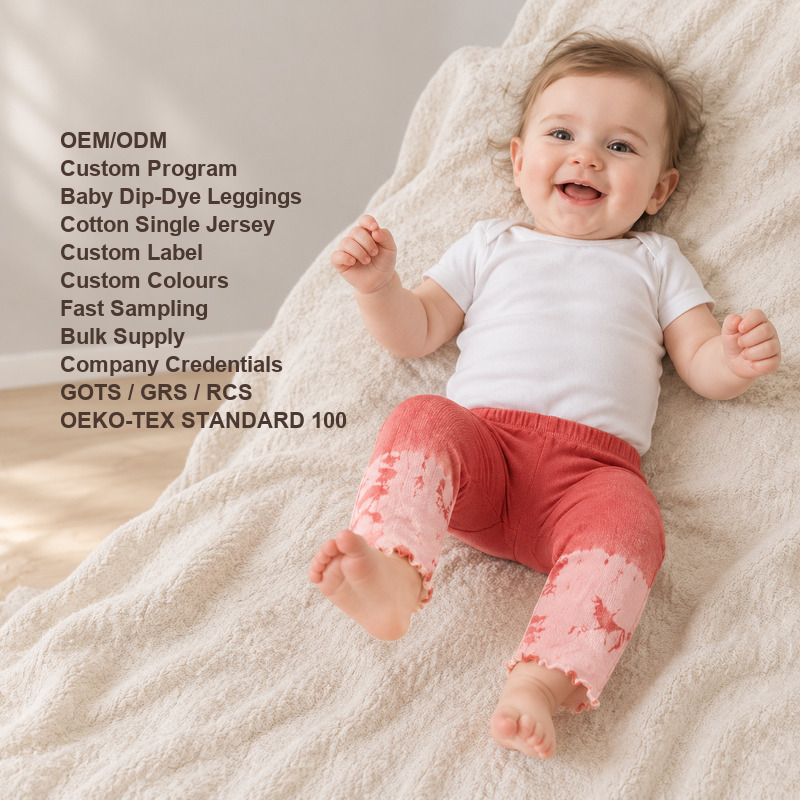
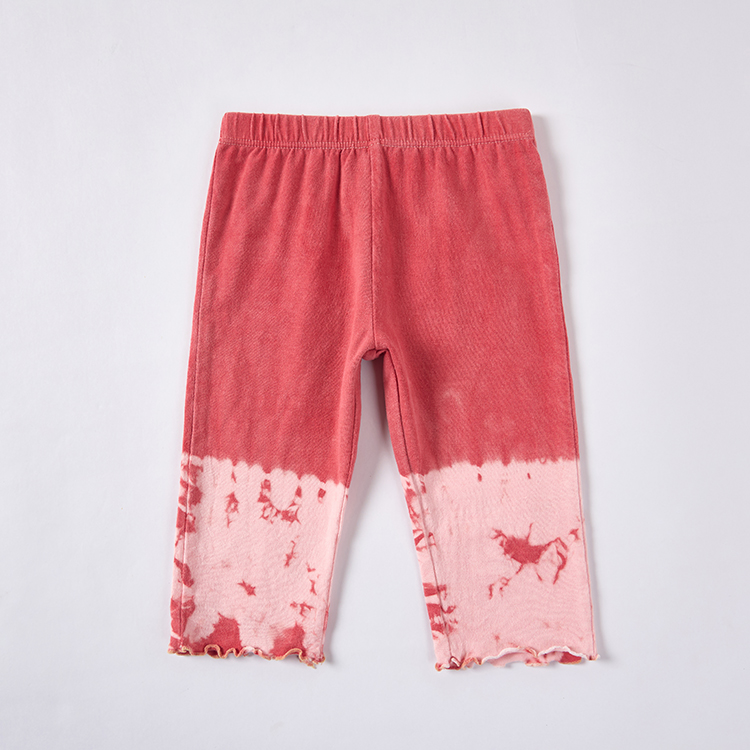
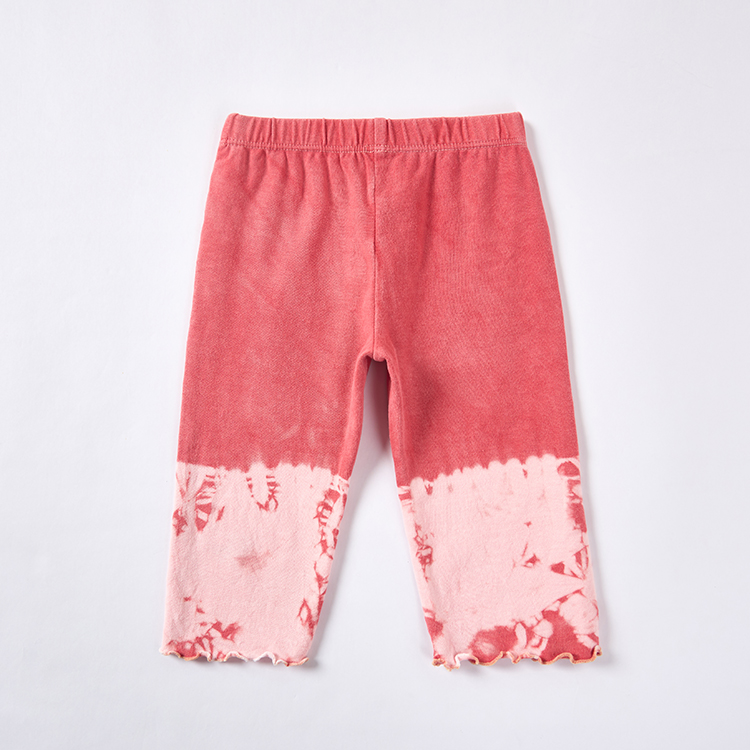
Pull-on trousers in a cotton single jersey, plant dyed with sappanwood (苏木) and madder (茜草), no added mordant: a soft elastic waist in a folded casing, a deep coral body from the waist to just below the knee, a pale coral lower leg carrying soft trails that run down from the dip line, and a rolled hem that reads a shade deeper than the leg it finishes.
Two shades on one garment normally means two dyebaths. Here it is one, entered to two different depths, and that changes what can be adjusted later: the two depths are not independent. Whichever one is deepened, the other stays where it is, so the contrast between them can be widened after the sample and not narrowed.
At a glance
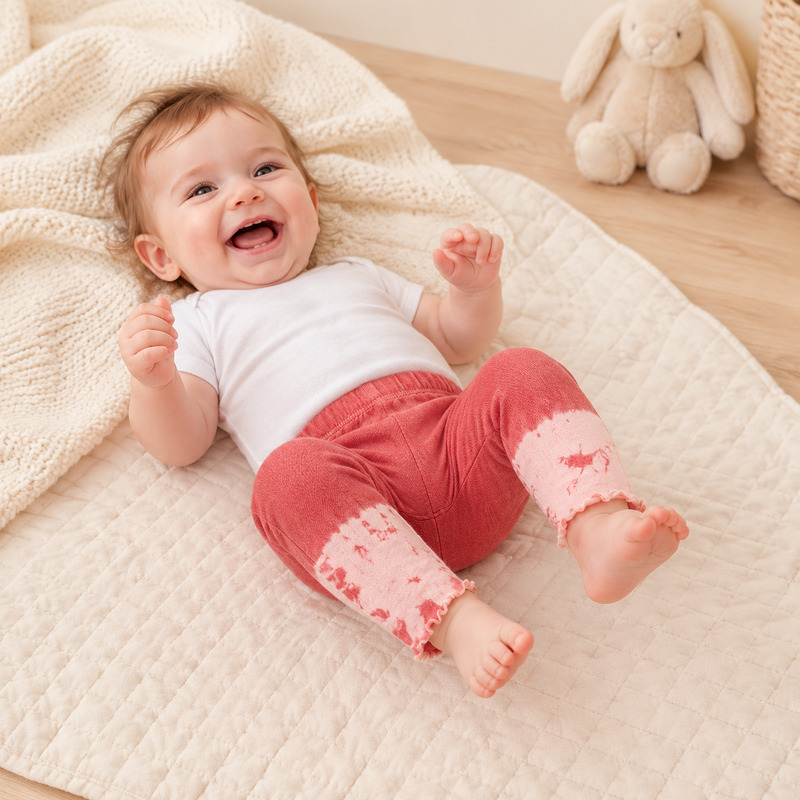
1. Two depths, one dyestuff, and only one direction to adjust
- The pale leg is not a second colour, it is the deep coral at fewer dips, so both zones come out of the same bath sequence and neither is mixed separately.
- That couples them: deepening the deep zone widens the contrast and leaves the pale zone exactly where it was, and no amount of extra dipping narrows it.
- To reduce contrast you have to re-enter the pale zone, which means masking the deep zone and re-doing the line; it is a new dye schedule, a new sample and a new reference, not an adjustment.
- So the sample is set at the lowest contrast you would accept, and the acceptable range runs upward from there; approving the middle of a range you cannot return to is how a colour ends up rejected at bulk.
- The pale zone is also the harder one to hold, because at one or two dips the shade is most sensitive to soak time, so soak time is written as a range for the pale zone and the deep zone is built by counting dips rather than by lengthening the last one.
2. Dipped as a garment, or dipped as panels
- The line crosses the inseam without a break and the rolled hem reads deeper than the leg, and both point the same way: the trousers were made up and then dipped, so the hem was already sewn when it entered the bath.
- Garment dyeing is what makes a soft line possible at all, because the cloth is hanging in its final shape and the liquor finds the same level all the way round.
- It also makes the line a measurement on a made garment, so the line is set from the hem after making up rather than placed in a cutting layout.
- The cost is dimensional: a cotton jersey that goes through a bath and a wash shrinks in length, so the line is measured again after the first wash and the pattern carries the allowance; the trousers are graded from the post-wash measurement, not the pre-wash one.
- The alternative is dipping the panels and cutting to the line, which places the boundary in the layout and gives a sharper edge; it costs a separate operation on the hem, because the rolled hem would then have to reach the deep shade on its own.
- The route is settled before the sample, because a garment and a set of panels are not interchangeable references.
3. Where the line sits, and why it moves with the size
- The line is measured from the hem, the only straight datum on a trouser leg, and the pale zone is the distance from the hem up to the line.
- Specified from the hem, the pale zone stays the same height as the size grows and the deep zone takes up all the extra length, which is what the smallest size shows: a large share of a short leg in pale.
- Specified from the waist, the opposite happens: the deep zone stays fixed and the pale zone grows, so the largest size reads as a much paler trouser.
- Only one can be written down; writing both produces a bulk run where 3M and 3Y look like different products.
- The line is level all the way round, which on a trouser means it is checked at the outseam, the inseam and the centre front and centre back; a line that is level at the outseam and rides up at the inseam reads as a slant when worn.
- The line is read again after washing, since the jersey relaxes in length and moves with it.
4. The trails are geometry, and the hem is a tension setting
- The trails below the line are liquor that ran down the cloth, so they record how the garment hung and how the cloth was folded when it came out of the bath, not a pattern drawn on the leg.
- They are therefore specified as a character rather than a copy: they run downward, they thin as they descend, they do not cross to the other leg, and both legs are read as one pair.
- The trail length has a limit, and it is set in millimetres below the line; a trail that reaches the hem turns a two-zone garment into a three-zone one and reads as a fault rather than as a finish.
- Larger patches near the hem come from the cloth folding on itself, and are accepted while they stay inside the pale zone and do not join the line.
- The rolled hem is a stitch-tension product, so its wave is set by differential feed and tension rather than by the pattern; the amplitude and the number of waves are fixed on the sample and counted per leg, because two legs with different wave counts read as mismatched.
- The hem reads deeper than the leg it finishes because the roll holds two and three layers of cloth in the same space, and that mass takes more colour; it is a consequence of the finish, not a second dyeing.
5. The elastic, and when it goes in
- The waist is a folded casing with two rows of stitching, so the elastic is enclosed and nothing is exposed at the upper edge.
- If the trousers are garment dyed the elastic is in the bath, which raises two questions: whether it keeps its recovery, and whether it stays its own colour or picks up a cast.
- A white elastic under a coral bath rarely stays white, so either an elastic in a tone that will not read as a fault is chosen, or the elastic goes in after dyeing and the casing is left open until then.
- Inserting after dyeing protects recovery and costs an extra operation, and it is the route for a waist that has to pass the hips repeatedly without going slack.
- The casing is where a fixed waist fails first, since stitching through a stretched casing holds the gathers but does not return them; recovery is measured on the made waist after the bath and after five washes.
- The waistband shade is not a separate approval: it is part of the deep zone, so it is read against the body below it and never on its own.
6. Class I, and the two places that need declaring
- Class I applies: 3M to 2Y sit inside Class I by age and 3Y is assessed as Class I, the scope for this cloth and colourway is confirmed against the certificate at quotation, saliva and perspiration run to the destination market's methods on the same lot, pH is measured on the garment and held between 4.0 and 7.5, and extractable heavy metals are tested on the finished garment.
- The elastic is the first declaration, as a component with its own fibre and its own test position, whether it was dyed in the bath or inserted after.
- The rolled hem thread is the second, since a hem that reads deeper is read as design and a thread that shifts in the wash is read as a fault; it carries its own fastness rather than following the cloth.
- Crock is read on the hem roll and on a trail edge, since those are the two places where two depths meet on this garment.
- There is no cord, drawstring, toggle or opening anywhere; the only hardware is the enclosed elastic.
7. Sizes, sampling and quoting
- Seven sizes graded on measurements: 3M, 6M, 9M, 12M, 18M, 2Y and 3Y move on waist relaxed and extended, hip, front rise, back rise, inseam, leg opening, the height of the line from the hem and the wave count at the rolled hem.
- Customization. The line height from the hem at 3M and at 3Y, and which of the two it is specified from; contrast between the two zones, approved at the lowest acceptable point; trail length limit; patch size in the pale zone; wave amplitude and count at the hem; hem thread in a tone matched to the leg or to the roll; elastic route, in the bath or inserted after; and the waist depth, each sealed on its own reference set.
- Sampling: 3-7 days from a confirmed tech pack, covering a dip strike-off with its reference pair at one and at full dips, a made-up pair dipped as a garment with the line level at four points, a wash-and-remeasure of the line and the inseam, a trail read against the millimetre limit on both legs, a wave count per leg, an elastic recovery check before and after five washes, crock on the hem roll and on a trail edge, and light on the deep and the pale zones separately.
- Bulk: 30-60 days from approval, planned per dip sequence and per bath, with the garment dipped in its made-up state and hung so the two legs enter the liquor together; AQL 2.5 major and 1.0 critical.
- MOQ: 300 pcs for a custom development covering cloth, shade, line or fit; 50 pcs for a decorative process on a stock body; 100 pcs for stock cloth with your own logo and label. Mixed colour and size orders are quoted per order.
Production runs with our production partner, Suzhou Shelmin Trade Co., Ltd.: founded 2017, 7,200 m² workshop, 8 lines, 200 staff, 6,000 pieces per day. Design confidentiality is held under NDA; buyer patterns, shades and prints are not re-used.
To quote, we need: target market and the Class I tests it requires, including the saliva method; the line height you want at 3M and at 3Y and whether it is specified from the hem or from the waist; whether the trousers are dipped as a garment or as panels; contrast at the lowest point you would accept; trail length limit and patch size; wave amplitude and count; the elastic route and its fibre; lot certificates for both plants; the pH target and the dyehouse water specification; packing method; and whether certification is to run in your brand name.