EN

OEM/ODM 100% Cotton Toddler Girls Polo Dress Natural Plant Botanical Dyed Tie Dye Kids Summer Short Sleeve Puff Sleeve Dresses Custom Wholesale Private Label


- Overview
- OEM Custom 100% Cotton Plant Dyed Girls Polo Dress
- Recommended Products
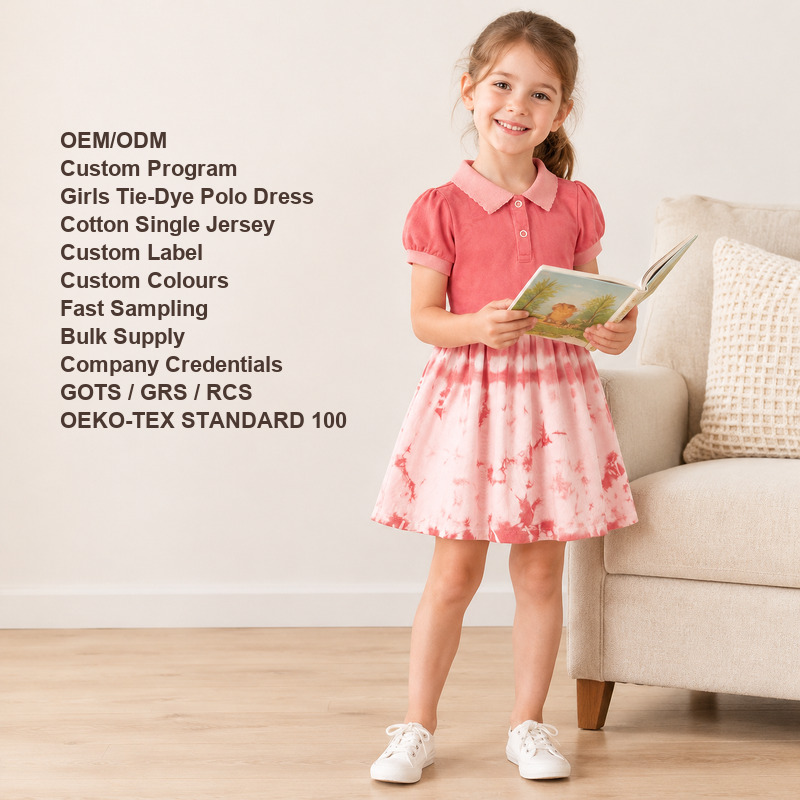
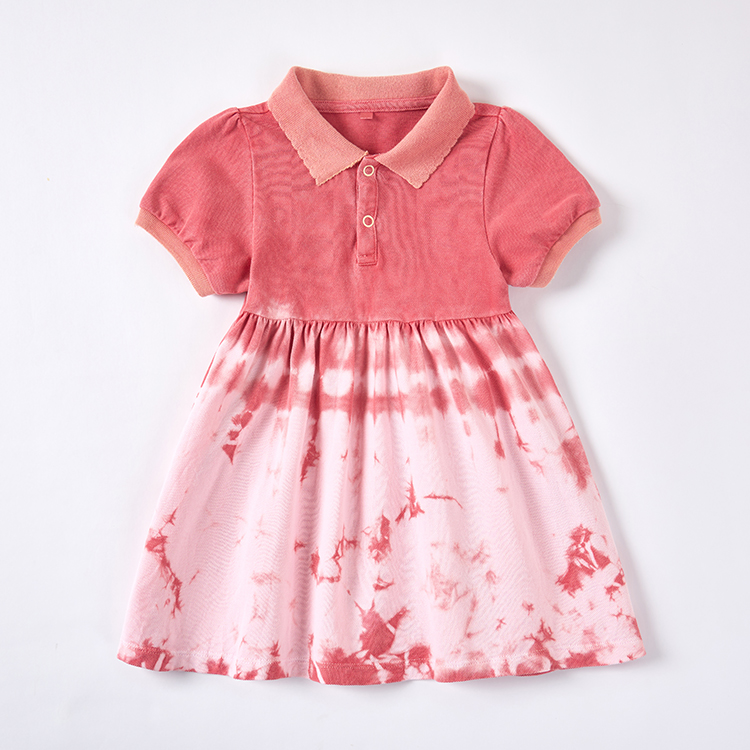
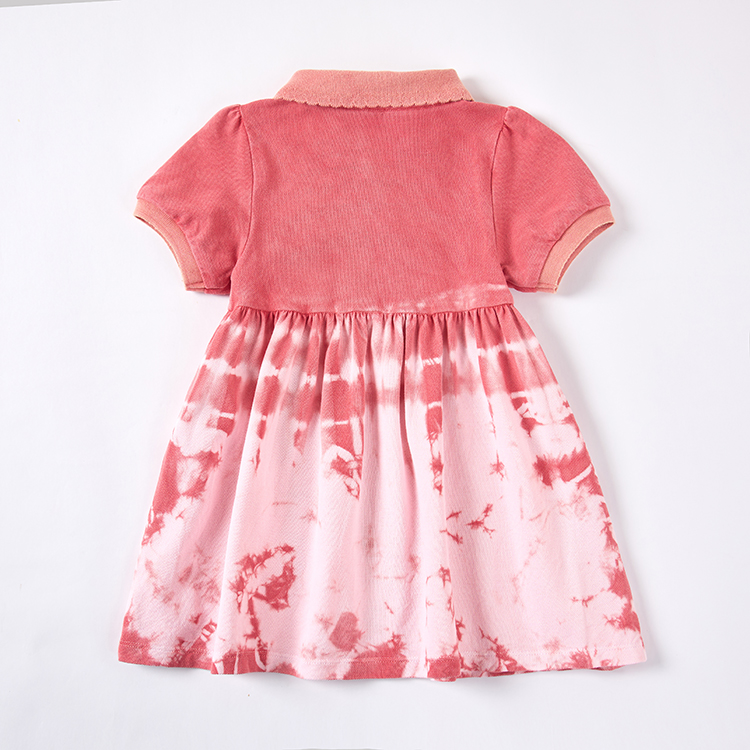
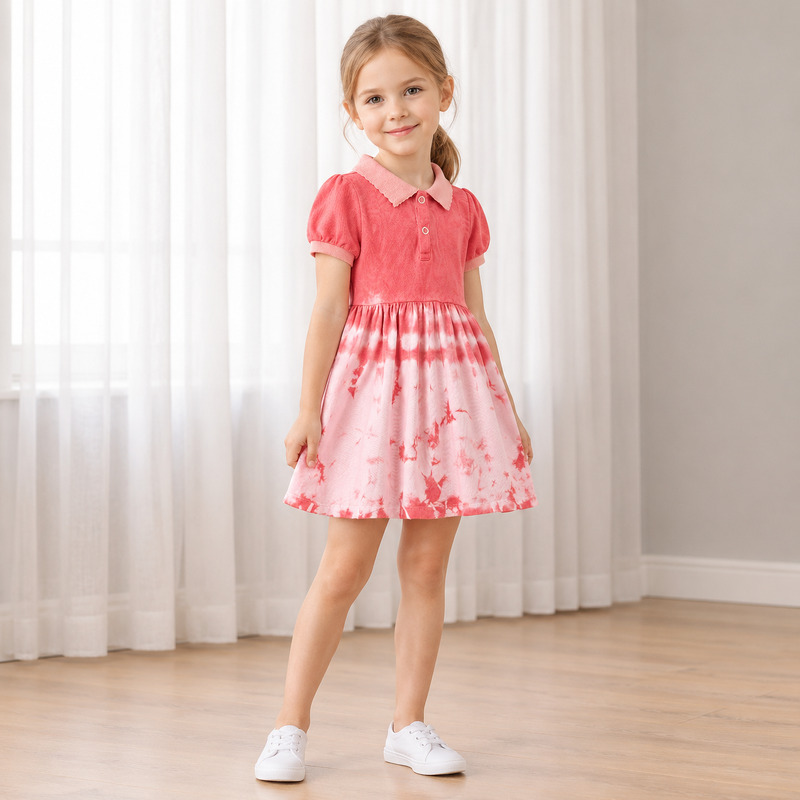
A polo dress in a cotton knit with a fine rib surface, plant dyed to a coral with sappanwood (苏木) and madder (茜草), no added mordant, and read in three values at once: a deep bodice, a blush collar and matching sleeve bands, and a pale skirt carrying large soft blotches from a bound resist, gathered into the bodice at a plain waist seam with no waistband and no zip.
Three values from one dyestuff is a design decision before it is a dyeing result, and it is the thing that can quietly collapse: if the collar drifts towards the skirt's pale field, the dress loses its structure and reads as a deep bodice floating between two pale areas. Everything below is about keeping the three apart and keeping the joins between them clean.
At a glance
1. Three values from one dyestuff, and the hierarchy has to hold
- The bodice is the deepest part of the dress, the skirt is a pale field, and the collar and cuffs sit lighter than both. That order is the design, and each step has to stay visible on its own.
- The measured risk is the collar drifting down towards the skirt. A collar only a little paler than the skirt reads as a mistake rather than as trim, and the dress then has a dark middle and two pale ends instead of three values.
- So the collar is approved against the bodice and against the skirt on the same bench, not on its own, and the pair of reference values is written down: collar to skirt, and skirt to bodice.
- The skirt's mottle is part of the middle value. Its pale areas sit close to the collar tone, which is why the collar is kept deliberately lighter rather than merely pale.
- The gap is checked in daylight and under shop light, because a blush collar and a pale coral skirt can separate in one and merge in the other, and the buyer sees the dress under both.
2. The waist seam is where the value jumps
- A deep bodice over a pale gathered skirt puts the seam's shadow against the lighter of the two, so the seam allowance is pressed up into the bodice, and the shadow falls inside the deep area instead of drawing a grey line across the pale one.
- The gather's first fold is the awkward part: compressed cloth takes less dye, so the upper edge of the skirt is the palest strip on the dress, sitting directly under the darkest edge.
- Gather depth at the seam is therefore set, not left to the operator, so the first fold stands away from the shadow rather than catching it.
- There is no waistband to hide the join, so the bodice hem is finished before gathering and the seam is sewn with a stitch that gives, since both sides are knit and the bodice stretches when the dress goes over a head.
- Two knit panels gathered into one seam can also shrink differently, and the bodice has nothing to absorb that: the seam is measured after five washes, with the bodice length and the skirt length read separately.
3. The collar and the cuffs are the pale pair
- The collar is doubled and interfaced, and its scalloped edge is cut after fusing. Cutting the scallop into a fused edge gives a clean run; cutting it first and fusing afterwards frays the points at the curve.
- A scalloped edge on a knit wants to curl, so the interfacing does the structural work and the scallop pitch is set per size: a scallop that reads as a detail on 3Y reads as a coarse wave on 8Y.
- The cuffs repeat the collar tone, which means the two are cut from one lot: a collar and a pair of cuffs taken from different pale lots read as two different pinks, one warm and one cooler, and the eye finds it before the buyer can name it.
- The band is set to one width all round, because a sleeve band two millimetres wider on one arm reads as a fault at a glance, and on a short puff sleeve the band is a large share of the sleeve.
- The puff is gathered at the cap and again into the band, so the sleeve has two gather ratios, both recorded, and the band is applied with the sleeve on the machine rather than flat.
4. Two metal eyelets in a placket
- The closure is two small metal eyelets set through a doubled placket. They are the only hardware on the dress, and they sit against a child's chest, so they carry the whole metal-parts case on their own.
- That means nickel release to EN 1811 with the EN 12472 wear simulation, a rolled rim rather than a cut one so the edge cannot chafe thread, and a crimp checked for holding: a loose eyelet is a small part and goes through the small-parts cylinder.
- A knit needs interfacing before the hole is punched. A clean punch between wales and a fused placket stop the knit running; a ragged punch starts a ladder that opens in the first wash.
- The placket is cut and fused as one piece, so the eyelet passes through layers that will not delaminate, and both eyelets are set at one spacing from the edge so the placket hangs straight when closed.
- What closes them is a specification question, not a styling one: if anything is threaded through the eyelets the dress has a cord and the cord rules apply, so the closure is confirmed at quotation before the placket is sampled.
5. The skirt is the field where the mottle is read
- The skirt is the largest pale area on the dress, so it is where the resist is judged: blotches of coral on a pale ground, soft at every edge, with the fold streaks running out of them.
- It is read at the hem, not at the waist. The gathers compress the pattern into a fan at the waist and let it open towards the hem, so the same cloth reads tight and loose on one skirt, and the open end is the one the buyer sees.
- The blotch scale is specified per size, since a blotch that fills a third of a 3Y skirt is a spot on an 8Y one, and the skirt sweep roughly doubles across the run.
- A blotch that lands on the hem edge is accepted; one that stops dead on the hem line is a fold that held too much liquor and reads as a cut.
- The hem is a narrow hem on a pale ground, so the stitch line is visible on the outside: it is set with the cloth relaxed and checked for a level line on the hanger, because a wavy hem on a pale skirt is the first thing anyone sees.
6. What moves first across three values
- Three values give three results, so fastness is read on the bodice, on the skirt's pale field and on the collar separately, and reported as three readings rather than as one average that describes none of them.
- The collar is the transfer detector. It is the palest surface and it sits against the deep bodice at the neckline, so anything that moves in the first washes shows there first.
- The waist seam is the abrasion detector, since it is the highest-contrast edge on the dress and the place where a deep fold meets a pale gather.
- Light is read as a pair rather than as a shade: what changes first on a plant-dyed coral without a mordant is the gap between the values, so the dress can lose its three-part structure before it looks faded.
- Class II applies: 3Y, 5Y and 8Y are for children over 36 months, the scope for this cloth, colourway and eyelets is confirmed against the certificate at quotation, pH is measured on the garment and held between 4.0 and 7.5, and phenolphthalein yellowing is run on a specimen carrying the packing fold with packaging free of BHT.
7. Sizes, sampling and quoting
- Three sizes graded on measurements: 3Y, 5Y and 8Y move on chest, bodice length, skirt length, sleeve and waist. The scallop pitch and the skirt blotch scale are graded with the size, not held at the 3Y setting.
- Customization. Collar shape and scallop pitch; placket depth and eyelet spacing; sleeve length or the puff gather ratio; skirt length and gather depth; the three values and the gaps between them; and the mottle at a higher or lower contrast, each sealed on its own reference set.
- Sampling: 3-7 days from a confirmed tech pack, covering a bound strike-off for the skirt with its reference pair, a made-up dress with collar, cuffs, placket, eyelets and waist seam finished as production, a wash-and-remeasure with bodice and skirt lengths read separately, a scallop check on the collar at both 3Y and 8Y, an eyelet pull and small-parts check after washing, crock at the waist seam and on both pale areas, and light across all three values.
- Bulk: 30-60 days from approval, planned per bound length and per dyebath, with the skirt cut per lot so the blotch scale lands where the size needs it; AQL 2.5 major and 1.0 critical.
- MOQ: 300 pcs for a custom development covering cloth, shade, resist, trim or fit; 50 pcs for a decorative process on a stock body; 100 pcs for stock cloth with your own logo and label. Mixed colour and size orders are quoted per order.
Production runs with our production partner, Suzhou Shelmin Trade Co., Ltd.: founded 2017, 7,200 m² workshop, 8 lines, 200 staff, 6,000 pieces per day. Design confidentiality is held under NDA; buyer patterns, shades and prints are not re-used.
To quote, we need: target market and the Class II tests it requires; what closes the eyelets, since a cord changes the compliance route; eyelet specification or your own part to be tested; the three values and the gaps you will accept between collar, skirt and bodice; scallop pitch and collar shape; skirt blotch scale at 3Y and at 8Y; whether the cuff bands are cut from the collar lot; lot certificates for both plants and for the eyelets; the pH target and the dyehouse water specification; packing method; and whether certification is to run in your brand name.