EN

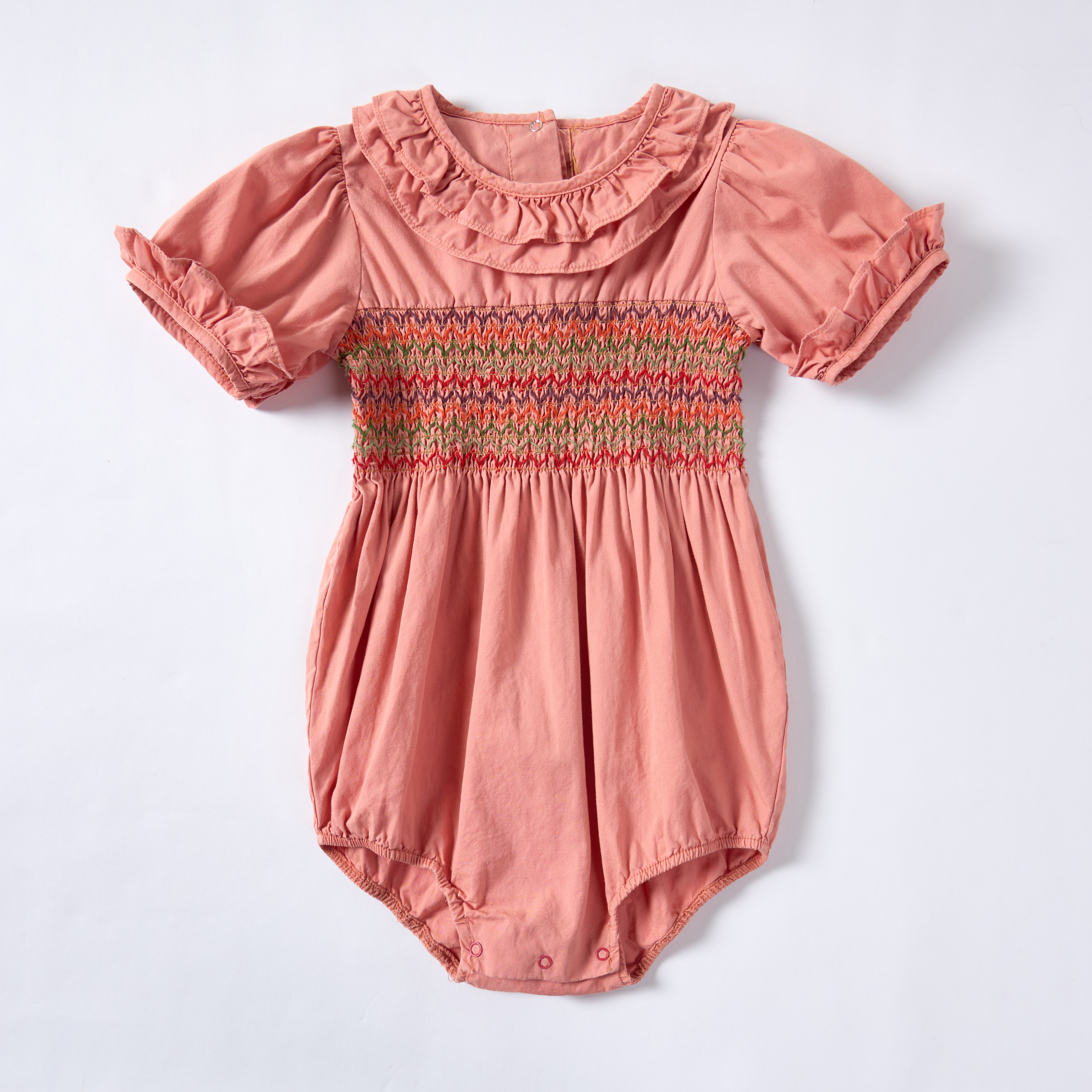
OEM/ODM Vintage 100% Cotton Smocked Baby Romper | Eco-Friendly Plant-Dyed Infant Jumpsuit | Custom Sustainable Ruffle Collar Newborn Bubble Bodysuit | Hand-Smocked Boutique Toddler Apparel Wholesale


- Overview
- OEM/ODM Smocked Plant-Dyed Cotton Baby Romper
- Recommended Products
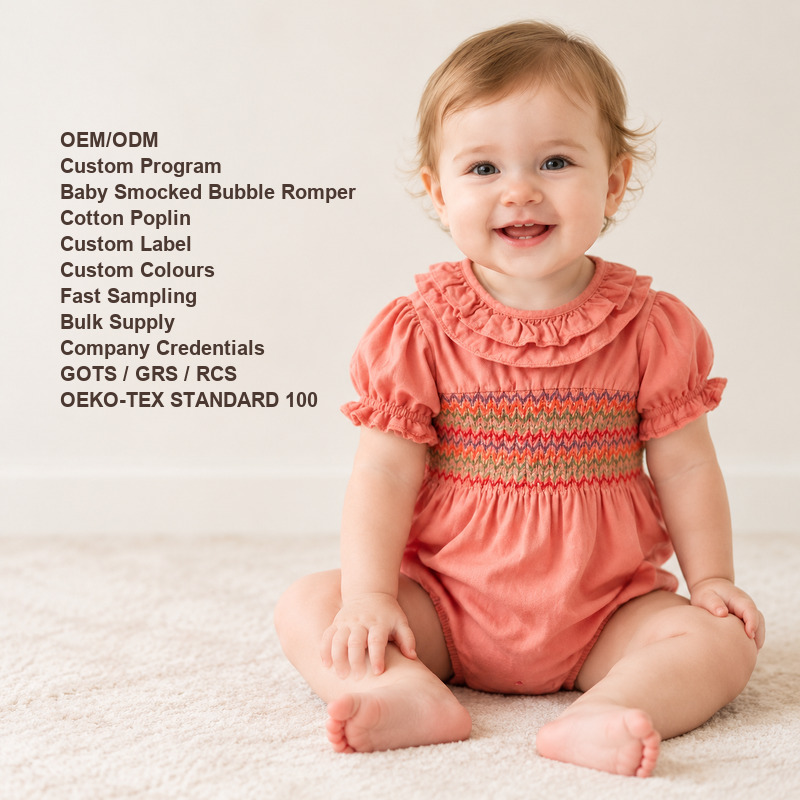
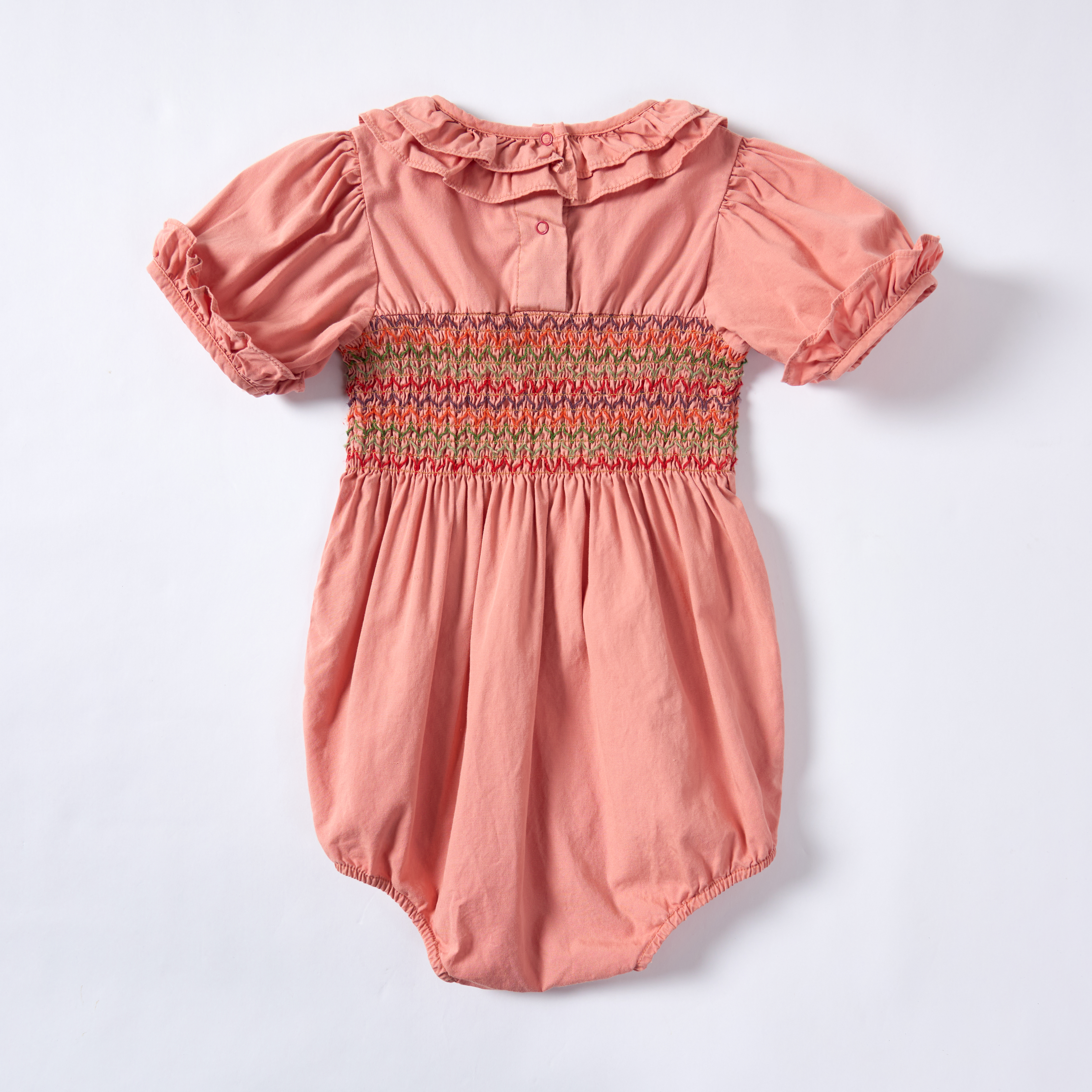
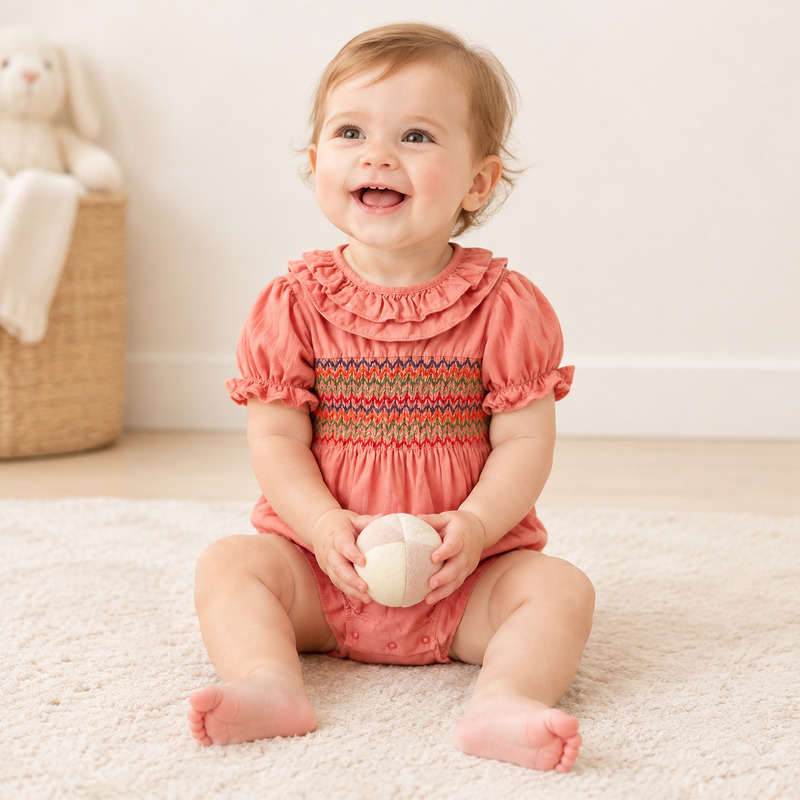
A short-sleeve bubble romper in 125 gsm cotton poplin, plant dyed to a salmon rose with sappanwood (苏木), madder (茜草) and pomegranate rind (石榴皮): a ruffle collar, puff sleeves gathered into a ruffle cuff, a smocked bodice worked in rows of wave stitch, a short back placket with one button, and a gathered bubble body closed at the crotch with snaps above elasticated leg openings.
The bodice is the same construction as the dresses in this range. What changes everything below it is that a bubble is a closed volume rather than a hanging skirt: the cloth has to be shaped, the leg openings have to clear a thigh without riding up, and the crotch closure is the part of the garment that gets used most in the first year. Those three facts decide the pattern, the trim and the tests.
At a glance
1. A bubble is a closed volume, and it is defined by three measurements
- Body length, crotch depth and leg circumference set the shape. Get one wrong and the garment fails visibly: too shallow and the bubble rides up into the nappy, too deep and it hangs like a sack, too tight at the leg and it marks the thigh.
- The volume is carried from the smocked band. Everything below the band hangs from one seam, so the body is cut to stay off the body rather than to fit it closely — there is no waist to take up slack.
- Cloth is never taut in a bubble. The gathers that make the volume are distributed rather than concentrated, because a single deep gather on a stiff poplin reads as a fold that never presses out, and on a warm mid-tone that fold catches light.
- Crotch depth is measured on the garment, not inferred from size. It is one of the dimensions checked on every size in the range, and it is the first thing a buyer measures when a sample comes back.
- The bubble has to hold its shape after washing. A volume that collapses into a flat bag is a construction failure, so the sample is washed five times and re-measured, not just inspected new.
2. The crotch closure is the most-used part of the garment
- Nappy changes go through the crotch, not over the head. That single fact reorders the whole risk list: the snaps are opened and closed more often than anything else on the garment, and they are opened by an adult in a hurry.
- So the closure is specified as a small part and tested as one. Retention and pull are measured on the finished garment, before and after wash cycles, because plating and setting both change with the first washes.
- Snap plating matters more here than on a dress. The snaps sit against damp cloth in a warm environment, and the plating has to resist corrosion without staining the dyed ground around the stud — a metal that discolours leaves a ring on a pale coral that no re-wash removes.
- The placket is a stack, and stacks are where a bubble puckers. Two plies plus the snap flange plus the leg elastic all meet at the same corner; the placket is graded and pressed at that point and checked for a flat sit, because a pucker there is both visible and abrasive.
- Reinforcement is a tape, not a second row of stitching. A stay tape spreads the opening load along the placket so the cloth around the outermost snap does not tear out over a season of use.
3. Leg openings: elastic in a channel, never a free cord
- The elastic is encased. It runs in a closed channel with no free ends and no loops, which is also what a cord-and-drawstring assessment expects of a garment in this age band.
- The specification is two circumferences, not one. Relaxed and stretched are both written down per size, with the shirring ratio between them, because a leg opening that passes a thigh when new and grips it after five washes has been specified by relaxed measurement alone.
- Clearance is checked on the largest size first. The thigh grows faster than the waist in this range, and the 24M and 36M sizes are where a leg opening that was comfortable at 12M becomes tight.
- The channel is cut on the bias of the shirring, not of the cloth. Distribution of the gather around the leg is what keeps the opening from spiralling, and a spiralled leg elastic reads as a twist at the side seam.
- Elastic is specified by type and by heat resistance, because a bubble is washed often and at whatever temperature the household uses; an elastic that relaxes early shows up as a leg opening that no longer holds.
4. The band carries the entire body
- On a dress the band holds a skirt; here it holds a volume. The panel-to-body join is the load path for the whole garment, so it is specified with a reinforcing stitch and inspected for puckering on every piece.
- Stretch is needed for dressing, not for changes. Because the crotch opens, the band only has to pass a head at dressing, which is why the gathering ratio can be set for a snug fit rather than for a generous one.
- That makes the head-clearance check the acceptance test. The panel is gathered to roughly two and a half to three times its finished width, and the ratio is set per size against head circumference plus clearance; recovery is checked on the sample and again after five washes.
- Band and body read as one colour, or not at all. Pleats hold shadow, so the band reads deeper than the flat bubble below it; colour is approved with the band and the body side by side, since on a mid-depth coral the step between them is easy to see.
- Rows are counted and pitched, and width is checked at three points per panel, because a drifting row pulls the panel into a trapezoid and the body hangs off-centre.
5. Plant dye and metal, in the same garment
- This is the one place in the range where dyed cloth and metal sit in permanent contact. The tannin that carries the colour is also what attacks a plated snap, and the damp, warm environment inside a nappy does the rest.
- So the snap is specified by plating and tested for both directions of the problem: corrosion of the snap, and staining of the cloth around it. A ring on the ground is a fault even where the snap itself is intact.
- Cloth pH is part of that specification. The dyed ground is held between 4.0 and 7.5, and a lot at the acid end of that band is harder on a plated part; pH is measured on the finished garment rather than assumed from the bath.
- Nickel release is confirmed for the EU market from the snap supplier's own test report, and the declaration travels with the lot rather than being filed once.
- The threads are conventional dyed threads, not plant dyed. The warm tones across the bodice come from conventional dye; the plant-dyed element is the ground cloth, and the smocking thread is tested as a skin-contact component to the same restricted-substance limits.
6. Fit above the band
- The band's upper edge sits at a fixed distance below the armhole per size, a dimension that does not scale by percentage, and the plain bodice above it is where a fit error shows first: long by a centimetre and the collar bunches, short and the band sits too high to stretch comfortably.
- The two-tier collar ruffle adds weight to a narrow neckline, so the neckline is stabilised and the upper tier cut narrower; a collar that gapes at the centre front is a weight problem before it is a sewing problem.
- Sleeve head gather is distributed in two passes against the armhole so the cap stays flat, and cuff band width, including whether the band carries elastic, is fixed in the tech pack because it changes finished sleeve length.
- One button at the back neck, tested at 70 N retention and checked against 16 CFR 1501 for the US market, on a placket faced so no raw edge sits against the neck.
- Grading follows weight as well as height in this range, so the bubble length and crotch depth are set from a measurement chart rather than a percentage step from the smallest size.
7. Tests, sizes, sampling and quoting
- Trim tests run on the finished garment: snap retention and pull before and after wash cycles, corrosion and cloth staining around the stud, leg elastic recovery after repeated washing, and button retention at the back neck.
- Fabric tests run at the shipped depth: light to ISO 105-B02, wash to ISO 105-C06 with the smocked panel in the load, rubbing to ISO 105-X12 across the smocked area and the crotch placket, perspiration and saliva to ISO 105-E04 plus the destination market's saliva method.
- pH is measured on the garment and held between 4.0 and 7.5, with phenol yellowing checked to ISO 105-X18 on a specimen carrying the actual packing fold and packaging specified free of BHT.
- Five sizes graded on a measurement chart: 6-9M, 9-12M, 12-18M, 24M and 36M move on chest, body length, crotch depth, leg circumference and head clearance; the panel is re-set per size because stretch does not grade like a seam.
- Customization. Single or double ruffle collar; plain neckline; smocking row count and stitch; thread palette; puff sleeve, plain short sleeve or sleeveless; snap placket with two or three snaps; elasticated or banded leg finish; and on the shade, a cleaner pink at lower rind or a dustier tone at higher rind.
- Sampling: 3-7 days from a confirmed tech pack, covering a dyed strike-off, one smocked panel with its body beside it, a fit check on the smallest and largest size with a nappy in place, snap retention and a corrosion and staining check, leg elastic measurement relaxed and stretched before and after five washes, crock and bleed on the smocked area, and a bubble-shape check after washing.
- Bulk: 30-60 days from approval, planned per dyebath, per thread lot and per snap lot, with cloth released only after pH, fastness and trim results are in hand.
- MOQ: 300 pcs for a custom development covering cloth, shade, smocking, trim or fit; 50 pcs for a decorative process on a stock body; 100 pcs for stock cloth with your own logo and label. Mixed colour and size orders are quoted per order, and terms are confirmed against the current quotation.
Production runs with our production partner, Suzhou Shelmin Trade Co., Ltd.: founded 2017, 7,200 m² workshop, 8 lines, 200 staff, 6,000 pieces per day. Design confidentiality is held under NDA; buyer patterns, shades and prints are not re-used.
To quote, we need: target market and the Class I tests it requires, including the nickel-release requirement if the snaps are to be sold in the EU; the snap type and plating, or a sample of the part you intend to use; leg elastic type and the relaxed and stretched circumferences you want; the shade target against the sealed standard; the thread palette; smocking row count and stitch; lot certificates for the three plants and for the thread; the pH target and the dyehouse water specification; packing method; and whether certification is to run in your brand name.