EN

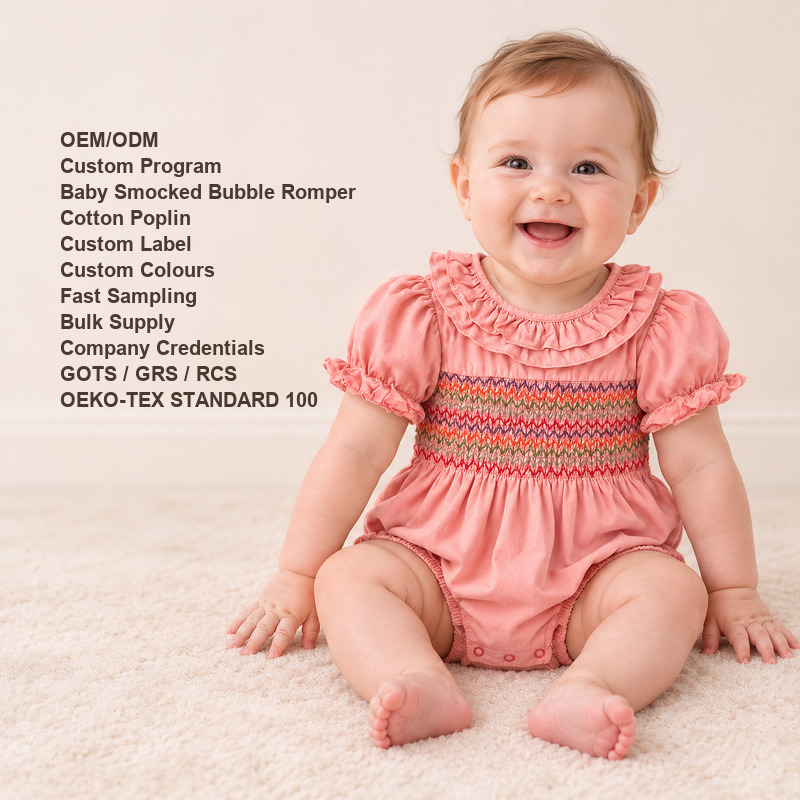
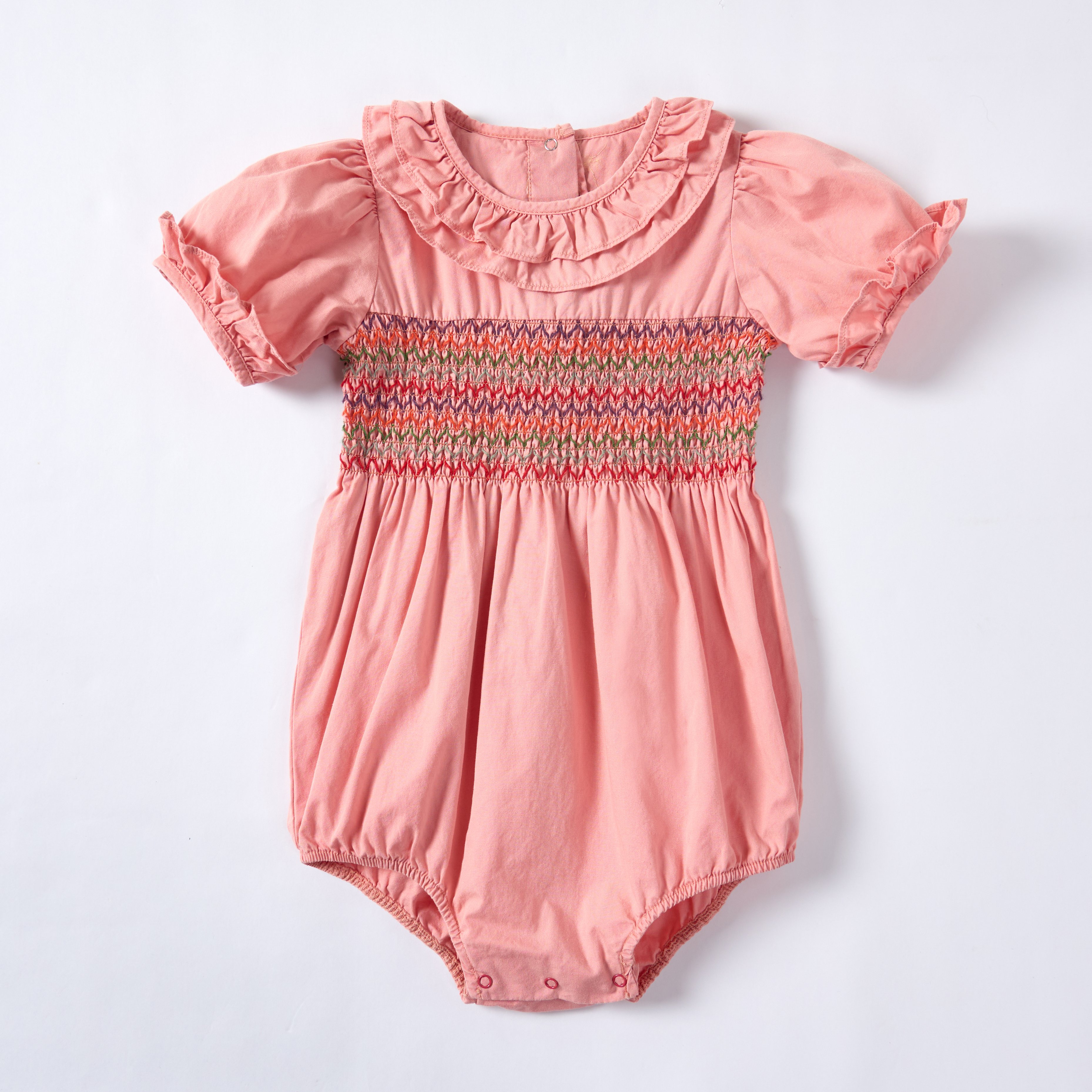
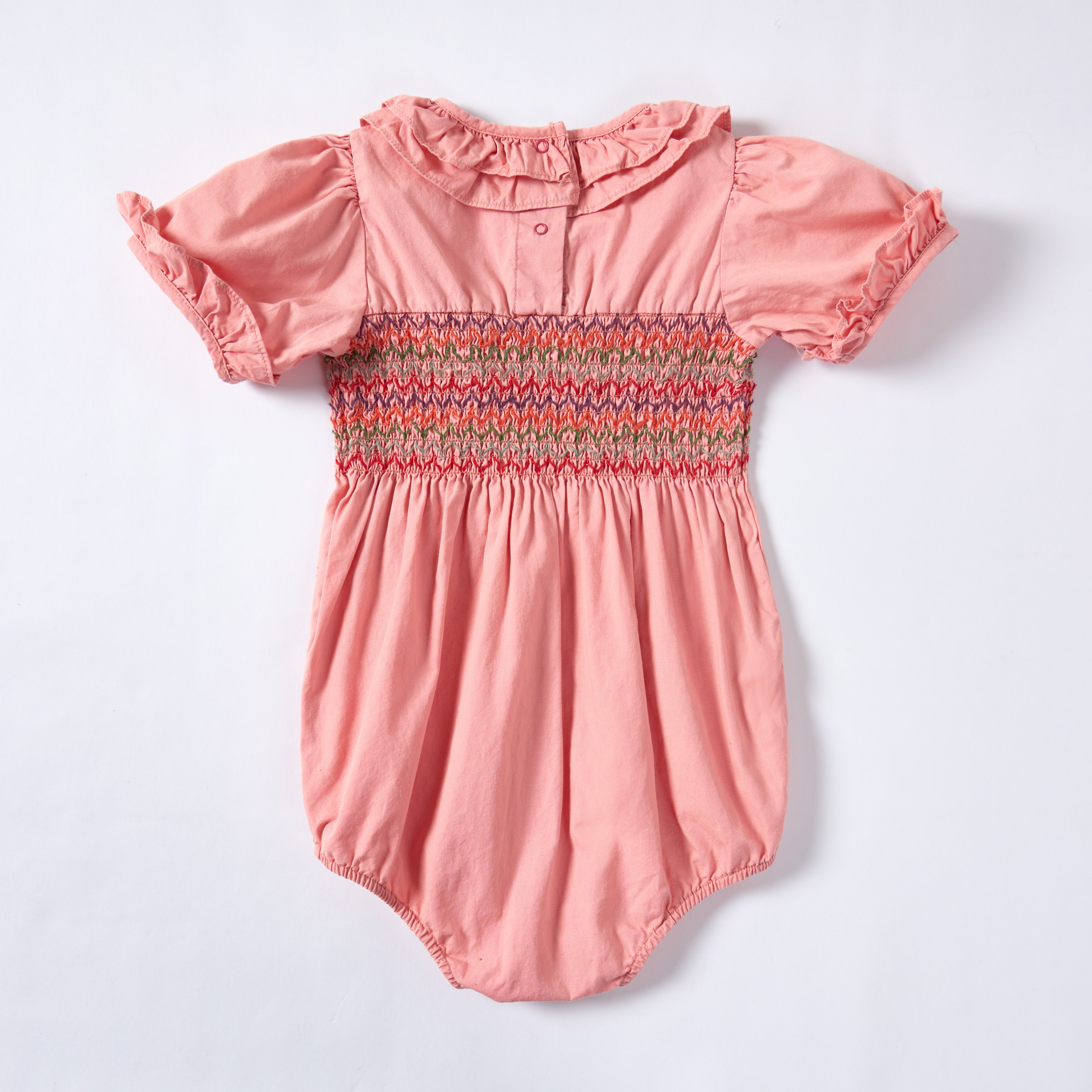
Baby 100% Cotton Poplin Smocked Bubble Romper, Plant Dyed Peach Coral (6-36M)


- Overview
- OEM/ODM Smocked Plant-Dyed Cotton Baby Romper
- Recommended Products
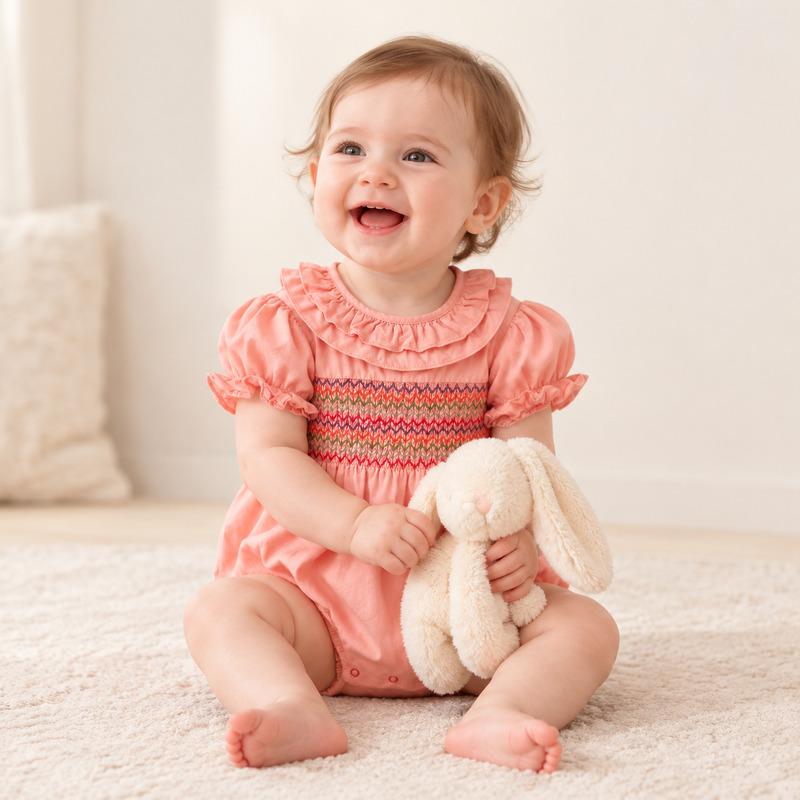
A short-sleeve bubble romper in 125 gsm cotton poplin, plant dyed to a peach coral with sappanwood (苏木) and madder (茜草) alone: a ruffle collar, puff sleeves gathered into a ruffle cuff, a smocked bodice worked in rows of wave stitch, a short back placket with one button, and a gathered bubble body closed at the crotch with snaps above elasticated leg openings.
Two reds and no tannin carrier is the least durable way to put colour on cotton, and a bubble romper is the garment that asks the most of that colour. There is no carrier layer, so the dye sits where the fibre's own affinity put it — near the surface — and a romper is rubbed, stretched and dampened at the crotch all day. So this page is about two things a dress page never has to answer: where a bubble wears through first, and whether a single layer of 125 gsm poplin actually covers at the seat.
At a glance
1. With no carrier, the colour sits where the fibre will let go of it
- Neither plant is a tannin. There is no layer under the reds, so what holds them is the affinity of the dye for cotton, taken up in passes; the colour ends up concentrated in the outer fibres rather than distributed through the yarn.
- That is fine on a garment that hangs. It is a design constraint on one that is used. A surface-held colour is removed by friction before it is removed by washing, so abrasion moves up the test list ahead of everything else.
- It also means the shade cannot be rescued by depth. Dyeing deeper does not push colour further into the fibre; it stacks more of the same on the outside, which comes off sooner and reads harsher.
- So the depth is agreed against the abrasion result, not against a colour target alone. The candidate shade is rubbed on the parts of the garment that actually wear, and the accepted depth is the deepest one that holds there.
- Colour is read on dried cloth under D65, because wet peach coral reads stronger than it will dry and a bath judged wet is always pulled lighter than the standard.
2. A bubble has a known friction map
- Three zones wear first, and they are predictable: the crotch placket where hands work the snaps, the leg opening where elastic and nappy meet the thigh, and the seat where the bubble rests against a nappy under a wriggling child.
- Abrasion is therefore tested zone by zone, not on a flat swatch. Rubbing runs on the placket, on the leg channel and on the seat, and each is assessed against its own unrubbed counterpart, because the three fail at different rates.
- The assessment is pale patches, not holes. A surface-held colour on peach coral lifts into a lighter haze long before the cloth weakens, and that haze is what a buyer will see in a returned garment.
- Dark colour on a fold makes it worse. Where the bubble gathers at the leg and at the band, a ridge carries the deepest part of the shade into contact and abrades first, so ridges are screened on every panel.
- Cutting is planned around the map. Panels for the placket and the leg channel are taken from areas with the most even, most fully built colour, since those are the zones with the least tolerance.
3. Coverage at the seat is a specification, not an assumption
- 125 gsm poplin is a light cloth for a single-layer seat. Dry, it covers; wet, a plain weave of this weight loses opacity, and a bubble that shows what is underneath is a return, not a design feature.
- So coverage is checked as a property, dry and wet, against a standard insert under D65, and the result is recorded per shade rather than assumed from the cloth's weight.
- Depth and coverage pull in opposite directions. A paler peach coral shows more through a damp single layer than a deeper one, which is one of the reasons this colourway is built to mid depth rather than to the lightest point the bath would allow.
- Where a buyer wants a lighter shade, the answer is construction, not chemistry: a second layer at the seat or a slightly heavier poplin, quoted as a variant rather than promised as the same garment.
- The same check applies to the front panel, because a bubble is worn without a vest as often as with one, and the front takes the same wetting.
4. The closure and the leg channel carry the rest
- Nappy changes go through the crotch, so the snaps are opened and closed more often than anything else on the garment; retention and pull are measured on the finished garment before and after wash cycles.
- The placket is a stack — two plies, snap flange and leg elastic at one corner — so it is graded and pressed for a flat sit, and reinforced with a stay tape that spreads the opening load rather than a second row of stitching.
- Without a tannin in the cloth, plating has an easier job than on a tannin-loaded shade, but the environment has not changed: damp cloth, warm and enclosed. Snap plating is still specified, and staining of the ground around the stud is still counted as a fault.
- Cloth pH is measured on the finished garment and held between 4.0 and 7.5, because a lot at the acid end of that band is harder on a plated part whatever the dyestuff was.
- Leg elastic is encased in a closed channel with no free ends, and specified as two circumferences — relaxed and stretched — with the shirring ratio between them; clearance is checked on 24M and 36M first, since the thigh grows faster than the waist in this range.
5. The band carries the whole volume
- On a dress the band holds a skirt; here it holds a closed body. The panel-to-body join is the load path for the whole garment, so it is reinforced and inspected for puckering on every piece.
- Stretch is needed for dressing, not for changes. Because the crotch opens, the band only has to pass a head, which is why the gathering ratio is set for a snug fit: two and a half to three times finished width, set per size against head circumference plus clearance.
- Recovery is the acceptance test, on the sample and again after five washes; a panel that stays stretched on a bubble pulls the body up under the arms rather than simply loosening a waist.
- Band and body read as one colour or not at all. Pleats hold shadow, so the band reads deeper than the flat body; colour is approved with the two side by side on one garment.
- Rows are counted and pitched and width is checked at three points per panel, because a drifting row pulls the panel into a trapezoid and the body hangs off-centre.
6. Fit above the band
- The band's upper edge sits at a fixed distance below the armhole per size, a dimension that does not scale by percentage, and the plain bodice above it is where a fit error shows first: long by a centimetre and the collar bunches, short and the band rides too high to stretch comfortably.
- The two-tier collar ruffle adds weight to a narrow neckline, so the neckline is stabilised and the upper tier cut narrower; a collar that gapes at the centre front is a weight problem before it is a sewing problem.
- Sleeve head gather is distributed in two passes against the armhole so the cap stays flat, and cuff band width, including whether the band carries elastic, is fixed in the tech pack because it changes finished sleeve length.
- One button at the back neck, tested at 70 N retention and checked against 16 CFR 1501 for the US market, on a placket faced so no raw edge sits against the neck.
- Grading follows weight as well as height in this range, so bubble length and crotch depth come from a measurement chart rather than a percentage step from the smallest size.
7. Tests, sizes, sampling and quoting
- Abrasion and trim tests run on the finished garment: rubbing on the crotch placket, leg channel and seat against unrubbed counterparts; snap retention and pull before and after wash cycles; corrosion and ground staining around the stud; leg elastic recovery after repeated washing.
- Fabric tests run at the shipped depth: light to ISO 105-B02, wash to ISO 105-C06 with the smocked panel in the load, rubbing to ISO 105-X12 across the smocked area, perspiration and saliva to ISO 105-E04 plus the destination market's saliva method.
- Wet and dry coverage at the seat and front is recorded per shade, since a pale ground and a light poplin are the combination where this has to be confirmed rather than argued.
- pH is measured on the garment and held between 4.0 and 7.5, with phenol yellowing checked to ISO 105-X18 on a specimen carrying the actual packing fold and packaging specified free of BHT.
- Five sizes graded on a measurement chart: 6-9M, 9-12M, 12-18M, 24M and 36M move on chest, body length, crotch depth, leg circumference and head clearance; the panel is re-set per size because stretch does not grade like a seam.
- Customization. Single or double ruffle collar; plain neckline; smocking row count and stitch; thread palette; puff sleeve, plain short sleeve or sleeveless; two or three crotch snaps; elasticated or banded leg finish; a seat lining or a heavier poplin where a paler shade is wanted.
- Sampling: 3-7 days from a confirmed tech pack, covering a dyed strike-off built to the agreed number of passes, the abrasion result on the three wear zones, a wet and dry coverage check, one smocked panel with its body beside it, a fit check on the smallest and largest size with a nappy in place, snap and elastic checks before and after five washes, and a bubble-shape check after washing.
- Bulk: 30-60 days from approval, planned per build run, per thread lot and per snap lot, with cloth released only after abrasion, coverage, pH and fastness results are in hand.
- MOQ: 300 pcs for a custom development covering cloth, shade, smocking, trim or fit; 50 pcs for a decorative process on a stock body; 100 pcs for stock cloth with your own logo and label. Mixed colour and size orders are quoted per order, and terms are confirmed against the current quotation.
Production runs with our production partner, Suzhou Shelmin Trade Co., Ltd.: founded 2017, 7,200 m² workshop, 8 lines, 200 staff, 6,000 pieces per day. Design confidentiality is held under NDA; buyer patterns, shades and prints are not re-used.
To quote, we need: target market and the Class I tests it requires, including the nickel-release requirement if the snaps are to be sold in the EU; the depth target and whether it is to be agreed against the abrasion result; the snap type and plating; leg elastic type and the relaxed and stretched circumferences you want; whether a seat lining is acceptable if a paler shade is required; the thread palette; smocking row count and stitch; lot certificates for both plants and for the thread; the pH target and the dyehouse water specification; packing method; and whether certification is to run in your brand name.