EN

OEM/ODM 100% Cotton Double-Layer Wrinkled Gauze Baby Bubble Shorts | Eco-Friendly Plant-Dyed 135gsm Toddler Bloomers | Custom Sustainable Botanical Dye Infant Summer Shorts with Side Bows Wholesale


- Overview
- OEM/ODM 135gsm Plant-Dyed Cotton Baby Bubble Shorts
- Recommended Products
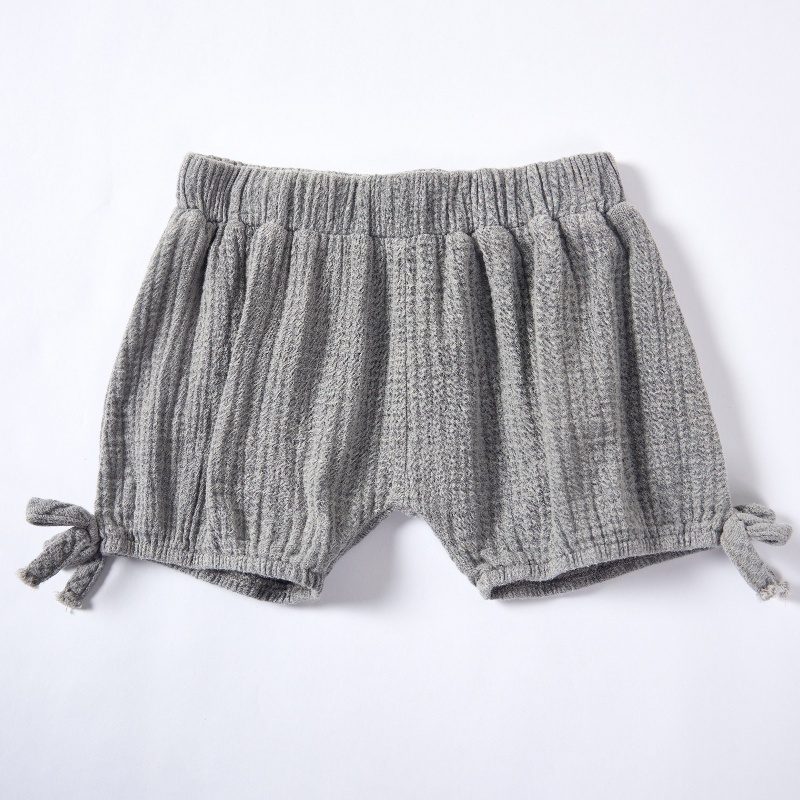
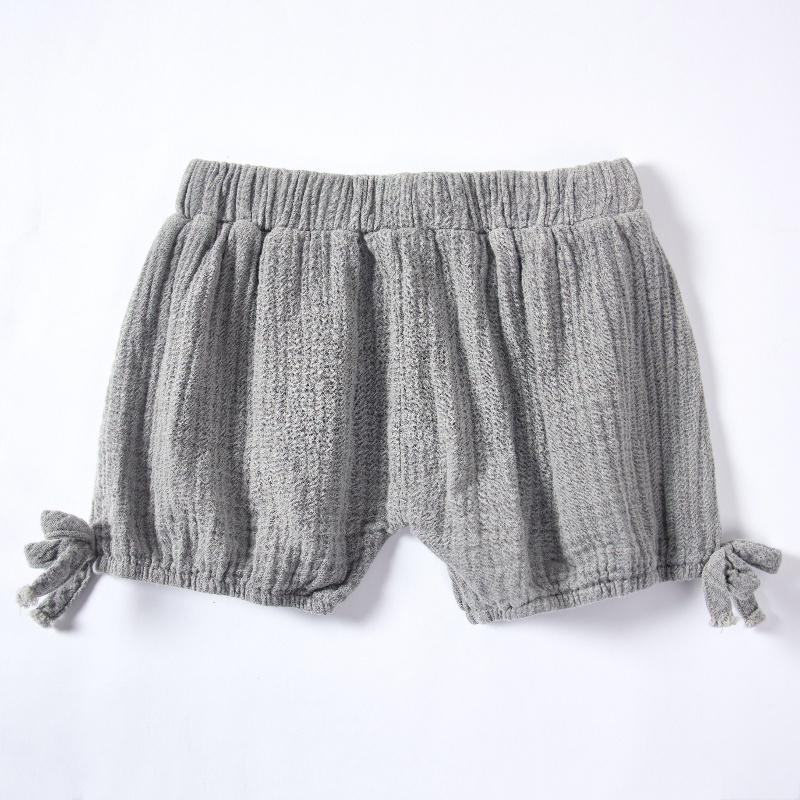
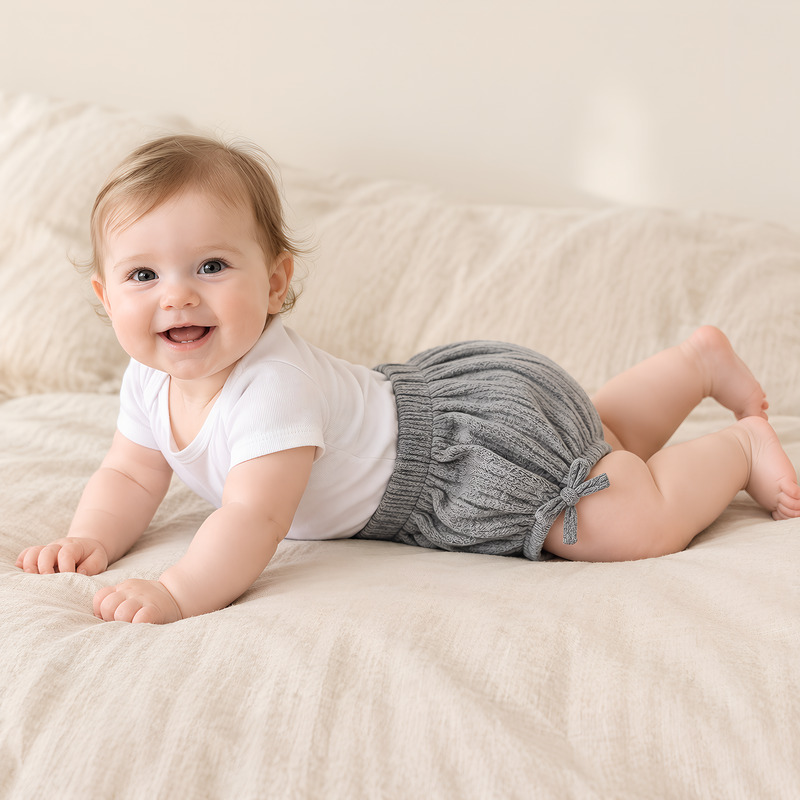
Baby bloomer shorts in a double-layer crinkled cotton, 135 gsm, dyed to an ash slate with gallnut (五倍子) and pomegranate rind (石榴皮) and finished in a ferrous second bath: a gathered paperbag waist on elastic, a full leg that closes at the thigh on encased elastic, and short self-fabric ties at the side seams.
This is the colourway in the range that runs a deliberate metal step, and it meets a cloth whose surface is folds rather than a plane. The two do not sit neutrally together: the tannin bath can soak a crease, but the iron that develops the grey has to reach the same place, and a compressed fold resists it. What follows is a colour where the texture stops hiding unevenness and starts writing it.
At a glance
1. Two baths, and the second one has to get inside the fold
- The tannin loads the cloth; the iron develops the grey. In this order only, because the iron needs tannin already in the fibre to complex with; reversed, the result is patchy and does not recover.
- The tannin bath soaks a crease easily. It is a large, slow molecule that sits on and in the fibre over time, and a fold that is wet long enough takes it.
- The iron bath is the one the fold resists. It has to reach the same fibre within the fold, and a compressed crease is the last place liquor arrives and the first place it drains from.
- Where the iron does not reach, the grey is not simply lighter, it is a different grey — cooler, greener, less developed — so the inside of a fold can read as a band of another colour rather than as a shadow.
- So the bath is built for penetration rather than strength: a full wet-out before the iron, cloth opened in the bath instead of packed, longer immersion with movement, and a fold that is not compressed against itself for the whole cycle.
- Adding iron to fix a pale fold makes the ridge darker and leaves the valley as it was — the bath is corrected by reaching further, not by dosing harder.
2. The texture writes the pattern instead of hiding it
- A dye that sits in the fibre can be masked by a crinkle, because folds break up a flat patch and the eye reads texture instead of unevenness.
- A two-bath grey is not masked that way. The unevenness is in hue as well as depth, and it follows the folds, so the crinkle prints its own banding onto the garment.
- That banding is either designed in or engineered out; it is not argued away later. The route is set so the folds are reached, and whatever banding remains is described on the sealed standard as a range rather than as an absence.
- The standard is therefore approved as a pattern. A photograph cannot carry it, so the sealed piece shows the deepest band and the calmest band on the same garment, and the buyer approves the range.
- It is read on the garment and on a flattened witness swatch cut from the same panel: the garment shows what a customer sees, the flattened piece shows whether the band came from the fold or from the bath.
3. The fold is also the weak point
- Iron-tannin chemistry stiffens cellulose and, overdosed, embrittles it. The damage shows first where the cloth flexes, and on a crinkle the flex points are every fold.
- So the strength bill lands exactly where a bloomer is stressed: the fold lines of the body, the gathered waist, the leg turn, and the crease across the seat where a child sits.
- Strength is tested against undyed cloth from the same greige lot, tensile and tear, so the loss from the process is separated from the variation in the cloth itself.
- The iron dose is capped as a ratio to the tannin measured on the cloth, not as a weight of powder, because an under-loaded tannin bath leaves unreacted iron behind.
- The rinse is verified before the garment is packed, since unreacted iron keeps working on the cloth after the order has shipped; the endpoint is the absence of unreacted iron, checked on the cloth rather than judged from the bath.
4. The grey keeps developing, and the crinkle makes that harder to read
- A tannin-iron grey continues to develop for days after drying, so the colour is approved after a defined resting period rather than off the line.
- On a crinkle the development is uneven by fold, because the amount of iron is uneven by fold, so a garment that reads correctly flat can read banded after resting.
- So the resting read is taken with the garment in the state it ships in, folded in its packing, and then opened and read under D65 against the sealed piece.
- Batches that look close on the line separate over the resting period, which is why each bath is read at the same point in its own rest rather than compared on the day of dyeing.
- The rest period sits inside the lead time. It is not slack in the schedule, and shortening it moves a colour difference from the factory to the customer.
5. Waist, legs and ties on the firmest hand in the range
- Tannin and iron together leave the firmest hand of any colourway here, which is felt in the fall of the bloomer and in how the gathers sit.
- The waist gathers a double-layer cloth onto elastic — four plies plus elastic at one seam, on a cloth that does not drape into the gather by itself, so the gather is graded and pressed and the needle and feed are set for the bulk.
- Elastic is specified as relaxed and stretched circumference per size at the waist and both leg openings, with recovery checked after repeated washing; a firm cloth does not forgive a weak elastic.
- Leg clearance is checked on the largest size first, since thigh growth outpaces the waist in this range.
- The ties are a children's-wear item: short, attached at both ends, unable to form a loop, held within the cord limit for the market against the 13 cm figure used for this size range; on this hand the tie holds a knot well, which is why it keeps its width.
6. Two plies, and a dry inside that keeps changing
- A double layer takes the iron bath at different rates at face and back, and the inner ply is where a weak pass hides.
- The inner ply is visible at the waistband turn and the leg turn, so both plies are graded against the standard there rather than only on the face.
- A two-ply cloth dries from the outside in, so the inner ply stays damp longer and keeps developing after the face has settled; drying time is specified per weight, and the resting period starts from the inside being dry rather than the outside.
- A step between plies on a grey reads as a band rather than a shadow, and at the waist turn it is the first thing seen when the garment is held up.
7. Tests, sizes, sampling and quoting
- Fabric tests at the shipped depth: light to ISO 105-B02, wash to ISO 105-C06 with a whole garment in the load, rubbing to ISO 105-X12 on flat areas and through creases, perspiration and saliva to ISO 105-E04 plus the destination market's saliva method, with colour read on both plies.
- Strength against undyed same-lot cloth: tensile to ISO 13934-1 and tear to ISO 13937-2, with the fold lines and the gathered waist tested rather than averaged into one body result.
- Iron route records: tannin measured on the cloth, iron dose as a ratio to it, immersion and rinse logged per bath, and the rinse endpoint checked on the cloth before packing.
- Colour is read after the defined resting period, in the packing state, on the garment and on a flattened witness swatch from the same panel.
- pH is measured on the garment and held between 4.0 and 7.5; extractable heavy metals are tested on the finished garment rather than on the cloth, which is the relevant check for this colourway; phenol yellowing is checked to ISO 105-X18 with packaging free of BHT.
- Trim and safety checks: waist and leg elastic relaxed and stretched circumferences, elastic recovery after repeated washing, tie length against the cord limit, tie attachment strength, and a loop check on the finished garment.
- Relaxation and dimension change after washing, recorded as length, width and rise before and after the wash sequence, with waistband and ties dimensioned in the relaxed state.
- Five sizes on a measurement chart: 6-9M, 9-12M, 12-18M, 24M and 36M move on waist, rise, leg opening and outseam, measured in the relaxed state and confirmed after washing.
- Sampling: 3-7 days from a confirmed tech pack, covering a dyed strike-off with its bath sequence and resting period stated, a made-up bloomer washed once and re-measured, a fit check on the smallest and largest size with a nappy in place, an inner-ply read at both turns, a strength comparison on fold lines, a banding range for approval on the garment and the flattened swatch, elastic and tie checks, and the packed resting read.
- Bulk: 30-60 days from approval, planned per dyebath, with cloth released only after both-ply colour, strength, rinse and resting results are in hand.
- MOQ: 300 pcs for a custom development covering cloth, shade, crinkle level, trim or fit; 50 pcs for a decorative process on a stock body; 100 pcs for stock cloth with your own logo and label. Mixed colour and size orders are quoted per order, and terms are confirmed against the current quotation.
Production runs with our production partner, Suzhou Shelmin Trade Co., Ltd.: founded 2017, 7,200 m² workshop, 8 lines, 200 staff, 6,000 pieces per day. Design confidentiality is held under NDA; buyer patterns, shades and prints are not re-used.
To quote, we need: target market and the Class I tests it requires, including the cord and tie requirement that applies there; the crinkle level you want, as crease count and depth per unit; whether the residual banding along the folds is acceptable as a range, or the route should be set to minimise it; the strength result the cloth must hold after the iron step; the acceptable post-wash length change; waist and leg elastic type with relaxed and stretched circumferences; tie finished length and width; gallnut and rind lot certificates with tannin content; the pH target and the dyehouse water specification; packing method; and whether certification is to run in your brand name.