EN

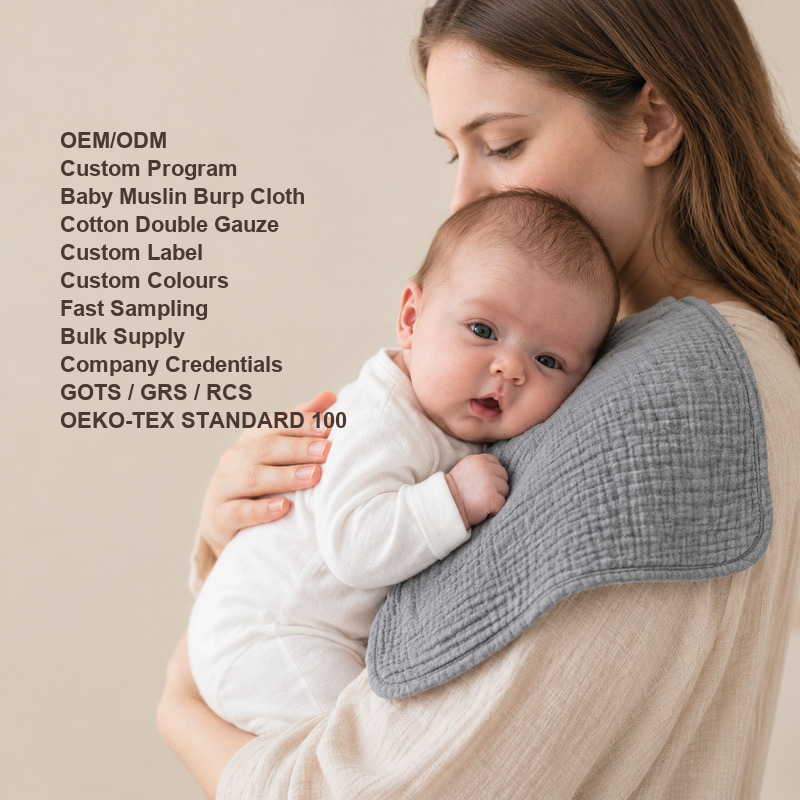
OEM/ODM Premium Baby Burp Cloth | 100% Organic Cotton Plant-Dyed Muslin Washcloth | Eco-Friendly Non-Toxic Botanical Dye Infant Spit-Up Rag for Private Label | Highly Absorbent Sustainable Nursery Essential | Manufacturer


- Overview
- Plant Dyed Cotton Burp Cloth, Pomegranate Grey | OEM
- Recommended Products
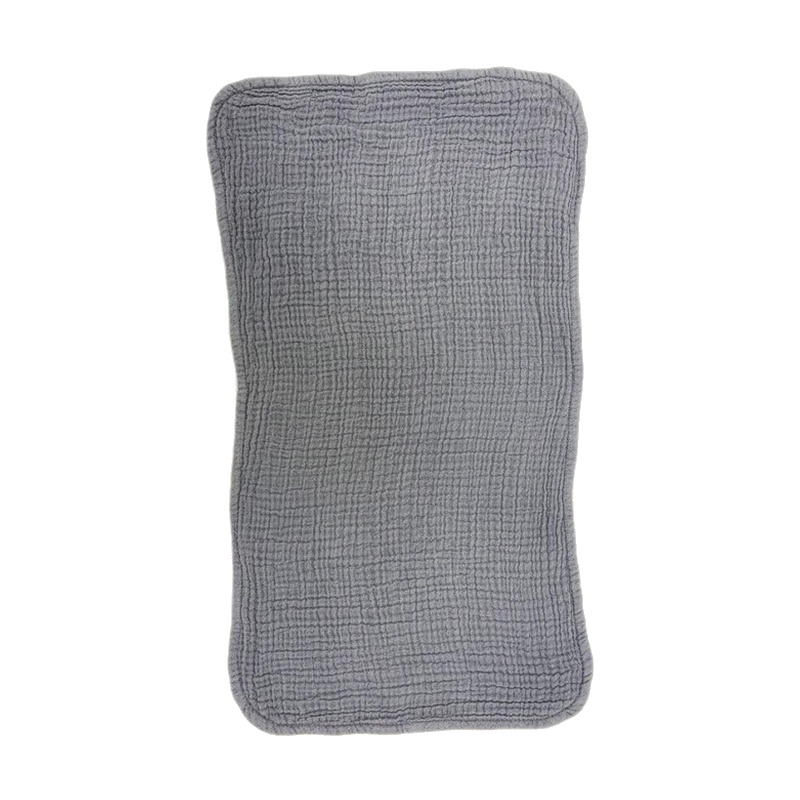
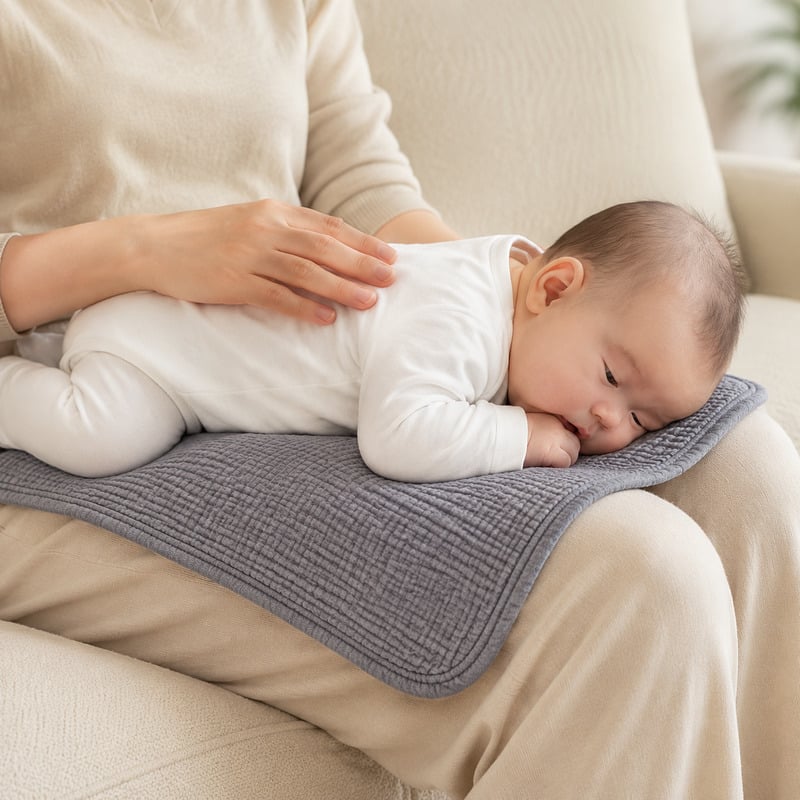
A burp cloth in a 100% cotton double-layer crinkle gauze at 135 g/m², cut to a rectangle with rounded corners and a narrow turned hem, dyed to a solid grey-lilac shade with pomegranate peel. No resist, no brushwork, no pattern: the evenness of the shade is the whole of the design, and on this cloth evenness is not a flat thing.
There is one thing to settle before anything else. Pomegranate peel is rich in tannins, and a tannin on cotton normally reads khaki, olive or brown — not grey. A cool grey-lilac of this kind usually means the peel was worked with a mordant that shifts tannin toward grey, and which mordant, at what strength, is a line in the dyehouse's record rather than something to be read off a photograph. So the page states the shade as seen and the dyestuff as ordered, and leaves the route to the documents: the colour is approved on cloth, and the recipe is confirmed at quotation.
At a glance
1. Pomegranate peel reads khaki; this cloth reads grey
- Tannins are the reason pomegranate peel works on cotton at all. Cotton has little natural affinity for most plant colour, and a tannin-rich material is one of the few that fixes to it without the cloth first being modified; that is why peel, gall and bark have been used on cellulose for as long as they have.
- But a tannin on its own is a warm colour. Khaki, olive, brown, depending on concentration and water; a cool grey-lilac is not what peel gives unaided, so something else in the route is doing the work.
- The usual lever is the mordant, and a greying mordant also changes how the colour behaves later: it can deepen the shade and it can shift how the cloth reads under different light.
- So the order needs two lines rather than one. The dyestuff is pomegranate peel, which is what was asked for; the shade is grey-lilac, which is what was approved on cloth; the mordant is the line that connects them, and it belongs in the dyehouse documentation rather than in an inference from the material name.
- That matters commercially, because a buyer re-ordering "pomegranate peel" from a different dyehouse will not get this grey; what reproduces this piece is the recipe, held as a record and as a retained swatch.
2. What looks like mottling is shadow
- The field is evenly dyed and still looks uneven, because the cloth is a field of small domes: the crest of each cell faces the light and reads pale, the valley around it holds shadow and reads dark.
- That is a relief pattern, not a dye fault, and it is permanent: no amount of re-dyeing removes it, because it is the shape of the cloth rather than the distribution of pigment.
- It also means a photograph of this cloth exaggerates unevenness. A camera flattens the relief into tonal blotches, which is exactly what an uneven dye lot would look like, so the two cannot be told apart from an image.
- The distinction is easy to make in the hand: tilt the cloth. If the dark areas move as the angle changes, they are shadow; if they stay where they are, they are in the dye.
- This is the single most useful thing to know when approving a solid shade on a textured cloth, and it is the reason the approval is on cloth rather than on a file.
3. Evenness is measured cell to cell, not across the field
- The pucker hides small faults and exposes large ones. A variation the size of a coin disappears into the grid; a drift across half the piece does not, because the eye compares regions rather than cells.
- So inspection runs at two distances. Close up, the question is whether neighbouring cells agree with each other; at arm's length, whether the two ends and the two sides agree with each other.
- Those are two different tests and they fail differently. Close-up failure means the liquor did not penetrate evenly into the folds; distance failure means the piece moved through the bath unevenly, or dried unevenly, or was folded wet.
- The cloth also has to be read dry. A wet piece is darker, cooler and more uniform than it will be, and a shade approved wet is a shade that will be rejected on the line.
- Which fixes the approval protocol: dry, on a flat surface, under the light it will be sold under, at both distances, and then once more after the first wash.
4. The hem is the only flat part, so it is where the colour is read
- Folding and stitching the hem presses the pucker out of a narrow band, so the cloth there is flat and doubled at the same time.
- That makes the hem the most honest patch on the piece: flat enough to read as a colour, dense enough to hold it, and the one place where the shade is not competing with shadow.
- On the sample the hem reads slightly deeper than the field, which is what a doubled, compressed band normally does; the difference is a property of the construction rather than a fault in the dyeing.
- So the hem is where a shade is compared to a swatch, and where a batch is compared to the previous batch; the field is where the grid is judged.
- The hem is also the wear line, since it is what gets gripped and wrung and what rubs against a shoulder, so the same band that reads deepest is the one that will lighten first.
5. Two faces, one bath, and a difference worth naming
- Both layers are wet through in the same bath, so both faces carry the shade rather than one being worked and the other left.
- They do not read identically, because only one face is against the light at a time and the pucker on the reverse sits the other way up, so the crests and valleys swap.
- For a burp cloth that is a practical point rather than a technical one: both sides get used within a minute of each other, and a cloth whose two faces read as two different shades will be noticed by the person using it.
- So the shade is approved on a named face, and the reverse is checked against it rather than against the swatch, which is how a two-face difference is caught before it becomes a complaint.
- The join points are where the two faces are in contact, and they are the only places where a difference in penetration between the layers can be seen at all.
6. Grey is a colour that keeps a record
- A mid grey-lilac sits exactly where milk, saliva and the ordinary marks of a feeding day show most clearly, and where a wash shows as a change rather than as a reset.
- That is not automatically a fault. A pale middle tone looks the same after fifty washes as after five, which is a real advantage over a white cloth that yellows unevenly; but it also means a mark is visible while it is there.
- The direction of change is worth stating: tannin shades generally deepen and grey slightly with washing and with light rather than fading out, so the cloth will move toward a cooler, flatter grey over its life rather than toward its original tone.
- Which is an argument for approving the shade after a wash and a short light exposure, not on the day it comes off the line, since the approved sample will not be the colour the customer first sees for long.
- And an argument for keeping the retained swatch in the dark, because a reference left on a windowsill is not a reference.
7. Sizes, sampling and quoting
- One size, with the dimensions fixed per order: length, width, corner radius, hem width and the finished depth.
- Customization. The depth of the shade; the mordant route, quoted as two products if more than one is on the table; whether the shade is matched to a swatch you hold or developed from the dyestuff; the corner radius; the hem width; the dimensions; and whether the cloth is supplied flat or pre-washed.
- Sampling: 3-7 days from a confirmed tech pack, covering a set of two or three pieces approved dry, under the selling light, at both distances, on a named face, and again after one wash; the hem compared to the swatch; the reverse checked against the face; and the shade re-read after a short light exposure.
- Bulk: 30-60 days from approval, dyed in batches with the mordant route, liquor ratio, dwell and drying method recorded per batch against a retained swatch; AQL 2.5 major and 1.0 critical.
- MOQ: 300 pcs for a custom development covering cloth, shade, mordant route or dimensions; 50 pcs for a decorative process on a stock cloth; 100 pcs for stock cloth with your own logo and label. Mixed orders are quoted per order.
- For a baby product the test list is not a formality. The faces of this cloth meet a chin and a shoulder, so the tests that matter are the ones for what a mouth leaves behind, and the saliva test is the one that covers it; which tests apply, at what limits, and whether they run in your brand name are set by the destination market and confirmed against the report at quotation.
Production runs with our production partner, Suzhou Shelmin Trade Co., Ltd.: founded 2017, 7,200 m² workshop, 8 lines, 200 staff, 6,000 pieces per day. Design confidentiality is held under NDA; buyer shades, recipes and patterns are not re-used.
To quote, we need: destination market and the age group it will be sold for; the Class I scope you need and the test list that comes with it; the dyehouse documentation for the pomegranate peel and the mordant, including the mordant identity and strength; whether the shade is to be matched to a swatch you hold; length, width and corner radius; hem width; whether the cloth is supplied flat or pre-washed; the certificate held for the cloth and the scope you need; the lot certificate for the dyestuff; the pH target and the dyehouse water specification; packing method; and whether certification is to run in your brand name.