EN

OEM/ODM Custom Pet Hoodie | 100% Cotton Organic Plant-Dyed Dog Sweatshirt | Eco-Friendly Non-Toxic Botanical Dye Brush Stroke Print Cat Apparel for Private Label | Sustainable Breathable Puppy Pullover | Boutique Supplier


- Overview
- Custom Brushed Plant Dyed Pet Hoodie, Yellow & Indigo | OEM
- Recommended Products
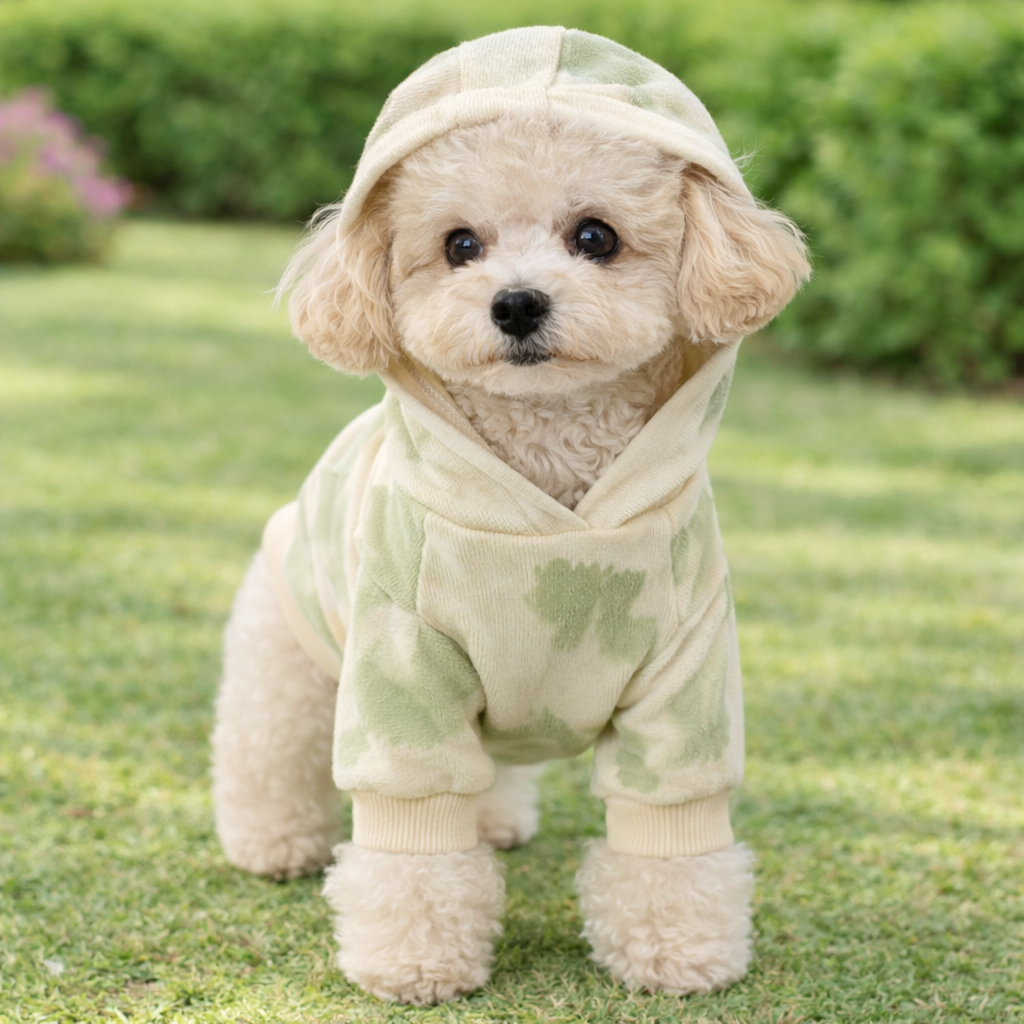
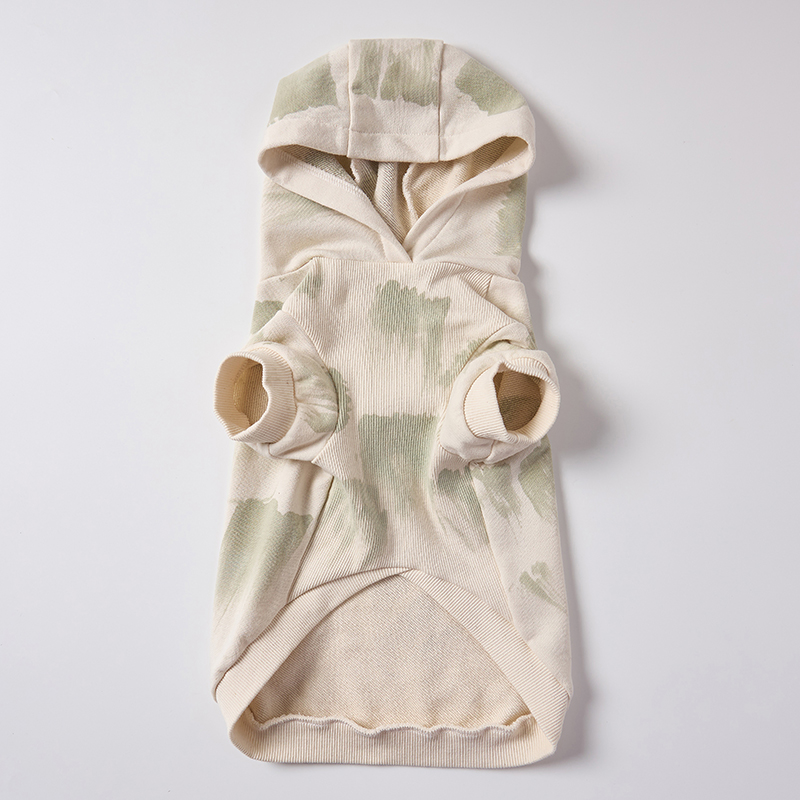
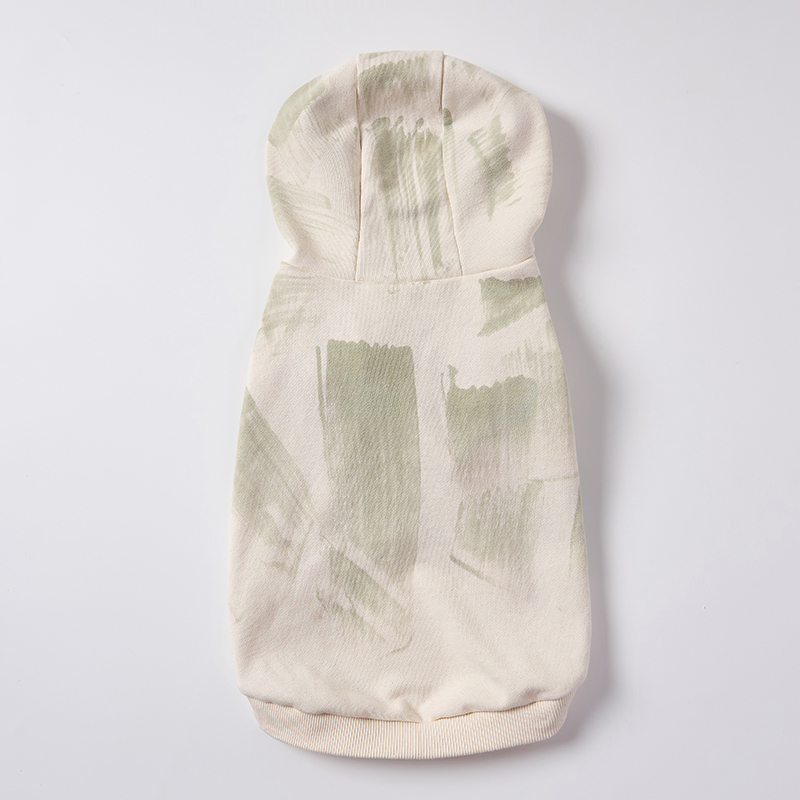
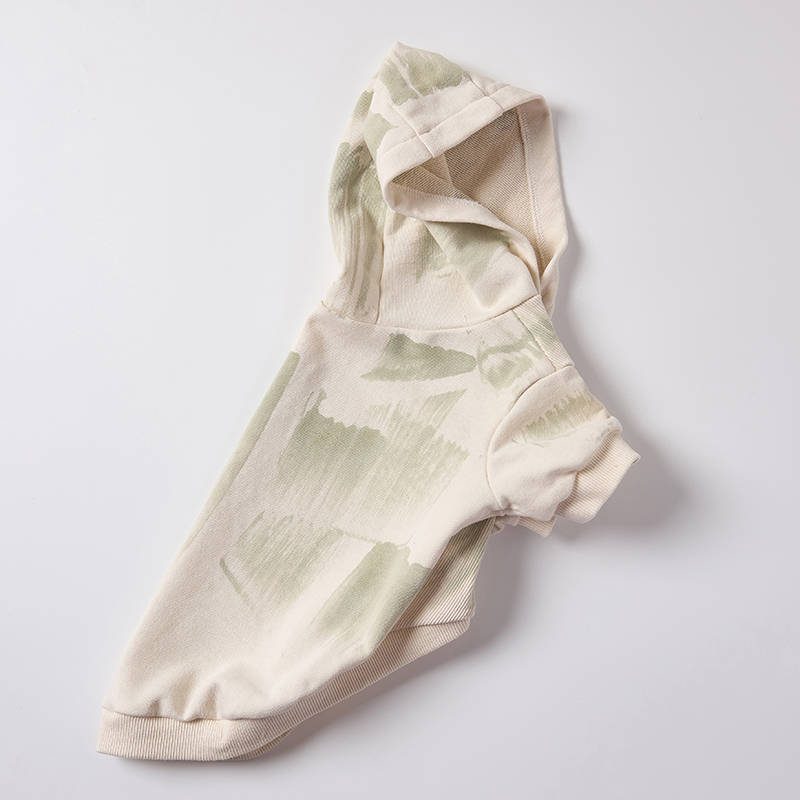
A hooded sweatshirt for a small dog or a cat, in a 100% cotton knit with a fine vertical wale and rib at every edge, carrying a pale cream ground and soft sage-green patches. The pattern was not printed onto the cloth and the cloth was not dipped in it: it was brushed on by hand, patch by patch, with a yellow from sophora buds and a blue from Isatis laid over it.
That single fact decides most of what a buyer needs to know here. A screen prints the same shape at the same place on every piece and a dye bath colours the whole piece at once; a brush does neither. The pattern sits in a hand rather than a tool, so the order is written as a range and approved as a set, and the places where the brush stops - the rib, the seams, the inside face - are where the specification has to be exact.
At a glance
1. A brush makes every repeat a range
- The pattern is carried by a loaded brush rather than a screen or a bath, so no two pieces hold the same patch in the same place, and an order written as a position is missed on every piece.
- What can be specified is the envelope, not the map: how much of the surface the patches cover, the largest patch allowed, how soft the edge is, and which areas stay pale. Those four numbers reproduce a family of pieces; a drawing reproduces one.
- Approval is on a set rather than a single garment, because the question a buyer asks - whether the range looks like one product - is answered across two or three pieces made together.
- The two sleeves do not carry mirrored patches and no part of the process makes them; on an animal they are seen from one side at a time.
- The hand is also the capacity limit: a brushed order is paced by trained hands rather than machines, which is why it carries a minimum and a longer sampling window than a print.
2. The blue reads green until it oxidises
- Isatis gives indigo, and indigo does not colour the fibre in the way a yellow does: it is brought into a soluble reduced state, taken up by the cloth, and turns blue only as the air oxidises it back into an insoluble pigment that sits on the fibre.
- Wet, the brushed blue is yellow-green and nothing like the finished shade; a colour judged at the table on damp cloth is a colour rejected at the wash.
- So the order cannot be shortened: brush, hang to oxidise, dry, wash, then judge. What gets approved is the shade after the first wash, because indigo keeps losing surface pigment and settles below where it started.
- Because the pigment sits on the surface rather than inside the fibre, a light pass over a pale ground reads dusty rather than saturated: hence the sample's green is soft and broken rather than solid, a property of the technique, not a faded batch.
- The oxidised result also depends on dwell and air temperature, so both are written into the route: two batches that hang for different times are two shades even from the same hand.
3. Yellow and blue cannot share one paste
- Sophora yellow needs a mordant on cotton, because cellulose has little natural affinity for it, while indigo needs an alkaline reducing bath. The two conditions pull against each other, so one pot cannot hold both and no single paste makes this green.
- The green is built in sequence: the yellow is applied, mordanted and dried, then the blue goes over it, and what the eye reads as green is two layers rather than a green pigment.
- That separates the controls: yellow strength sets the temperature of the ground, the number of blue passes sets the depth of the patches, and the two are adjusted and quoted independently.
- A green order is a two-pass order with a dry between, its cost sitting in the passes rather than in the dyestuff alone.
- The mordant applies to half the pattern only, and that half shifts first in washing and light while the blue fails by rubbing off, so the two are tested differently.
4. Where the paste stops: the rib, the seam, the inside
- On this sample all four rib positions are clean. The cuffs, the rear hem, the opening edge and the hood's front band carry the pale ground and no patch at all.
- That is a decision, not an accident. Rib has relief and stretch: a wet paste blurs across it, the edge cannot be held, and pigment in the channels reads darker than the field beside it. A pale rib gives a clean edge where a hand touches the garment.
- The patches also break at the seams. Across the hood's centre seam and at the armhole the shapes do not continue as one form; whether panels are brushed flat before making up or on the garment after it is a route decision, visible at every seam and fixed before sampling.
- The inside face stays on the ground, as the reverse seen through the cuff opening and the underside opening shows: a brush works one face.
- On a pet garment that matters twice: the inside meets the coat and is where loose colour is read, so the reverse is a specification line.
5. What a pale ground costs
- The cream is the yellow at low strength, not an undyed cloth, so the ground is a dye result and carries its risks: it can shift between lots, and it is the shade that shows a shift first.
- A pale ground on a garment that goes outdoors shows soil at once, first at the cuffs, rear hem and opening edges, all low and all pale.
- It is also the crock detector. Surface pigment coming away from a brushed patch shows on a cream field immediately, which is why crock is read on the inside and at the cuffs rather than mid-back.
- Pale yellow is the least forgiving depth to hold: small differences at low strength are hard to see at the table and easy side by side, so the lot reference is kept as cloth, not a photograph.
6. Brushing changes the colour, not the fit
- Fit is set by the forelegs. A dog does not swing a foreleg from a fixed socket: the leg moves under a shoulder blade that slides, so the armhole does not sit where a human armhole sits and a sleeve drafted on human logic binds at the first stride. Depth and angle carry the pattern, not length, and it is checked on a moving animal.
- The hood's front edge is a measurement. The folded band sets how far forward it can travel, a centimetre puts it on the brow and another covers the eyes, and because the hood carries weight at the neck the rear hem's rib tension is tuned against it. On the wearer shown, the band crosses the skull just above the brow with both ears hanging outside the opening: the drop-eared case. An opening drafted for ears that stand up is a different pattern.
- The rib serves four purposes and none is decoration: the cuffs grip, the rear hem holds the body back, the opening edge keeps the underside from curling and the hood band keeps the hood off the eyes, each with its own tension target.
- Brushing adds one fit risk. A paste carries a thickener and leaves pigment on the surface, so heavily brushed cloth flexes a little less; on a sleeve that is the shoulder, which is why the sleeve set is fitted on brushed cloth rather than greige.
- Hence the sample is fitted after the dye, and a change of coverage counts as a fit change for the sleeves.
7. Sizes, sampling and quoting
- Two sizes graded on measurements: S and M move on chest girth, back length, neck opening, hood depth and hood opening circumference, sleeve set and angle, cuff diameter, and the length of the underside opening.
- Customization. Patch coverage as a percentage of the visible surface; the largest patch size; edge softness; which positions stay pale, with the rib pale at all four on this sample or brushed on request; the number of blue passes; the strength of the yellow; the mordant route quoted as two products, each sealed on its own reference set; sleeve length and set; cuff diameter in both states; hood depth and the position of its front edge; the length of the underside opening; and whether panels are brushed flat or the garment after make-up.
- Sampling: 3-7 days from a confirmed tech pack, covering a brushed set of two or three pieces approved on the oxidised, dried and washed result; both sizes fitted on a moving animal with the hood up; cuff measured relaxed, stretched and over a paw; crock read inside and at the cuffs after the first wash; every rib re-measured after washing; and the underside opening checked for an edge that does not curl.
- Bulk: 30-60 days from approval, brushed in batches by trained hands with pass count and coverage recorded per batch against a retained cloth reference; AQL 2.5 major and 1.0 critical.
- MOQ: 300 pcs for a custom development covering cloth, shade, brush motif or fit; 50 pcs for a decorative process on a stock body; 100 pcs for stock cloth with your own logo and label. Mixed colour and size orders are quoted per order.
Production runs with our production partner, Suzhou Shelmin Trade Co., Ltd.: founded 2017, 7,200 m2 workshop, 8 lines, 200 staff, 6,000 pieces per day. Design confidentiality is held under NDA; buyer patterns, shades and brush motifs are not re-used.
To quote, we need: destination market and what it requires for pet textiles; the dyehouse documentation for both dyestuffs and the mordant; the coverage ratio and largest patch size you accept, with two reference pieces if you have them; whether the rib stays pale at all four positions; whether panels are brushed flat or after make-up; the number of blue passes and the strength of the yellow; chest girth, back length and neck-to-cuff for S and M; hood depth and its front edge position; cuff diameter in both states; the length of the underside opening; the certificate held for the cloth and the scope you need; lot certificates for both dyestuffs; pH target and dyehouse water specification; packing method; and whether certification runs in your brand name.