EN

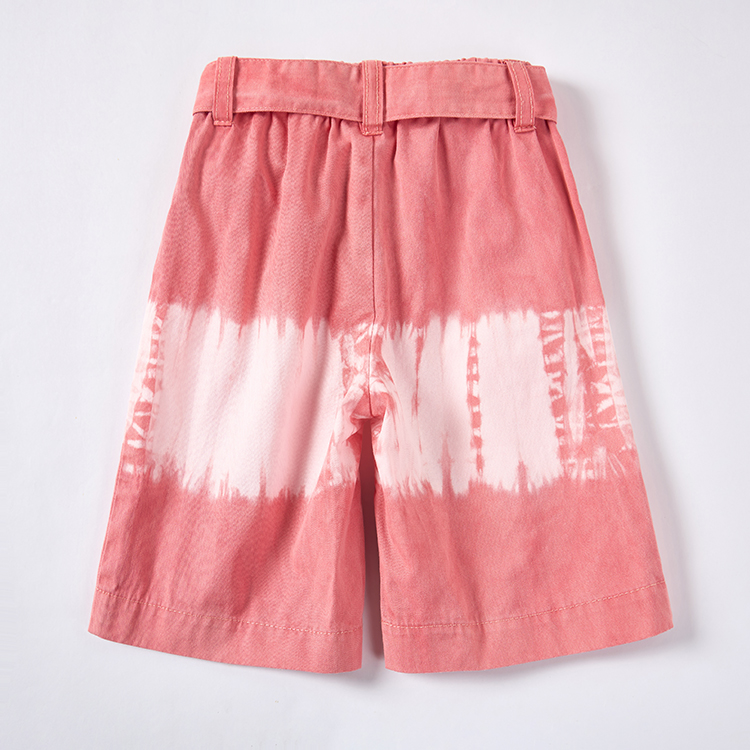
OEM/ODM 100% Cotton Girls Wide Leg Shorts with Bow Belt Natural Plant Botanical Dyed Tie Dye Kids Summer Elastic Waist Culottes Custom Wholesale Private Label


- Overview
- OEM Custom 100% Cotton Plant Dyed Girls Tie Dye Shorts
- Recommended Products
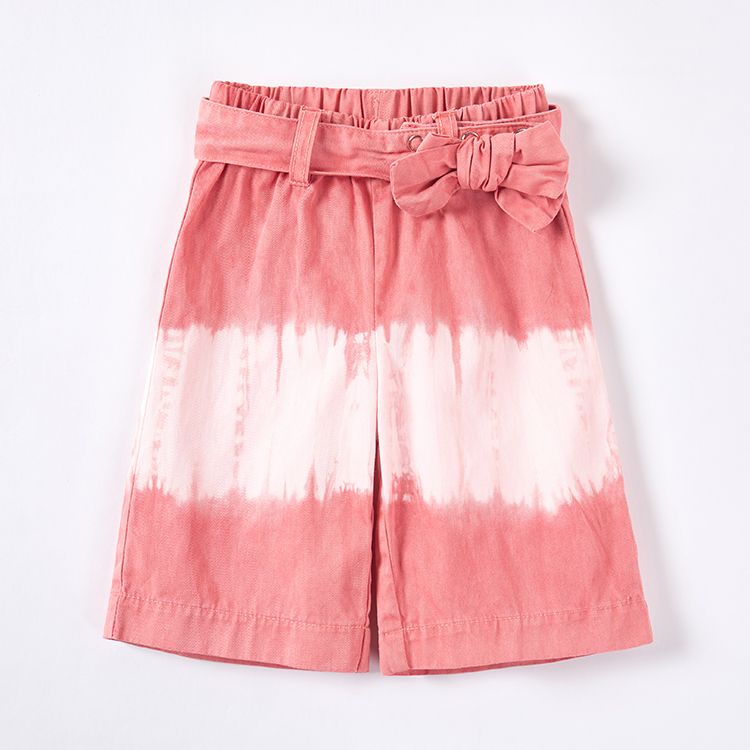
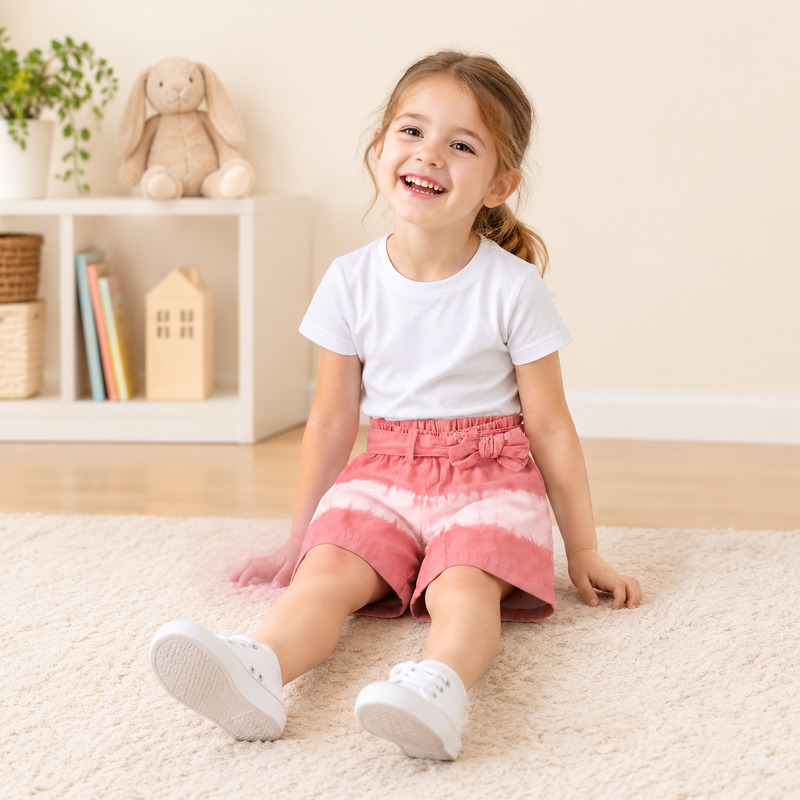
Wide-leg shorts in a cotton twill, plant dyed to a coral with sappanwood (苏木) and madder (茜草), no added mordant: a gathered waist with encased elastic, belt loops standing above the waistband with a self-fabric sash tied over them, a stitched fly that is a seam rather than an opening, and a wide bound band of pale cloth running across both legs, with the streaks of the binding running out into the coral.
The waist carries three things at once — elastic, loops and a sash — and the band across the legs is the widest single feature in this whole programme. Between them they decide what the shorts are: a pull-on that a parent can get onto a baby, and a horizontal line that has to arrive at the same height across four panels.
At a glance
1. Three things on four centimetres of waistband
- An elastic casing, a row of belt loops and a sash all land on the same narrow band, and each one pulls against the others: the elastic moves, the loops hold, the sash ties down.
- So the loops are anchored through the casing rather than stitched onto the outer band alone. A loop sewn to the face of a gathered waistband takes the sash's tension on one line of stitching and tears out; one that runs down through the casing into the waistband seam carries the pull into the structure.
- The elastic goes in after dyeing, so the casing is dyed empty and the loops are attached to a band that is already the right size rather than to one that is still stretched.
- The sash is cut on the cross grain, because a sash cut along the length stretches under its own knot and the bow goes limp after a week of tying.
- The waist is measured with the sash tied, since the sash draws the waistband in by a centimetre or two and a size chart measured without it overstates the fit.
2. The sash is a cord by another name
- A sash that ties is a functional cord, whatever it is called on the line sheet, and on a garment for children under three that is the first thing a compliance reviewer will look at.
- So it is specified as a fixed bow: stitched closed at the knot, tacked at the loop, with free ends held at 13 cm or under, which is the limit this programme works to for the waist area.
- The loops are part of the same question. A belt loop invites a sash to be pulled through it, so loop length is the sash width plus a working clearance and no more; a generous loop is what gets hooked on a chair or a cot rail.
- The route is stated rather than implied: either the sash is fixed as sampled, or it is supplied as a separate tie with the shorts finished without loops. The two are different products and are quoted as such.
- Class I is what makes this strict: 3M to 24M sit inside Class I by age and 3Y is assessed as Class I, the scope for this cloth and colourway is confirmed against the certificate at quotation, and pH is measured on the garment and held between 4.0 and 7.5.
3. The fly is stitched, not opened
- The front carries a fly seam with a topstitch either side of it, and no opening underneath: the shorts are pull-on, so the fly is there to give the front a line rather than to let anything through.
- That makes it a marking job. The seam is drawn on the pattern with its topstitch distance fixed, and both legs are stitched from the same mark, or the fly runs off centre at the crotch and every other fault reads from there.
- On a dyed cloth the fly reads darker than the panels either side, because two layers, a folded edge and two rows of stitching sit on one line; that is expected, and it is why the fly is pressed flat rather than left bulky.
- It is also described honestly in the product data. A stitched fly photographed from the front looks like an opening, and a buyer who orders expecting a zip is a return, so the specification says what it is.
- The bar tacks at the base of the fly are checked after washing, since they sit where a baby's weight pulls when the shorts are put on.
4. The band is placed from the hem
- A band that crosses the legs has to be level on the front, on the back and on both legs, so its height is a single number carried across three seams — two side seams and the centre back — with the fly seam as a fourth reference on the front.
- It is measured from the hem, not from the waist. The leg grows in length with the size while the rise grows at its own rate, so a band placed from the waist drifts down the thigh on the larger sizes; from the hem it stays where the design put it.
- Panels for one pair come from one banded length, so the front and the back agree by construction rather than by matching at the seam, and the two legs cannot end up with the band at two heights.
- The band's width is fixed in the cloth, which means the rise has to be planned around it: if the band must clear the crotch on the smallest size, that is a constraint on where the crotch is cut, not on where the band is dyed.
- The side seam is where a drift shows first, because it is the only place on the shorts where the band meets itself at an angle.
5. Every band edge is a wash-out, and that is the design
- The band does not end on a line; it dissolves into the coral over two or three centimetres, with streaks running out of the pale into the deep where the binding gathered the cloth.
- That edge is the signature of a bound band. A band that ends on a clean straight line has been printed or sprayed, and it is rejected at any width.
- The streak length is a specified character, not an accident: long streaks mean the cloth was gathered loosely under the binding, short ones mean it was pulled tight, and the sample fixes which of the two this product is.
- The palest point is specified as a value, because the band is meant to be pale, not white — pushed too far, the twill texture disappears and the leg reads as a bleached patch beside a saturated rise.
- The two legs are matched for band height and width, not for pattern, since no two bands are identical and a pair matched by pattern would have to be cut from adjacent cloth that does not exist.
6. Wide leg, deep hem
- The leg is wide and straight, and the hem is deep, which is the combination that shows a twist: a deep hem turned on a wide opening pulls the leg out of line if it is set flat on the table.
- So the hem is set with the leg hanging and the cloth relaxed, and the opening is checked for a level line on the hanger rather than by measurement alone.
- The inseam and the outseam are balanced at the hem, because a leg that is half a centimetre longer on one side reads as a twist when the child walks.
- Leg opening is measured on the finished shorts, since it is the dimension that decides whether they go over a nappy and a crawling knee without binding.
- Hem depth is graded with the length, because the same deep hem on a 3M leg takes a visible share of a short leg, and the proportion is what a buyer sees first in a flat photograph.
7. Sizes, sampling and quoting
- Seven sizes graded on measurements: 3M, 6M, 9M, 12M, 18M, 2Y and 3Y move on waist relaxed, rise, inseam, leg opening and band height from the hem. Waist is graded by the elastic's working range rather than by a percentage of the chest.
- Customization. Sash as sampled or no sash with plain loops; loop count and length; fly as a stitched seam or a real opening with a zip; band height, width and streak character; hem depth; and the mottle at a higher or lower contrast, each sealed on its own reference pair.
- Sampling: 3-7 days from a confirmed tech pack, covering a banded strike-off with its two reference pieces and the band marked at the intended height from the hem, a made-up pair with waist, loops, sash, fly and hems finished as production, a waist extension and recovery check before and after five washes, a loop pull test with the sash tied, a band-height check at both side seams and the centre back, crock across the band edge and light on the deep and pale areas.
- Bulk: 30-60 days from approval, planned per banded length and per dyebath, with the cutting layout made per size so the band arrives at the quoted height; AQL 2.5 major and 1.0 critical.
- MOQ: 300 pcs for a custom development covering cloth, shade, band, trim or fit; 50 pcs for a decorative process on a stock body; 100 pcs for stock cloth with your own logo and label. Mixed colour and size orders are quoted per order.
Production runs with our production partner, Suzhou Shelmin Trade Co., Ltd.: founded 2017, 7,200 m² workshop, 8 lines, 200 staff, 6,000 pieces per day. Design confidentiality is held under NDA; buyer patterns, shades and prints are not re-used.
To quote, we need: target market and the Class I tests it requires, including the saliva method; whether the sash is fixed as sampled or supplied separately with plain loops, and the free-end length you will accept; the elastic specification and the tension you want at the middle of each size band; whether the fly is to stay a stitched seam; band height from the hem at 3M and 3Y, plus width and streak character; the palest value you will accept inside the band; lot certificates for both plants and for the elastic; the pH target and the dyehouse water specification; packing method; and whether certification is to run in your brand name.