EN

OEM/ODM Vintage 100% Cotton Smocked Baby Girl Dress | Eco-Friendly Plant-Dyed Toddler Dress | Custom Sustainable Botanical Tie-Dye Ruffle Kids A-Line Dress | Hand-Smocked Boutique Children Apparel Wholesale


- Overview
- OEM/ODM Smocked Plant-Dyed Cotton Girl Dress
- Recommended Products
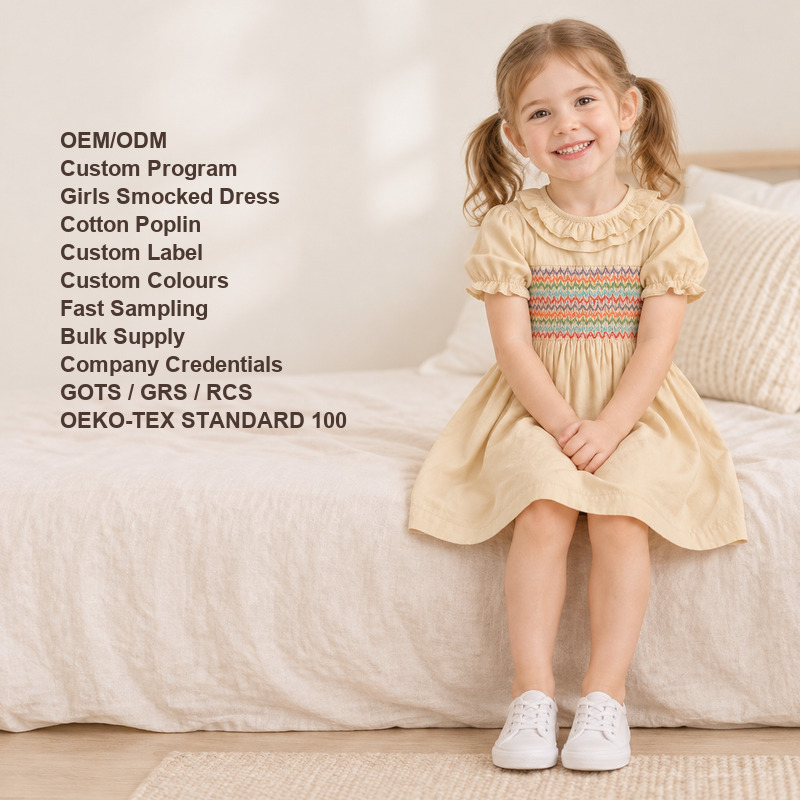
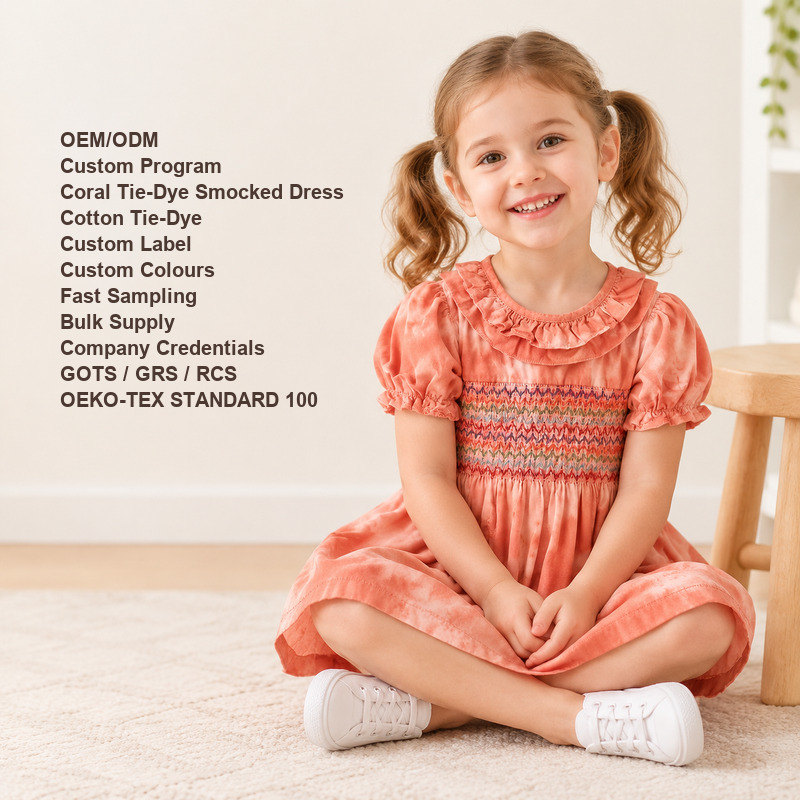
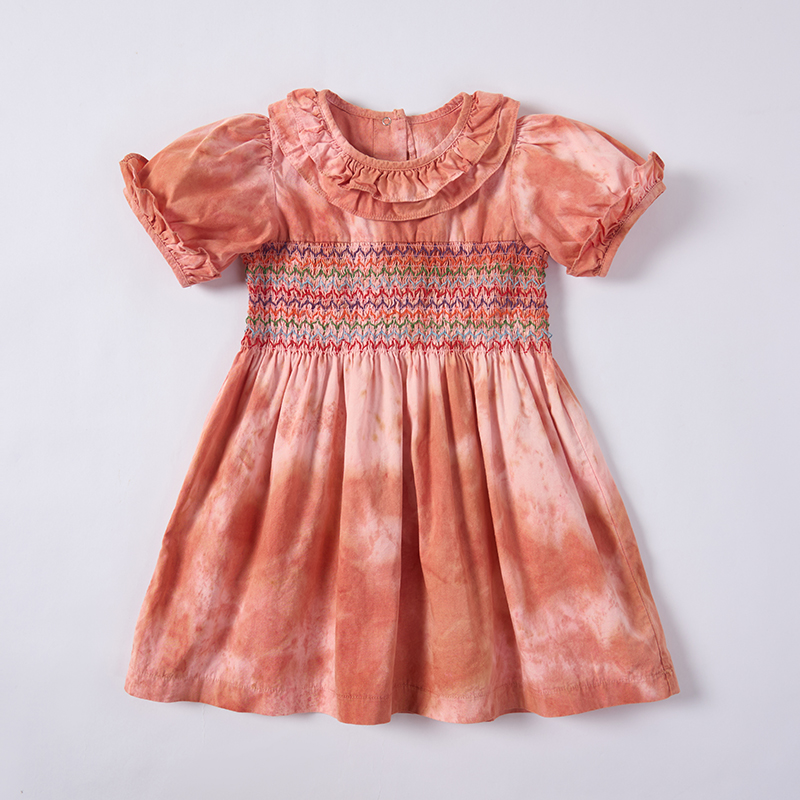
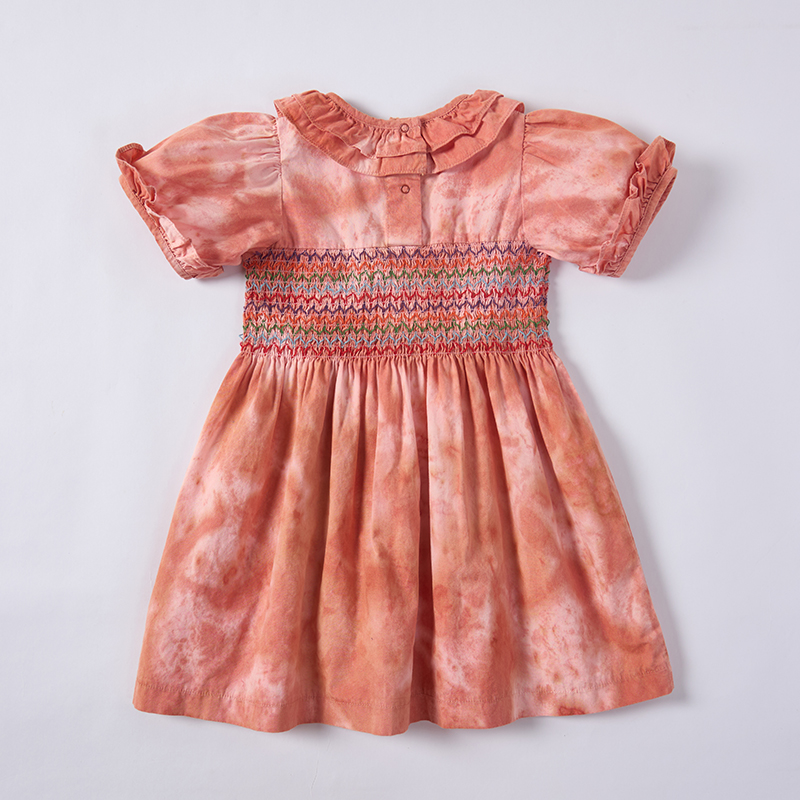
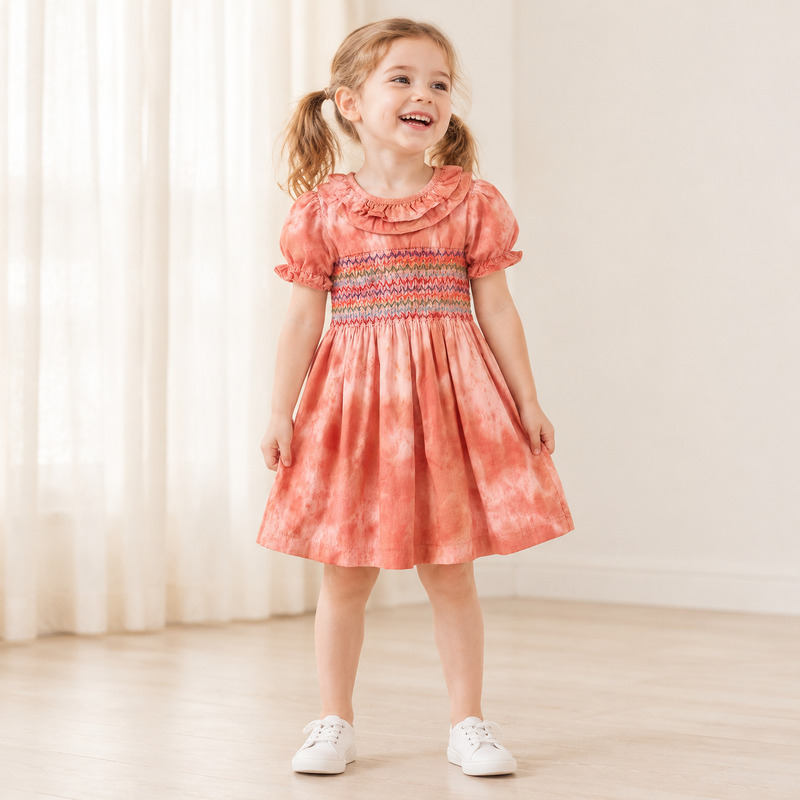
A short-sleeve smocked dress in 125 gsm cotton poplin, plant dyed to a clouded coral with sappanwood (苏木), madder (茜草) and pomegranate rind (石榴皮): a ruffle collar, puff sleeves gathered into a ruffle cuff, a smocked bodice worked in rows of wave stitch, a short back placket with one button, and a gathered skirt hung from the smocked panel.
The mottle on this ground is deliberate, and that changes the whole problem. A level dye lot is judged by how little it varies; a clouded one has to be judged by how it varies, against a definition agreed before the first sample is cut. Everything below is about turning an irregular surface into something a buyer can approve, reject and re-order without an argument about taste.
At a glance
1. How the mottle is made, and what it is not
- It is made in the bath, not on the cloth. The pieces are dyed in a restrained pack so that part of the surface sees more liquor than the rest; the pattern comes from contact, packing and movement, not from a print or from tied resists.
- That means it can be steered but not drawn. Packing density, liquor ratio, how often the cloth is turned and how long it stays in the bath set the scale and softness of the cloud; none of them can place a particular shape on a particular panel.
- So the mottle is specified as a range, not as an image. What is approved is a set of limits — scale, contrast, distribution, edge quality — and any piece inside those limits is the product.
- Two stages, one of which is held level. The rind is applied evenly because it is the carrier; the irregularity is created in the red stage alone. Unevenness at both stages stacks into a patch that reads dirty rather than clouded.
- Colour is read on dried cloth under D65, in the same light for the deepest and lightest areas, because a mottled ground read under a warm lamp loses the very contrast being judged.
2. The acceptance definition has to exist before the sample
- Scale. The clouds are judged against the garment: a patch that spans a whole skirt panel reads as a stain, one smaller than a coin reads as dirt, and the accepted range sits between those two on this size run.
- Contrast. The gap between the deepest and lightest area is specified as a range, and the reference is a physical pair of swatches at the two ends rather than a description.
- Distribution. No single patch may dominate a front panel, and no repeat may appear that makes the cloth look printed; a mottle that tiles is a mottle that was not made the way this one is.
- Edge quality. Transitions are soft. A hard boundary — a tide line where liquor sat — is a fault at any contrast, because it reads as a mistake rather than as a cloud.
- Which is why the approval is three pieces, not one: the deepest acceptable panel, the lightest acceptable panel, and a smocked panel showing how the same cloth behaves once gathered. A buyer who approves only the middle has approved an average.
3. Seams and gathering are where a mottle fails
- The pattern has to carry across a seam. Side seams and the centre back are matched so the cloud runs on rather than restarting, and panels are cut in pairs from adjacent positions across the width; a mottle that breaks at every seam reads as patchwork.
- Gathering changes the picture, not the colour. On the smocked band the cloth is compressed to a fraction of its flat width, so a soft cloud becomes a set of fine streaks — the same cloth, a different surface, and a band that looks like a stripe is the usual surprise.
- So the band is cut from cloth chosen for it. Panels are taken from areas with the calmest contrast, and the stronger clouds are left for the skirt where the cloth stays flat and the scale can be read.
- Nothing can be corrected after smocking. A panel that reads wrong when gathered cannot be re-dyed or re-cut without losing the pleat set, so the panel is judged before the rows go in, and again as a made-up band.
- Pleat ridges are the second check. Where the cloth folds, the deepest area of a cloud lands on a ridge and the lightest in the valley, which amplifies contrast at the fold; the panel is screened for ridges that have gone too dark.
4. A mottled ground has more than one colour on it
- Fastness is not one result here. The deepest and the lightest areas of the same piece are two different colours with two different amounts of dye on them, so wash, rub and light are run on both areas and reported separately.
- A single figure would describe neither. Averaging the two produces a number that is wrong at both ends, which is exactly the number a buyer would later find contradicted by the garment.
- Washing is done on the finished dress, with the smocked panel in the load, and the deepest area is checked for change against its own unwashed counterpart rather than against a flat swatch.
- Light exposure is the test that changes the look of a mottle most. As the reds and the rind tannin move at different rates, contrast between cloud and ground can widen before the overall shade shifts, so the pair is re-read together after the light test.
- Phenol yellowing is checked to ISO 105-X18 on a specimen carrying the actual packing fold, since a warm coral holding tannin is one of the shades that moves in storage, and packaging is specified free of BHT.
5. The band is the entry, and the fit lives above it
- The band is gathered to roughly two and a half to three times its finished width, with the ratio set per size against head circumference plus clearance, so the dress passes over a head without a long opening; recovery is checked on the sample and again after five washes.
- Its upper edge sits at a fixed distance below the armhole per size, a dimension that does not scale by percentage, and the plain bodice above it is where a fit error shows first: long by a centimetre and the collar bunches, short and the band sits too high to stretch comfortably.
- The panel-to-skirt join carries the whole skirt under continuous tension, so it is specified with a reinforcing stitch and checked for puckering — on a clouded ground a pucker reads as a dark edge, because the lightest part of a cloud is usually what gathers there.
- Width is checked at three points per panel; rows that drift pull the panel into a trapezoid and the skirt hangs off-centre.
- The two-tier collar ruffle is stabilised at the neckline with the upper tier cut narrower, and the single back button is tested at 70 N retention with a check against 16 CFR 1501.
6. Threads, and the parts that are not plant dyed
- The ground is plant dyed; the smocking is not. The warm tones across the bodice come from conventional dyed threads, tested as a skin-contact component to the same restricted-substance limits as the cloth, with a supplier declaration held per lot.
- A mottled ground makes palette approval harder, not easier. The thread sits against a surface that changes underneath it, so the palette is signed off across the full contrast range of the ground — deepest, lightest and band — rather than on one piece.
- Thread count per row is fixed, because a heavier thread covers more of the ground and narrows the visible contrast, which is the one thing this colour is being sold for.
- Bleed is checked by comparison: washed against unwashed panel under D65 with the ground masked off, plus ISO 105-X12 rubbing in both directions across the smocked area.
- Labels and fusible are declared separately from the 100% cotton shell in the fibre content and on the care label, per the destination market's rule.
7. Sizes, sampling and quoting
- Five sizes graded on body measurements: 6-9M, 9-12M, 12-18M, 24M and 36M move on chest, length, head size and the band's drop below the armhole; the panel is re-set per size because stretch does not grade like a seam.
- Customization. Single or double ruffle collar; plain neckline; smocking row count and stitch; thread palette; puff sleeve, plain short sleeve or sleeveless; one or two buttons; gathered, pleated or plain skirt; and on the surface, a calmer mottle at lower contrast or a stronger one at larger scale, each sampled and sealed on its own three-piece set.
- Sampling: 3-7 days from a confirmed tech pack, covering a dyed strike-off with its two reference swatches, one smocked panel cut from band-grade cloth with its skirt beside it, a stretch-and-recovery check before and after five washes, crock, bleed and light on both the deepest and lightest areas, a button pull test, and a fit check on the smallest and largest size.
- Skin-contact tests run with the same lot: perspiration and saliva to ISO 105-E04 plus the destination market's saliva method, with pH measured on the garment and held between 4.0 and 7.5.
- Bulk: 30-60 days from approval, planned per dyebath and per thread lot, with cloth released only after the mottle has been graded against the definition, and pH and fastness results are in hand.
- MOQ: 300 pcs for a custom development covering cloth, shade, smocking, trim or fit; 50 pcs for a decorative process on a stock body; 100 pcs for stock cloth with your own logo and label. Mixed colour and size orders are quoted per order, and terms are confirmed against the current quotation.
Production runs with our production partner, Suzhou Shelmin Trade Co., Ltd.: founded 2017, 7,200 m² workshop, 8 lines, 200 staff, 6,000 pieces per day. Design confidentiality is held under NDA; buyer patterns, shades and prints are not re-used.
To quote, we need: target market and the Class I tests it requires; whether the mottle is to be graded against the standard four-parameter definition or against your own; the contrast and scale you want, with a reference garment or swatch if one exists; the thread palette; smocking row count and stitch; lot certificates for the three plants and for the thread; the pH target and the dyehouse water specification; packing method; and whether certification is to run in your brand name.